


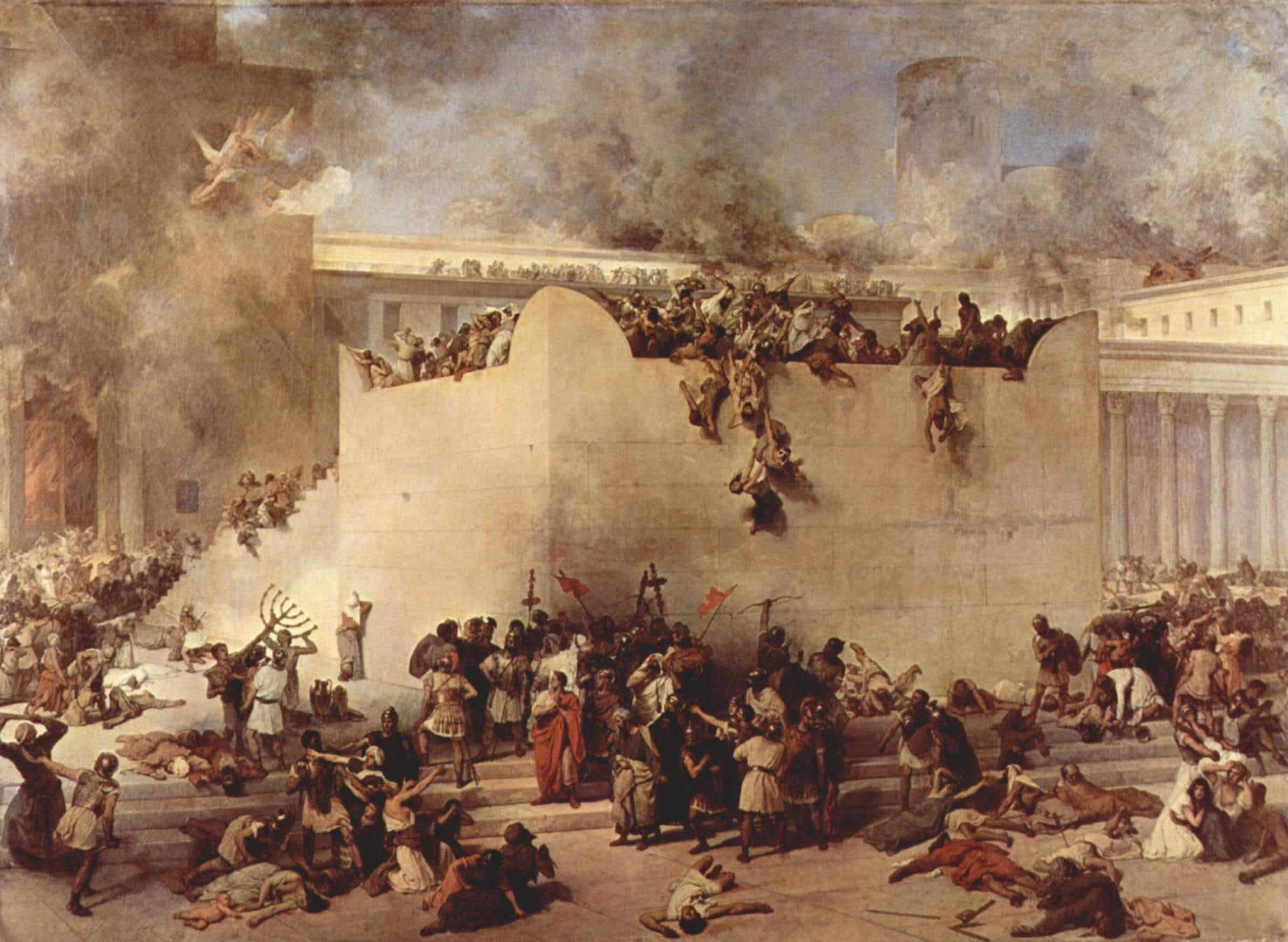
Over the past few years I’ve been writing about how Tisha B’Av has undergone revisionism in various ways. Contrary to popular ideas today, it’s not about yearning for spirituality, it’s about mourning tragedy. And contrary to widespread belief, this mourning is not primarily about the tragedy of the destruction of the two Batei Mikdash. The Temples were the ultimate symbol of the Jewish nation’s status and center of our way of life, even after corruption had emptied them of spiritual significance, and thus the day on which they were destroyed was the logical date to select for annual mourning. But Megillat Eichah and the kinnot are primarily about the destruction of the first two Jewish commonwealths, with the enormous loss of life and human suffering that were involved.
In this post I’d like to explore another seeming case of Tisha B’Av revisionism. In yesterday’s guest post by Rabbi Eli Clark, he argued that while the Sages’ reason for the destruction of the Second Commonwealth, sinat chinam, is usually understood to mean baseless hatred among the nation as a whole, this ignores other statements in Chazal that demonstrate them to be referring to the moral corruption and failure of the priestly and rabbinic leadership. Meanwhile, some others explain sinat chinam to refer to the sectarianism that divided the nation. And Chazal elsewhere give all kinds of other reasons for the destruction, including the desecration of Shabbat, the interruption of Torah study for children, people not rebuking bad behavior in others, people disrespecting Torah scholars, etc.
But surely all these kinds of explanations ignore the most obvious reason for the destruction of the Second Commonwealth: that the Jews started a rebellion against Rome which they lost!
The same is the case with the destruction of the First Commonwealth. The Sages attributed it to the sins of idolatry, illicit relationships, and bloodshed. But surely the real reason was that the Jews started a rebellion against Babylon which they lost!
And it’s not as though this is some kind of secular heretical perspective. With the destruction of the First Commonwealth, the prophet Yirmiyah himself was explicit about this being the cause! He told King Tzedkiah to submit to Nebuchadnezzar, or else Judah would be destroyed and the people would be massacred. Likewise, with the destruction of the Second Commonwealth, the Sages blamed R. Zecharia ben Avkolos for rejecting the Emperor’s sacrifice and provoking Rome. So why would the Sages give different explanations than these accurate historical-political ones?
There are two answers that I can think of. One is that while the Sages were obviously well aware of the proximate historical causes, they were describing the underlying metaphysical causes, stemming from ethical and spiritual shortcomings in the nation. These too are things that Yirmiyah mentioned. Had these sins not existed, God would have arranged for the problems with Babylon and Rome not to have existed.
Another answer would be that the Sages took the opportunity to point out more general and widespread problematic behaviour that needed to be fixed. And just like the Sage who attributed it to the desecration of Shabbos was not ruling out other causes, the Sages were not excluding the problematic behavior of Jews who were arrogant or overly-confident that God was on their side, instead of accepting that they should show some deference to Babylon and to Rome.
The lesson for us today should be clear. True, we don’t need to listen to dictates from the farcical UN and ICC and ICJ, and there are innumerable people who will be opposed to Israel no matter what we do. But nevertheless there is a particular problem of Jews who think that we can do whatever we want, and do not remotely need to take into account what anyone else thinks, because Israel is strong and God is on our side. Rome Schmome!
Alas, the events of our history prove otherwise. This mistake cost us the land twice before, and it can do so again. We are not invulnerable, and we are not guaranteed to have God’s protection. We need to be as strong as we can - not just militarily, not just economically, but also in our moral integrity. But even with all that, we need to accept that we also need to be wise rather than arrogant, and know when we need to be deferential. Putting all those together correctly is the path to surviving and thriving.
I agree. The idea of the modern State of Israel as a "Super Sparta" is a fantasy.
In my studies of history of the Bronze age, especially the catastrophic Bronze Age Collapse around 1200 BCE (which would have occurred roughly during the period of the Shoftim), I was especially interested in the shift to the dawn of the Iron Age (roughly during the period of Sefer Shmuel).
Bronze is an alloy of 96% copper and 4% tin. Separately, each is too malleable to make swords or spokes for chariot and wagon wheels. When melted together, the resulting Bronze alloy is strong and can poured into molds to make many useful things.
While Copper was plentiful in the Mediterranean region (i.e. Cyprus/ Copprous, and the Timna copper mines north of Eilat), Tin is rare in the Fertile Crescent and the Mediterranean.
The closest reliable source of Tin were mines in Afghanistan. During the Bronze age, Tin Routes were established to transport Tin to the Yafo Port, where it was distributed to Egypt, the Minoans on Crete, the Myceneans in Greece and across the entire Mediterranean.
With the sudden catastrophic Bronze Age Collapse, the Tin Routes also collapsed, bringing the Bronze Age to an abrupt end.
Luckily, the adage that "Necessity is the mother of invention" proved true. For a thousand years during the Bronze Age, people discovered that the process of refining copper ore (those green and blue rocks) was more efficient if you threw a few of those red rocks (iron ore) into the fiery hot kiln (they figured out that the iron acts as a catalyst in the chemical reaction), and when everything cooled, you were left with an ugly iron slag at the bottom, a beautiful copper disc in the middle, and a liquid silica (the molten sand) that was drained away while everything was still hot. After cooling, the iron slag was easily separated from the pure copper disc with a hammer, and the useless iron slag was tossed onto an ever growing slag waste pile because no one knew what to do with it, it was considered useless.
The refined copper disc was melted in a crucible with tin in the correct proportion, and this molten bronze alloy was poured into a mold to make whatever you desired.
The reason that the solid iron slag was considered useless was an issue of technology. The kilns could get hot enough to reach the melting point of copper at 1084 degrees C, and tin at just 232 degrees C, but iron melts at 1538 degrees C and no one could figure out a way to make a fire hot enough to melt it. They would throw the iron slag onto the fire, and it would just sit there.
Now it's 1200 BCE and the Tin Routes have collapsed along with all the great civilizations in the region and no one can make Bronze without Tin. So someone looks at the Iron Slag waste pile and says "what can we do with this stuff?".
They throw it on the fire and it turns red hot but doesn't melt, and up until now everyone thought in terms of pouring molten metal into molds.
Eventually, they realize that while the iron slag doesn't melt, it does get red hot and somewhat softer, and if you hit it with a hammer, the excess molten silica flys out in a shower of sparks and the red hot iron gets more and more workable and you can keep hitting it with a rock or a hammer over and over, and put it back on the fire to keep it red hot and soft, until you finally work it and hammer it and stretch it into the shape of the tool or knife or nail that you need.
(This discovery democratized metal work throughout the world, because Iron is among the most abundant elements on earth. You don't need to import copper or tin from far away places. You find a nice red clay soil anywhere and you have lots of raw iron).
Thus, the art of iron working was born and Saul and David became early Iron Age kings, and even they understood that whatever you lack locally needs to be imported from afar (think the cedar wood imported from Lebanon for the temple).
The moral of this long story is that when your Tin Route collapses (think about lithium in our modern age, or oil from the Persian Gulf, or rubber for tires and tank treads), sometimes you get lucky and find a work around solution and sometimes you don't.
Fortunately, the profit motive has provided a huge incentive for people around the globe to build global supply chains that can provide everyone with anything that they need (think Iranians who buy sophisticated centrifuges for purifying Uranium to weapons grade quality).
No man is an island, and you find that to be especially true when the world turns against you, implements trade sanctions, cuts you off from the global banking system, limits academic, scientific and technological cooperation, etc.
I pray that the zealots among us who don't understand this will study history and economics, and fast!
If I'm not mistaken, according to Aviezer Ravitzky's understanding of the situation a great deal of Rav Tzvi Yehuda' ideology was specifically that since 1967 we are already currently living in age of Geula. Mashiach may not have officially arrived, but nothing can undo the redemptive process that has already begun. And this is the very ideology that has influenced Ben-Gvir, Smotrich, and the settler movement. These people are under the impression that Israel will come out on top no matter what.