


Several months ago I went to an antiques fair in Yaffa and picked up an extraordinary menorah (more accurately, a chanukiyah). It needs a bit of a polish, but take a look at it. This menorah tells the history of the Jewish People!
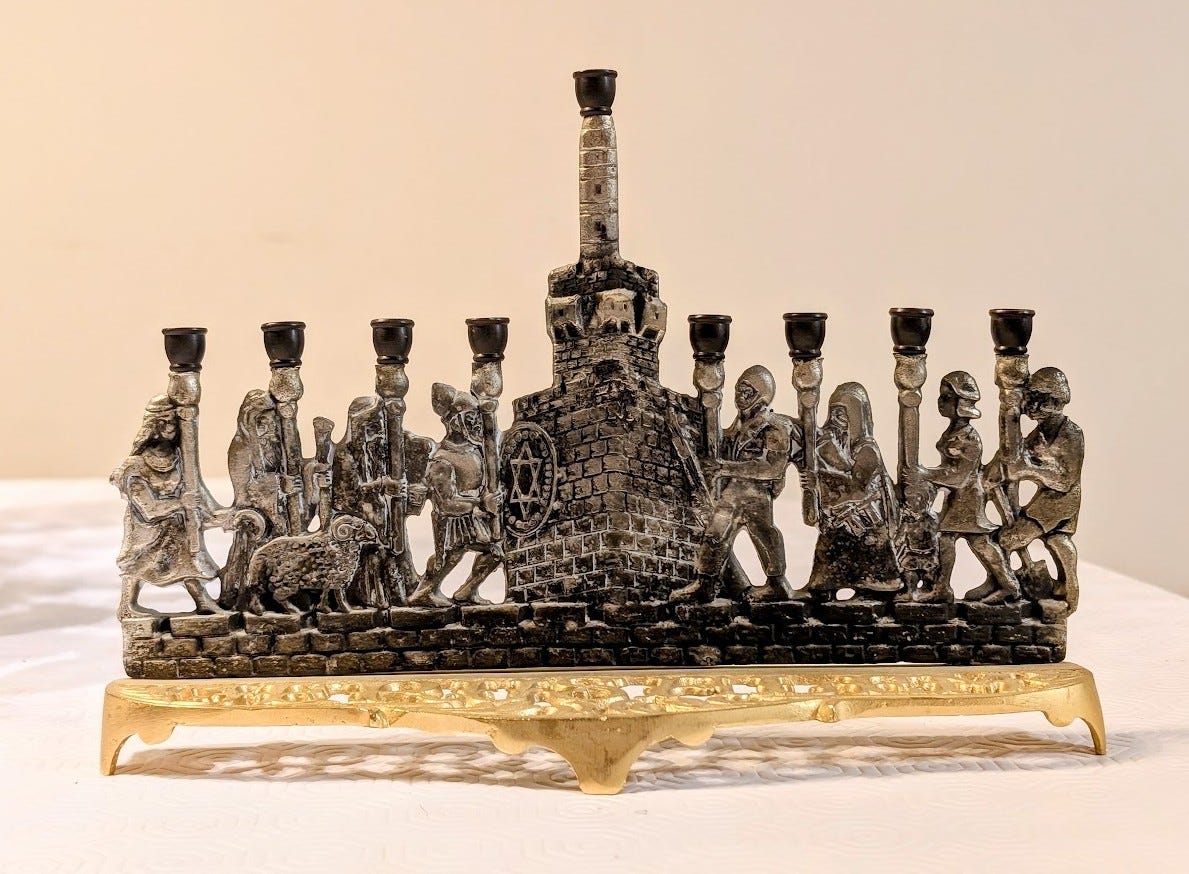
On the left are four ancient figures. The first person, bearing a sickle, is (I think) King David, associated with Shavuot, the time of harvest. Next to him is Avraham Avinu with the ram of the Akeida, then Moshe Rabbeinu with the Luchot, then a shield-bearing Maccabee (though the Star of David is anachronistic). Then continuing on the other side of Jerusalem are an IDF soldier, a rabbi holding a Sefer Torah, and a pair of early Zionist pioneers, the woman with a child and the man with a shovel.
I absolutely love it. But not everyone would. The Nosson Slifkin of thirty years ago, for example, would have had an issue with it. What do IDF soldiers and secular Zionist pioneers have to do with Jewish history?! Meanwhile, some of those secular Zionist soldiers and pioneers would have seen the rabbi as being irrelevant.
Chanukah is such a significant holiday, yet it is distorted at both ends of the religious spectrum. While 92% of secular Israelis light a menorah, many do not identify with what it was actually about - fighting to retain the Jewish way of life against a larger assimilating culture. The fact of the Maccabee Games being named for the very cultural phenomenon that the Maccabees fought against is rather unfortunate (though, truth be told, the original Olympics were more problematic for their idolatrous nature than for the idea of celebrating physical prowess, which is not alien to Judaism).
Meanwhile, at the charedi end of the spectrum, the distortions are just as bad. II’ve heard people claim that the Greek army was defeated entirely by way of supernatural miracles, and that the ultimate message of Chanukah is that Torah and mitzvos is all that counts, and hishtadlus is entirely irrelevant, and basically pointless and unnecessary.
The reality of Jewish history, expressed so perfectly in the menorah I bought, is that both Torah and physical endeavor are of fundamental importance. It is Torah that gives us our unique mission, our way of life and our identity, which sustained us even when we had no land and no physical strength, and which we fought for on Chanukah. But physical endeavor - together with Divine assistance - is what enabled us to attain some of our greatest achievements, such as the victory over the Seleucid Greeks, and the creation and survival of the modern State of Israel.
Happy Chanukah! And if you’d like to get a sense of the courage that it took the Maccabees to fight the Greek army, come and be awed by our elephant at the Biblical Museum of Natural History, which this year we have dressed up as a Greek war elephant, complete with tower! (And meanwhile there are just 10 spots left at our Feast of Exotic Kosher Curiosities next week - buy one for yourself or for a soldier!)
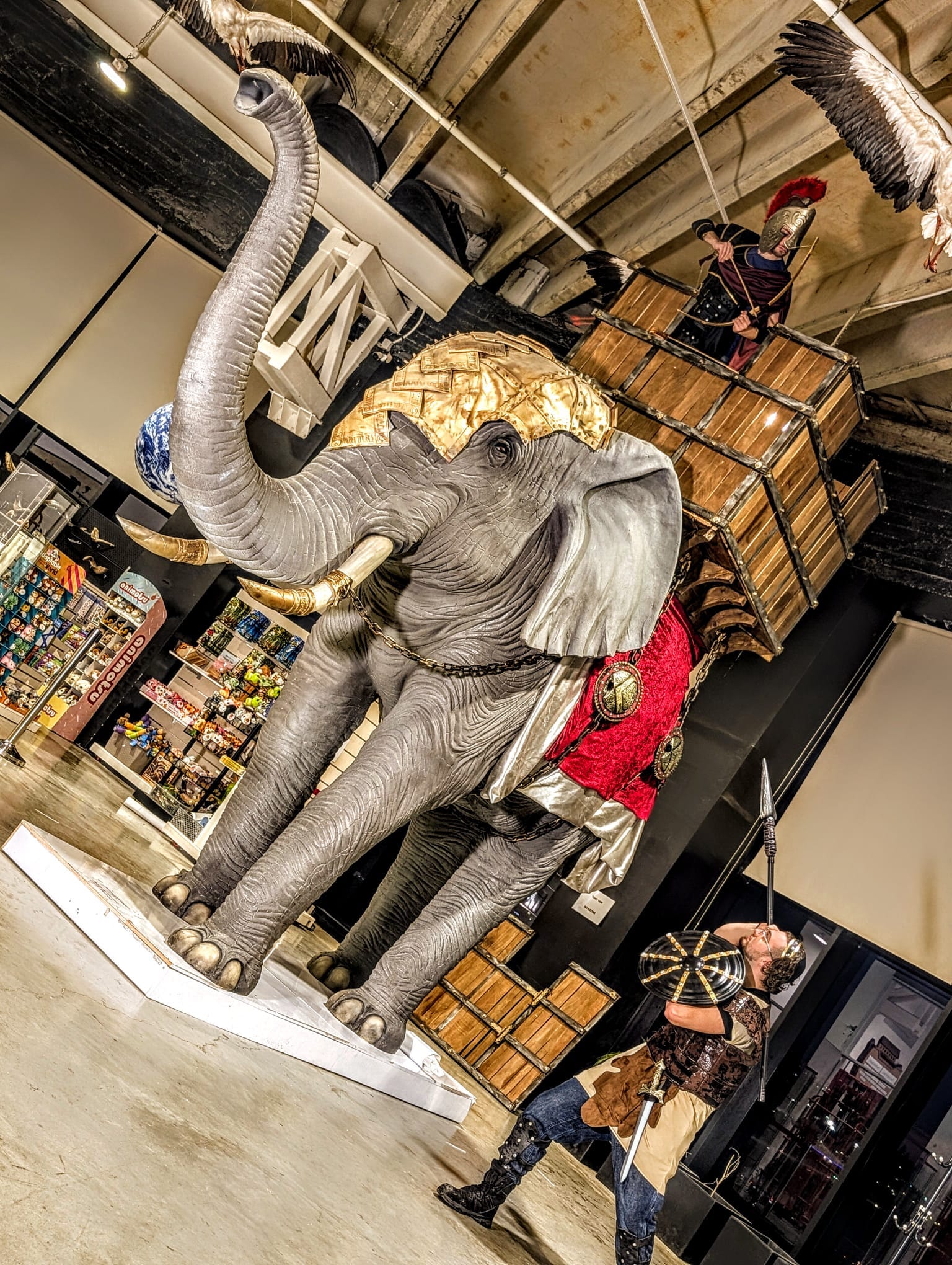
Keep the war tower on the elephant for Sukkot as an example of a kosher portable sukkah
At the risk of being accused of pedantry I should like to point out that the Maccabees DID NOT fight the Greek army. They were fighting the Seleucid empire, an indigenous neighboring power that had been Hellenized. The irony is that the Seleucids had once been under the control of the late Alexander the Great who had been so tolerant and friendly to our ancestors that some Jewish boys continue to be named after him. Our battle was not with Greece proper or with "Greeks;" it was with Grecian culture and the Seleucid's obsessive desire to destroy our Torah-based lifestyle and replace it with their Hellenistic ways.
Furthermore, it was as much a civil war as a war with invading foreigners, as there were any number of Jews who were attracted to Hellenistic modes as more up-to-date and sophisticated than our Torah ways. Does that sound familiar?
Do we celebrate the Hanukkat HaBayit and rekindling of the Menorah to downplay the internecine strife that occurred? To avoid having to deal with the embarassment that there were so many Jews eager to give up Torah observance and "be like everyone else?" The Maccabees were battling those traitors as much as Antiochus's armies. In fact, one might suggest that this battle was the more difficult, and one that still confronts us.