


I was struck by the following recent headline in Yeshiva World News:
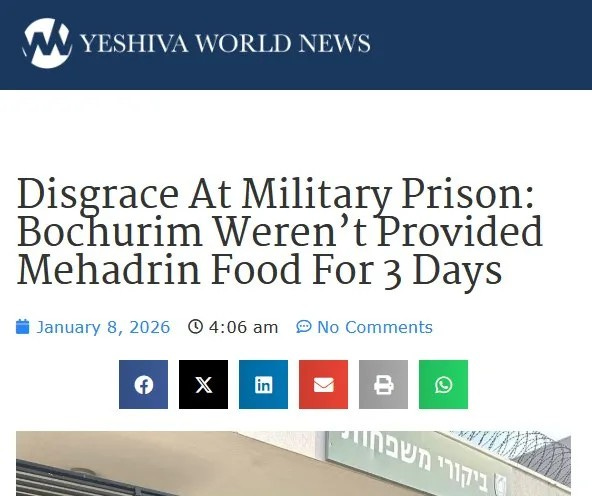
Now, since the prison service does commit to providing mehadrin food for those who normally only eat such food, they should indeed have provided it. But the idea that failing to have such food means, as the article claims, that they suffered the neglect of “the most basic nutritional needs and religious rights,” is, to put it mildly, an exaggeration.
Furthermore, the fact that this is considered to be a “disgrace” reveals a deeply warped order of priorities. The guys who didn’t participate in Milchemet Mitzvah, transgressed Lo Taamod Al Dam Reyecha, and contravened the most basic Torah values of chessed, were spiritually devastated because they didn’t get mehadrin food?!
However, there is something else that I would like to focus on: the expectation that charedi standards of kashrus and other things must always be met, whether in military service or in prison. And this is put forth as one of the very reasons why charedim will not serve in the army. They deny that such standards are met. This was most recently argued by TV personality Yedidya Meir as providing sufficient justification for even non-learning charedim not to enlist, on the ironically-named Israeli television show "The Patriots.”
In previous posts, I have pointed out that these claims are simply false. The Chashmonaim Brigade absolutely meets charedi standards of kashrus and other such things, contrary to the slander spread by R. Aharon Feldman and others. And the fact that the IDF failed to provide mehadrin food in prison does not at all mean that they don’t reliably provide mehadrin food to those who obey the law and enlist in Chashmoniam. But in this post, I would like to address this charge in a different way.
The charedi expectation - nay, demand - is that they should not have to compromise their personal religious standards in any way. They insist that they should not have to take spiritual risks. After all, if you allow the IDF to serve food that is only rabbanut, or if there is a female on the base, next thing you know there will be mixed dancing.
But even when the IDF charedi units do fully accomodate charedi sensitivities, there are still risks of compromises to religious standards. Because that is the nature of war!
The Torah itself acknowledges this in several ways. There is a mitzvah to use a yated (spade) to dig a hole for your excrement (Devarim 23:10). Why on earth is there a mitzvah for this? And why only during war? Because, as the commentaries explain, war is a time when personal standards are challenged, and thus an additional level of obligation is required.
A few verses earlier, the Torah says כִּי־תֵצֵא מַחֲנֶה עַל־אֹיְבֶיךָ וְנִשְׁמַרְתָּ מִכֹּל דָּבָר רָע “When you go out as a troop against your enemies, be on your guard against anything untoward.” Ramban explains that “the well-known custom of armed forces going to war is that they eat all abominable things, rob and plunder, and are not ashamed even of lewdness and all vileness. The fairest of man by nature comes to be possessed of cruelty and fury when the army advances against the enemy. Therefore, Scripture warns, be on your guard against anything untoward.” War inevitably involves spiritual challenges and decay.
And then there’s an even more powerful example. There’s the mitzvah of Yefat To’ar, the procedure that is done to manage the problem of Jewish men taking non-Jewish women captive and wanting them as partners! Forget mixed dancing - this is mixed marriages!
And yet, despite all these enormous spiritual risks of war (which were far greater in antiquity - no modern Israeli soldier is taking a Palestinian wife in Gaza!), never does the Torah say that someone who is concerned about the spiritual risks and compromises is exempt. If anything, the expectation is that the people who are most concerned about spiritual costs are the ones who are most worthy and suitable for going out to battle. The Bnei Gad and Bnei Reuven did not and could not have argued that they wanted to stay in a spiritually safe environment. Because real life does not allow for such luxuries.
Serving in any army carries all kinds of risks of losses and compromises, especially if war breaks out. Bochrim in military prison weren’t provided mehadrin food? In war you might not get any food at all! You might even be killed, which is a pretty big physical and spiritual loss. And you might have to compromise in all kinds of ways, which could leave lasting harm. God knows how much the reservists have suffered spiritually as well as physically and materially over the last two years.
But we all want and need the IDF to exist, even with whatever challenges and shortcomings it has. And thus we all need to share the burden. You don’t get to force others to pay a higher price because you don’t want to pay yours. That’s all there is to it.
Make them suffer…only OU-D for them….
You've got to be kidding. You have successfully provided an even greater support for giving them all of their requests! Precisely because of the inevitable risks, the Torah clearly instructs to do everything you can to avoid unnecessary risks and maintain your camp in holiness - והיה מחניך קדוש. Only then can you be sure that God will be with you. They should be even more demanding of a higher degree of spiritual strength when possible in the army than anywhere else!
Your argument is backwards. Because was is dangerous, well, then, let's just give in to the risks and give up our protections? Let's not fortify ourselves? This works be absurd even if the Torah didn't make a point of emphasizing the greater degree of preparedness needed.
Yes, some risks are unavoidable and yes, they'll use any excuse they can pull out of nowhere to avoid participating in the army. I am mostly in agreement with your comment for their general attitude to this topic. But they're right about this one.
(Also, you make mehadrin sound like an extra. That's already below their usual standards but even if it meet them, they deserve that. The only reason they didn't get it is neglect, bad faith or incompetence. No one was in the heat of battle when compromise is needed)