


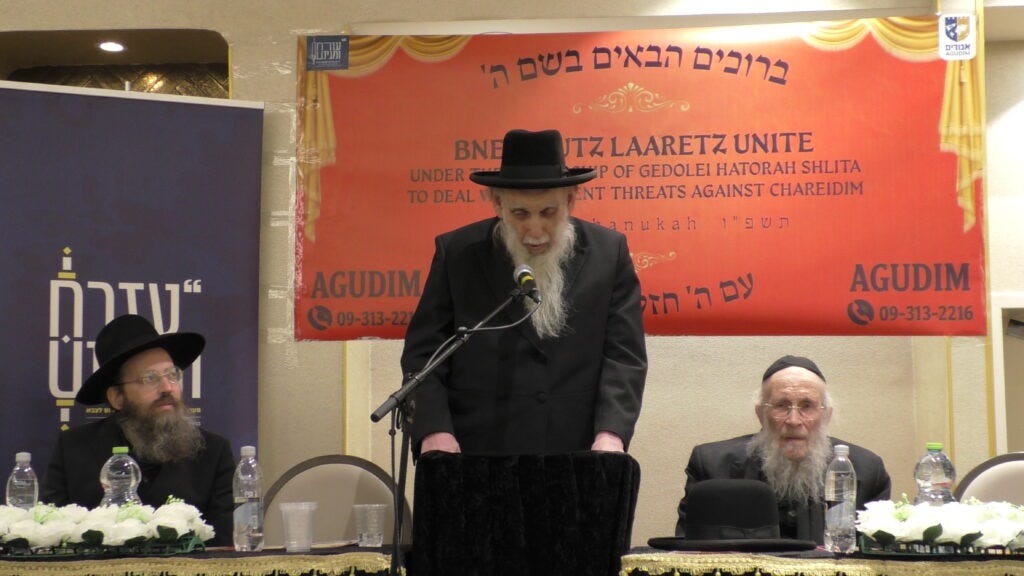
Here is my rejoinder to the first of the speeches at the event to discourage Anglo-chareidim joining charedi IDF hesder programs. It was delivered by R. Aharon Feldman, Rosh Yeshiva of Ner Yisrael in Baltimore. You can download the entire audio here:
It’s too long to quote and refute in its entirety, so I am restricting myself to some key sections. R. Feldman begins as follows:
“I will say this. The secular Jews and the religious Jews, all Jews, want one thing. They want the survival of the Jewish people. The question is, what’s the definition of the Jewish people? The secular Jews do not have a definition of the Jewish people. To them, the Jewish people is a nation like any other. Israel is a nation like Italy or France. There is no definition of the Jewish people. If you ask him, a secular Jew, what’s the purpose of the State of Israel, he won’t be able to tell you what the purpose is…. On the other hand, a religious Jew says that the purpose of life is to come closer to God, to perfect one’s character, to become kinder, to create a society where everyone cares about everyone else, a society that expresses belief in God, a society that fights for truth, a society that leads the world to a recognition there’s a Borei Olam.”
It beggars belief that R. Feldman claims to represent a group that, in contrast to secular Jews, believes that the purpose of life is to create a society where everyone cares about everyone else. Secular (along with religious Zionist) Jews have created a society in which everyone does care about everyone else - in which millions of people made huge sacrifices on behalf of others over the last two years. Charedim created a society in which the majority sacrificed absolutely nothing for others, and their rabbinic and political leadership don’t even care about them. R. Feldman himself, along with many others, has expressed his discomfort with even davening for soldiers!
“Now, to live in a society where the people around me have different definitions of what it means to be a Jew is the most torturous existence for a person. To send anyone to live for three years in a society where everyone thinks the definition of being Jewish is different from yours is torturous. It’s wrong. It’s undemocratic. It’s a violation of human rights. You’re asking someone to live, to be married, for example, to someone who has a different view of life than you. If you ask someone to join, to live, to be a friend, to share with someone who has a different view of life, it’s torturous. A religious Jew that goes into the army lives with people who have another and another definition.”
First of all, the idea that it’s a “violation of human rights” to expect people to make sacrifices for others, for the sake of everyone’s needs and benefit, is simply wrong. Charedim want their lives to be defended from those who want to kill them - they don’t get to opt out of the way of doing that merely because it’s “torturous” to spend time with people who have a different worldview.
(I am reminded of a quote that I saw today from Chagai Luber, a right-wing person who lost a son in the war. He reported, with respect, that someone from Achim L’Neshek - a left-wing group - told him as follows: “For 30 years I’ve been serving in the IDF defending settlements that I’m ideologically opposed to. I’m not asking you to say thank you, I just want you to recognize the ideological price I am willing to pay so that we can live here together.”)
But R. Feldman is also presenting the great strawman that charedim keep invoking. Nobody is asking that a young charedi man spends time “in a society where everyone thinks the definition of being Jewish is different from his.” They are asking that he spends time in a society where everyone else is also charedi, as part of a charedi army program!
R. Feldman then summarizes the difference between a religious Jew and a secular Jew:
“A religious Jew’s life is to control the Yetzer Hara because that way he comes closer to Hashem. A secular Jew’s life is to enhance the Yetzer Hara. How can they live together? A secular Jew has mixed genders, unfiltered internet, vile language, Chillul Shabbos. And a religious Jew says, my values are to come closer to Hashem. I cannot have internet unfiltered. I cannot have vile language. I cannot have mixed genders. How can they live together?”
A secular Jew’s life is to enhance the yetzer hara?! They might not have the same sort of modesty restrictions that R. Feldman has - but these are in turn not the same sort of modesty restrictions that various Chassidic sects have! And what about R. Feldman’s aforementioned Jewish value “to create a society where everyone cares about everyone else,” which secular Israelis do so far more than charedim?!
While framed in a “frum” manner, R. Feldman’s defining secular Jews’ essence as driven by their animalistic desires (aka, their yetzer hara) is dehumanizing slander and no better than the worst antisemitic tropes thrown against Jews. Had his words been said by someone non-Jewish, it would have been widely condemned for its antisemitic overtones and message. And it disregards the average “secular” Israelis’ overall strong Jewish identity, their sacrifices for the Jewish people, and their desire to do good in this world. It’s not clear to me why some people describe R. Feldman as a “tzaddik.”
The Danger of the IDF
R. Feldman next turns to the facts on the ground, to what actually happens when religious boys join the IDF:
“I asked the rabbi of a very large town in Israel, what’s the percentage of his children, children in his community, that go into the army and come out religious? He said, 50% at least, and probably more come out non-religious. I have a student in my yeshiva who was born in Beit Shemesh. His parents lived here when he was a young child, and he made friends. He grew up here, went to school here, and then his parents moved to America. He had 15, 20, 25 friends that he was close to, and every time, every year, they used to come back to visit. And he continued his friendship with his friends. Until the age of 18, when all his friends went into the army. He was not left with one friend, because they all became secular. I’m telling a story that someone told me. Maybe that’s extreme. I don’t have statistics. But everyone I know from my family, cousins here in Israel, went to the army and they became secular.”
The Great Strawman rises again. It’s right there in his words. “Until the age of 18, when all his friends went into the army.” Anyone who goes to the army at the age of 18 is (A) going to the general army environment, where he is surrounded by a majority of secular Israelis, and (B) someone who from the outset chose not to go as part of a yeshiva framework, and thus is less attached to religion to begin with.
This is not what people are proposing that charedim do. They can enlist as part of a yeshiva program, where they first spend two years in yeshivah, then spend a year and a half in combat surrounded by their yeshiva friends as part of a religious environment, and then return to yeshivah for more years. The dropout rate from religion in such hesder programs is minimal - probably even less than the general dropout rate in charedi society! (At my museum we work with organizations that help the endless thousands of charedi teens at risk - both boys and girls.)
Chashmonaim
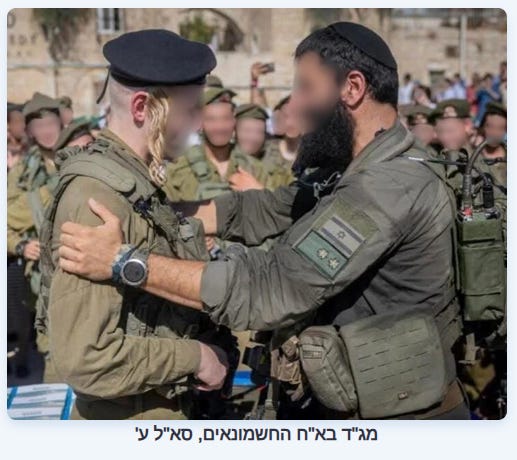
R. Feldman then turns to the new chareid army unit, Chashmonaim:
“The closest thing to doing something is Chashmonaim. Chashmonaim is supposed to be strictly Haredi. You can’t have a kippa sruga in Chashmonaim. And there was a genuine desire by those who founded Chashmonaim to accommodate religious Jews. I spoke to one rabbi who was invited to deliver the Haredi view before the generals that were supposed to were forming the Chashmonaim unit. They genuinely, the ones that originally founded it, they genuinely wanted to help the Jewish people, the Haredi people, have a Haredi environment for the army. So he presented the Haredi view without any compromises. He told them, You know that Haredim have dinnim of Shabbos, who’s going to decide about Shabbos? You’re going to have some rabbi who finished learning a couple of years in yeshiva deciding?! You have to have Gedolei Torah deciding! It’s pikuach nefesh, decisions of pikuach nefesh. Who’s going to decide these things? A haredi has to have halacha deciding his life, not a commander. They said they’ll try to accommodate, they’ll try to get an authority to pasken shaylos of pikuach nefesh. Which they haven’t done.”
This is the point at which a friend of mine in the audience - a dedicated talmid chacham who received a prestigious semicha and served as a Rav for 16,000 soldiers - could keep silent no longer. (You can read the grossly distorted coverage of this moment at Yeshiva World News - and check out the comments!) My friend said four words aloud:
“Rav Asher Weiss decides!”
R. Feldman’s claim was simply false. Rav Asher Weiss, a very distinguished Torah scholar, decides such questions for charedi soldiers in the IDF. R. Feldman responded: “Please don’t interrupt me.” My friend continued to protest that R. Feldman’s claim about Chashmonaim was just not true. At this point one of the other speakers started screaming at my friend to be silent when the Rosh Yeshiva speaks, because of Kavod HaTorah. Personally I don’t see why it was Kavod HaTorah for R. Feldman to deny the existence of Rav Asher Weiss.
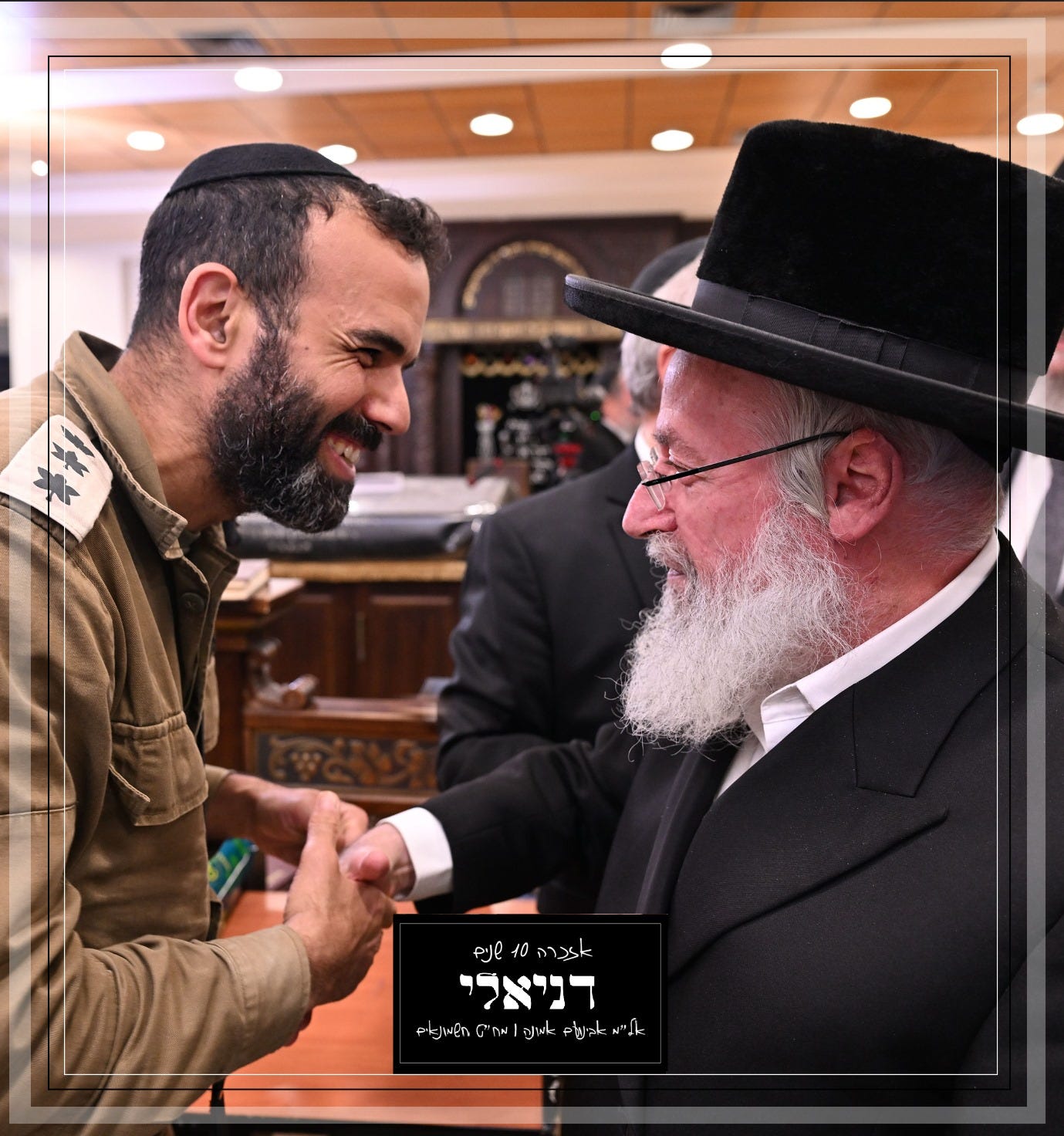
Ignoring my friend’s correction, R. Feldman continued to give another reason why “a religious Jew” cannot join Chashmonaim, quoting the anonymous charedi rabbi’s report on his meeting with the generals:
“Then he said, you know, he’s quoting what happened at the meeting, he said, a religious Jew cannot sing HaTikva. It’s against his religion to say “lihiyos am chafshi b’artzeinu,” he can’t sing HaTikva. How will you accommodate him? At your ceremony, he’s swearing in, you have to sing Hatikva. He (the General) says, that’s something we’re not ready to do. That’s what the commander said, that’s what General said.
In other words, they want you, they want to accommodate religious Jews, but they want to turn you into a Chardalnik. They want you to be a nice Zionist, a shomer mitzvos, but a Zionist. They want you to lose your - I’m not saying Chardalnik are, chas v’shalom… (he pauses here) they’re ehrliche Yidden… but I’m talking about the value system, the belief of the definition of the Jewish people. They want you to believe that the Jewish people is being a free people in our nation. Purpose? No purpose. Vision? No vision. No definition of the Jewish people. We want you to be a Jew without a definition of being a Jew. We’re not ready that you should be a Jew with a definition of a Jew.”
Now first of all, the idea that it’s “againt religious Judaism” to sing “to be a free people in our land” is just silly, for two reasons. First is that religious Jews in general, and charedi Jews in particular, excel at providing their own creative interpretations of texts that were formulated by others with completely different intentions. Is it really impossible for them to recite the words “to be a free people in our land” and have in mind that it means to be free of non-Jewish rule?! This is the great obstacle against them helping save Jewish lives?!
And the second issue is that, once again, this is simply not true. I checked with one of my (religious) nephews, who is logistics platoon commander for Chashmonaim, and he flatly denied it. HaTikvah is played at certain ceremonies, but nobody is forced to actually sing it.
(It should also be noted that R. Feldman is trying to have it both ways. On the one hand, he is claiming that any expression of Zionism is totally antithetical to Judaism. On the other hand, he won’t say that deeply religious Zionists are “chas v’shalom” not practising Judaism.)
R. Feldman then brings further anecdotes to claim that Chashmonaim is not an acceptable path:
“There's a boy in Ner Yisrael, my yeshiva, whose brother volunteered for Chashmonaim. He's a big idealist. He wanted to help in the war, so he volunteered for Chashmonaim. The first Shabbos, he was ordered to carry a cell phone around. The commander told him, you'll be put in jail if you don't carry your cell phone. He says, it’s Shabbos, I can't carry. There's no Pikuach Nefesh. He says, no, you have to wear your cell phone. That was the first time in his life he was mechalel Shabbos. Who makes the decision? The commander. So Chashmonaim, maybe a lot of people meant well by forming it, but it's not going to work.”
Again, I checked, and this story could not be true. If it was his first Shabbos in the army, then he was at the start of his basic training. And at that stage, he’s not even allowed to have his phone during the week, let alone on Shabbos! The stage at which a soldier is allowed to have his phone is when he is put in some kind of position with responsibility. But at that stage, it’s bizarre to describe a soldier carrying a phone as engaging in chillul Shabbos. Carrying a phone in case you need to answer a call that involves saving lives is not chillul Shabbos, just as with every Hatzala medic that carries a phone on Shabbos.
Final Words
R. Feldman wraps up his presentation with a look at the bigger picture:
“What about the fact that other people are dying who are not dying for the army, for the country? It’s a very, very serious question. It bothers me very, very much. But the thing is if somebody wants to make you not frum, the halacha is yaharog ve-al yaavor, you have to give up your life. I’m supposed to give up my life to maintain my Jewish Judaism. I therefore also am not going to save someone else’s life and give up my Jewish Judaism.”
If the question really did bother him very, very much, then he would look into matters more carefully and/or honestly. Nobody is making anyone not frum in Chashmonaim. I am on a Hebrew charedi WhatsApp group, Lechatchilah, which reports endlessly on the superb religious standards and accomplishments of soldiers in Chashmonaim. And there are other fine charedi programs too, such as Derech Chaim, run by my neighbor Rav Karmi Gross. The young men are not just keeping Shabbos; they are thriving in their Torah learning and spiritual growth, along with fulfilling R. Feldman’s professed ideal of creating a society where everyone cares for everyone else. The idea that all this counts for nothing, that they are giving up Judaism just because once or twice they will hear HaTikvah, is ludicrous.
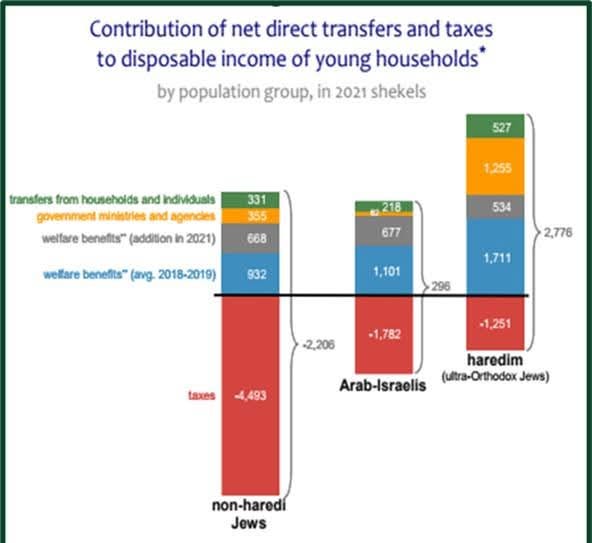
And finally, R. Feldman turns to the other aspect of the army controversy - the fact that not only do charedim not enlist, but they also receive various financial benefits.
“The big five-storey high sign that says Lo Mishalmim? Lo Mikablim! as if we’re only mekabel, as if we don’t pay taxes?! I felt like getting up on that scaffold and adding Lo Mishalmim?! We don’t pay taxes?! …Where do they get their money from - a gemach? We have a right to the money like anyone else. They’re giving us money?! They’re supporting us?! We’re supporting ourselves! We pay taxes also. It’s nonsense. It’s all propaganda.”
Alas, the only nonsense and propaganda here is that being spread by R. Feldman. The taxes that the charedi sector pays are disproportionately low compared to the rest of the population, and the financial benefits that they receive are disproportionately high. This is precisely why the charedi political parties have always been so desperate to be in the government that they have been ready to support any government policy, in exchange for receiving additional funding that they wouldn’t otherwise get.
R. Feldman concludes his post-Chanukah speech with a wish that we should all merit a salvation like that of Chanukah. Well, that salvation happened when the Chashmonaim decided to risk their lives on behalf of the Jewish People rather than take the easy way out. And that’s how Judaism survived.
I received this comment from a rabbi who was in attendance:
I was at the event, and one of the things I noticed is how sparse the crowd was. You can even see it in the pictures posted on YWN. It took a long time before the room felt even remotely full. I think one of the reasons for that is that events like this are actually counterproductive for the Haredi community, and there are two main reasons why.
First, when you listen to the arguments being presented by the Gedolim, they are simply not compelling. The analysis isn’t deep or penetrating, and it doesn’t seriously engage with the full range of relevant sources. Much of it is superficial, often based on misinformation, with incorrect facts and full of fairly shallow arguments that have never really been subjected to rigorous scrutiny. For someone within the Haredi community, it’s often easier, and safer, to avoid these topics altogether. Not thinking about them is preferable, because thinking about them and then realizing how weak the arguments are can be deeply unsettling. That’s why many people would rather not attend these events at all and prefer simply not to engage.
The second reason, and I think this is the more fundamental problem, is that the entire Haredi system rests on Daas Torah as its ultimate backstop. If you’ve ever had a full conversation about these issues with someone Haredi, you’ll recognize the pattern: when their arguments start to fail, they eventually retreat to the claim that “it’s Daas Torah.” If your arguments seem more correct or compelling, the response is that your disagreement is ultimately with the Gedolim; go argue with them. Surely the Gedolim are wise and brilliant, and there must be deep reasons behind their positions, even if we don’t understand them.
But the problem arises when you actually pull back the curtain. When the Wizard of Oz is revealed, when the Gedolim themselves appear publicly and articulate their reasoning, the mystique collapses. Instead of encountering an all-knowing oracle, you often hear weak, superficial, and poorly thought-out arguments. The Gedolim don’t have any hidden truth; their arguments are exactly the same as what the average guy on the street says.
What’s exposed is not hidden wisdom, but a group of elderly men who may possess enormous Torah knowledge, yet who have not seriously engaged in analytical thinking on these issues or had their ideas rigorously tested.
And at that point, you realize there’s nothing there. From the community’s own perspective, it would be far better to keep the oracle hidden, to believe that there is some profound wisdom beyond our comprehension, than to reveal it and expose the fragility of the arguments on which the entire system rests.
R. Feldman says, “You’re asking someone to live, to be married, for example, to someone who has a different view of life than you.”
I didn’t realize that the IDF is in the shadchan business.