


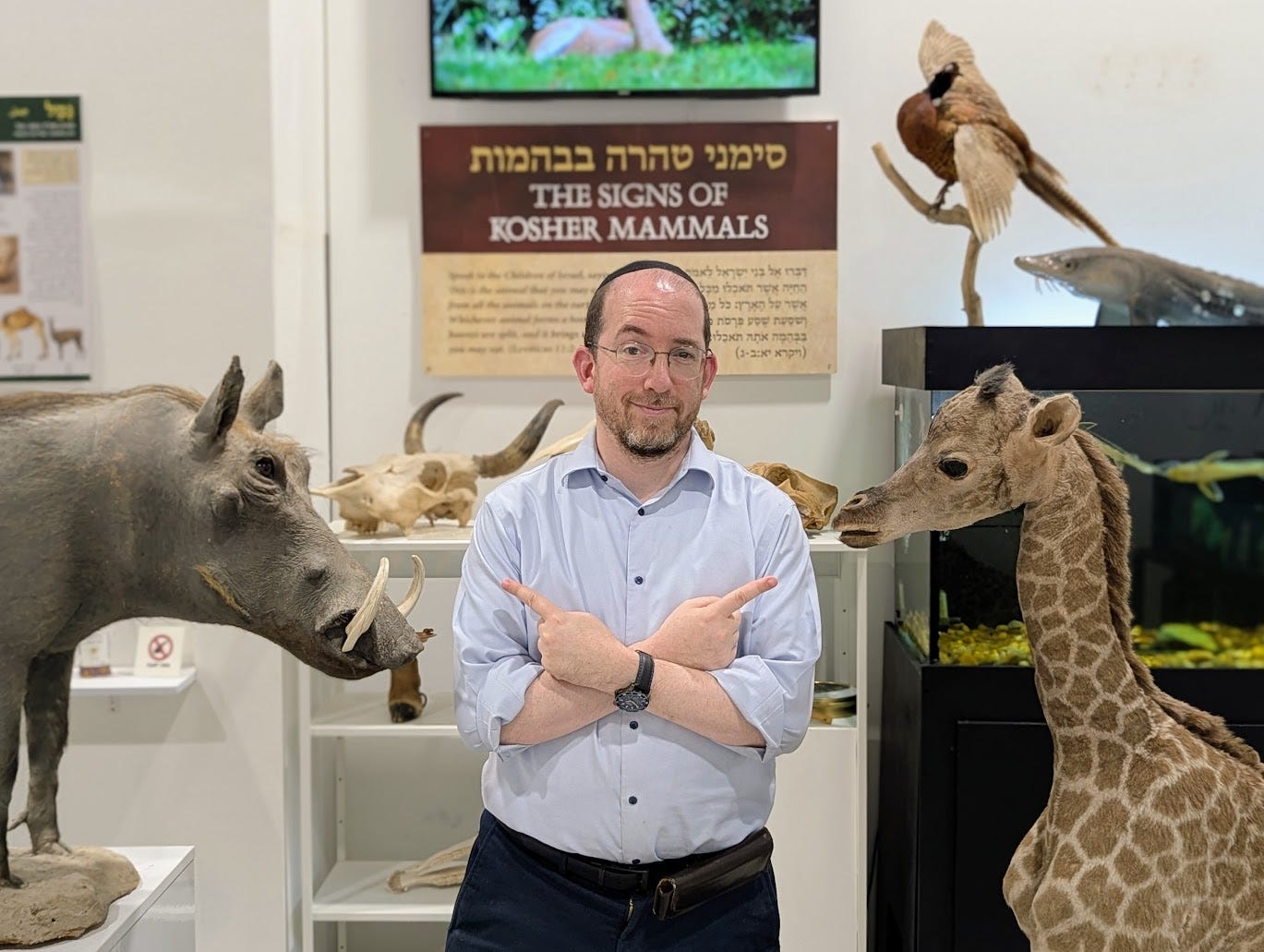
There’s lots of amazing things about Judaism, but something that really frustrates me is that due to the way that the calendar works out, nobody has any time to think about this week’s parashah, Shemini. And yet it features far more animals than any other! There’s the laws of kashrut, including locusts. There’s the eight “creeping creatures” that transmit impurity. But actually I just had an insight about how it connects to Pesach itself.
On Pesach, one of my children asked me an excellent question. She understood the idea behind matza. But why does the Torah care so much about not having any chametz around?
I didn’t want to give an answer that involved mysticism. And I managed to come up with an explanation, borrowed from the idea of kashrut.
Why are some animals kosher and others not? There is not one single explanation that covers every type. But there is certainly a general idea of cultural distinction. The Torah (Vayikra 11:45-47) says explicitly that it is about God’s People being required to practice kedusha, sanctity. Sanctity is about separating out things to be special. Shabbat is sanctified by being separated out from the rest of the week, with kiddush at the beginning and havdalah at the end. With kashrut, we separate themselves from certain foods, and thereby also separate our nation culturally from other nations, so that we survive.
Some take this to the next level of the particular non-kosher types, with regard to the land animals at least. The reason why the laws create camels, hares, hyraxes and pigs to be non-kosher is that these were animals favored in the cuisine of the neighboring tribes in antiquity.
Now, let’s turn to chametz and matza. As discussed in my book The Lions of Zion, bread had enormous cultural significance in Egypt. Matza, on the other hand - the original type of soft matza, baked on a metal plate over a fire - was the food of nomads who wander freely.
It occurred to me that today we live in world when the cultural specifity of particular foods has lost much of its significance. Everyone eats Italian food, Chinese food, Japanese food, British food. But before the modern globalist era, certain foods were much, much more culture-specific. Making the full break from Egypt required a total detachment from the quintessential Egyptian food, in favor of the food that represents freedom.
If you’d like to learn more about the details of all the kosher and non-kosher mammals, birds, fish and insects, we produced an hour-long in-depth video presentation of the Hall of Kosher Classification at the Biblical Museum of Natural History. It’s available for purchase on the museum website, but here’s a coupon code for paid subscribers to get it for free: