


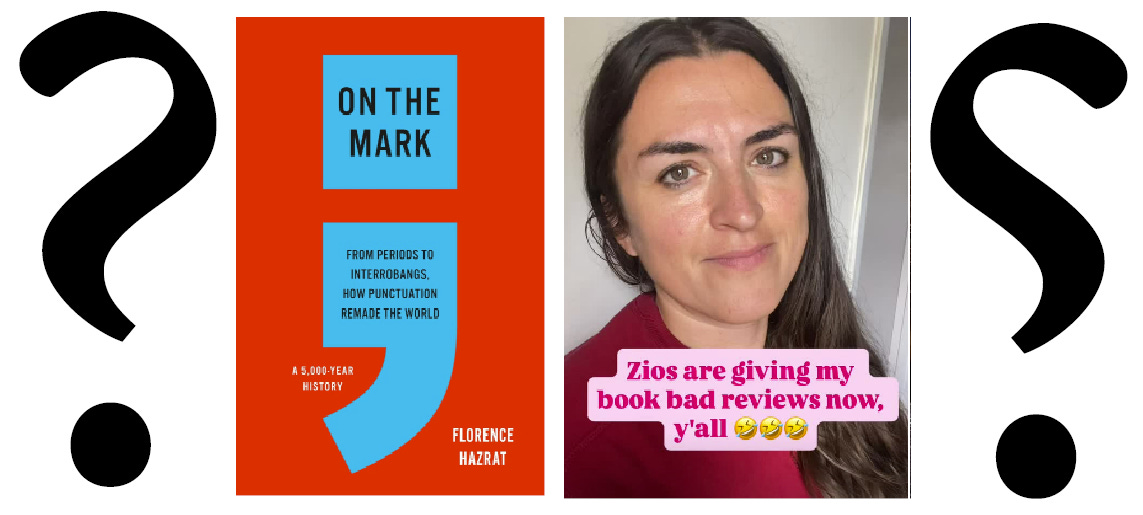
Florence Hazrat is the author of “On the Mark: From Periods to Interrobangs, How Punctuation Remade the World.” It’s been reviewed with praise by The New York Times, The Wall Street Journal, The Guardian, The Telegraph, The Daily Mail, Bookreporter, The Washington Free Beacon, and the Literary Review. As the New Yorker points out in a review that includes some gentle criticism, the book belongs to a familiar genre: the grand claim that some small, overlooked thing changed everything. In this case, the small thing is punctuation; the grand claim is that “the history of punctuation is the history of humanity.”
Including the evils of the Jews!
“Punctuation marks in Hebrew are relics of a brutal colonial system that is far from over… Language - including punctuation - is complicit in this process, paving the way for an artificial sense of unity among Jewish people from all over the globe, encouraging them to move to the land that already had people—a people made to suffer and bear the brunt of European anti-Semitism in the most horrendous ways for generations, causing bloody wars across the entire Middle Eastern region…”
Now, it’s tempting to simply roll your eyes at this depraved stupidity, and not to even bother refuting it. But considering that this book is receiving so much attention, I think that it’s important to detail precisely why Hazrat’s arguments are not merely hateful but also abject nonsense. (It’s also worth noting that if a book contained a few paragraphs with an attack on, say, African-Americans, or the transgender movement, there is no way that this would be overlooked and the book reviewed positively in the aforementioned publications.)
For this post, I also made use of two excellent critiques that I saw, one by an anonymous author on Reddit and one on X by Isaac Choua. I’m going to begin by dismantling various parts of the section quoted above, then I will move to other claims made by Hazrat.
Punctuation and Colonialism
“Punctuation marks in Hebrew are relics of a brutal colonial system “
I must first address the last three words in that sentence. Zionism was not a “brutal colonial system.” It was a rescue movement that sought to create a refuge to save millions of Jews from being murdered in Europe (and alas succeeded too late for most of them). It did so by enabling them to join their brethren in their ancestral homeland, by purchasing and developing empty land that others had been unable to develop. Zionists assumed that some sort of agreement could be reached with the Arabs who lived on the land, and many even thought that the Arabs would welcome the health and economic benefits that the Jews brought for them. Unfortunately the Palestinian and other Arab leadership rejected any compromise and preferred to try to brutally genocide the Jews, turning it into a zero-sum game - which they ended up losing.
And punctuation marks have very little to do with Zionism. Whatever role European conventions played in standardizing punctuation in modern Hebrew (which did not even start until 1937!), they did not arrive wholesale with Eliezer Ben-Yehuda and a band of settlers, nor were they devised as instruments of colonization. Hebrew’s punctuation history predates the modern Zionist movement by centuries. European punctuation conventions appeared in Hebrew texts in the Middle Ages, especially with the development of printing. This basic error in Hazrat’s chronology undermines her entire argument.
“Language - including punctuation - is complicit in this process, paving the way for an artificial sense of unity among Jewish people from all over the globe…”
Language did not “pave the way” for an “artificial” sense of unity, it reflected a genuine fact of unity. Hazrat talks about “Jewish people,” but it’s actually the Jewish People. Jews originated as a single group in the Land of Israel. After their various tribulations ended up in being dispersed around the world, they retained this relationship and stayed in communication, by use of their original language. Jewish communities corresponded in Hebrew across the Mediterranean and beyond, exchanging religious and legal questions, helping captives and distressed communities, and followed events affecting Jews elsewhere. The Cairo Geniza preserves thousands of letters linking Jewish communities in the Mediterranean and Red Sea worlds, including many written in Hebrew. Others were written in Judeo-Arabic, or other languages which were more convenient - but all the correspondence reflected the fact that this was a single people.
“encouraging them to move to the land that already had people”
It wasn’t language that encouraged Jews to move to the Land of Israel. Jews moved back to their ancestral land over many centuries, for religious reasons of living in the Holy Land. Still, the obstacles were often overwhelming, and for all but the most idealistic, the challenges and impracticalities outweighed the religious benefits.
Then, most of the masses of Jews who moved from Europe to Palestine in the 19th and early 20th centuries did not do so for any reason relating to language or even to Zionist political ideology. Nor did they need “encouragement” from the Hebrew language. They came because they desperately needed somewhere to survive, and had nowhere else to go!
Immediately following the First World War, over 100,000 Jews were murdered in the Ukraine. Then, in 1924, the Polish government instituted anti-Jewish economic legislation that made it almost impossible for Jews to survive. The United States started severely limiting immigration in 1924, but Palestine was still open. Those who escaped Europe before the Holocaust saved themselves from extermination; indeed, had the British not closed off Palestine during the Holocaust due to Arab pressure, untold numbers of Jews could have escaped death. Those refugees who came after the Holocaust did so when no other country was willing to take them in. They were later followed by hundreds of thousands of Jews expelled from Arab countries in widespread ethnic cleansing, which followed centuries of unequal status punctuated by the occasional massacre.
Yes, the land already had people - some people. However, there was plenty of space, and there was no reason for Jews, who had literally nowhere else to live, not to move to their ancestral homeland. And, as noted earlier, the local Arabs had much to gain from this - indeed, Jewish investment in the land attracted many more Levantine Arabs from surrounding areas to Palestine. Arab wages in the late 1930s in Palestine were more than double the going rate in Syria and three times the wages in Iraq, making Palestine a magnet for immigrants from throughout the Arab world.
“a people made to suffer and bear the brunt of European anti-Semitism in the most horrendous ways for generations”
Er, no, actually the people made to suffer and bear the brunt of European antisemitism in the most horrendous ways for generations were the Jews, who were massacred in the millions. Not the Arabs of Palestine, whose population exploded as a result of the medical and economic benefits of Jewish immigration, and only lost politically as a result of their leadership insisting on jihad.
What Changed With Modern Hebrew?
“While Palestinian Jews spoke Arabic like their neighbours, the foreign settlers arrived with different languages. Creating a shared, unifying speech was thus at the heart of the colonial endeavour, as it would be at the core of any nation-building project.”
Hazrat constructs a binary difference between Jews in Palestine who spoke Arabic and foreign European colonial settlers who spoke different languages. But Jews in Ottoman Palestine included Sephardim, Ashkenazim and North African Jews, among others, who communicated in a mix of Hebrew, Arabic, Yiddish and Ladino. Reducing the indigenous and long-established Jewish population to “Arabic-speaking Palestinian Jews” is a not just a simplification, it’s a falsification.
As Isaac Choua points out, “this whole idea that Hebrew somehow had to be ‘turned into a language’ is bizarre. Hebrew never stopped being a written and orally used language. What it stopped being for centuries was the everyday mother tongue of an entire speech community. Jews continued reading it, writing it, praying in it, studying in it, composing in it, and sometimes using it to communicate with Jews who did not share their vernacular. The modern revival was about making Hebrew the language of everything again. The grocery store, the classroom, the street, science, politics, technology, family life. And yes, that meant creating words, adapting old words, and borrowing from other languages.” Which is exactly how all languages work and evolve, and is also what happened with Arabic.
Hebrew vs. Arabic
Arabic puncutation is also a modern phenomenon. Arabic writers and reformers discussed and adopted European punctuation in the late nineteenth and early twentieth centuries. You’d think that this would present a major challenge to Hazrat’s claim that Hebrew punctuation demonstrates colonial influence and is a tool of colonial domination, but no. The same phenomenon is treated as liberating when Arabs do it!
“Punctuation enabled both the colonised to resist and the coloniser to settle.”
If adopting European punctuation in Hebrew is proof of colonial domination, but adopting it in Arabic is an act of resistance, the distinction is not linguistic. It is political—and selectively applied to Jews. That’s called antisemitism.
Meanwhile, Hazrat claims that there is a crucial difference. She notes that Arabic changed the direction of two European punctuation marks, the question mark and the comma, whereas Modern Hebrew kept the same direction. And she claims that this makes all the difference in the world:
It is in the question mark and the comma, their faces turned towards Europe, that we find answers…
It’s simple ludicrous. That teeny-tiny thing is what she’s basing her distinction on?! Hey, I’ve got an even better one - Jews brought the misidentification of the shafan as the rabbit over from Europe, where they didn’t have hyraxes! And they brought the measurement of an olive as being much bigger than an actual olive, since they didn’t have access to olives in Ashkenaz Europe! And they mark the departure of Shabbat in Israel later than it really is, due to twilight having taken much longer in Europe!
To be sure, there was some baggage as a result of many centuries in Europe. But this does not negate the profound cultural rootedness in Biblical Israel - which you can see, for example, in how European Jews knew and cherished the names of animals and plants from the Land of Israel which did not even exist in Europe, as I discuss in my book The Lions of Zion: Biblical Natural History and the Significance of Israel. Nor does it negate the legitimacy of Jews fleeing persecution and redeveloping their homeland in the Land of Israel.
Meanwhile, if you want to claim that the direction of recently-created punctuation reveals a people’s true home, how about much more fundamental parts of culture? As I further discuss in The Lions of Zion, several aspects of Palestinian cultural identity are actually foreign. The sabra cactus, symbol of Palestinian villages and resilience, is a recent import from North America and is the national plant of Mexico. The Jaffa orange developed by Arab farmers in the 19th century is a variety of citrus, which all originated in south-east Asia. And, of course, the two holiest sites in Islam - the official religion of the Palestinian Authority - are not even in Palestine.
And much more fundamentally, the Arabic language itself and culture originated in Arabia! It’s extraordinary that Hazrat presents Hebrew - a language that originated in the Land of Israel, and has been used by Jews ever since - as an example of European origins and foreignness to Palestine, rather than Arabic which actually originated outside of Palestine!
From Punctuation to Genocide
Hazrat uses punctuation as a springboard to launch into a tirade of condemnation of Israel:
“Language - including punctuation - is complicit in this process, paving the way for an artificial sense of unity among Jewish people from all over the globe, encouraging them to move to the land that already had people—a people made to suffer and bear the brunt of European anti-Semitism in the most horrendous ways for generations, causing bloody wars across the entire Middle Eastern region.”
The cause of bloody wars across the entire Middle East was not remotely Modern Hebrew or Zionism. First of all, most of the bloody wars across the entire Middle East did not even involve Israel at all. The Iran-Iraq war caused around a million deaths - an entire order of magnitude greater than the entire Israel-Arab conflict. Second, even those wars that did involve Israel started due to the Islamic Arab desire to genocide the world’s only Jewish state, which for both nationalistic and religious reasons they decided should not be allowed to exist in any shape or form.
Today this brutal oppression (aided and abetted by the United States, Germany, and a host of other countries through arms deliveries, technological support, and trade deals) has evolved into the worst crime of all crimes: genocide.
Of course! Indeed, how can you write a book on punctuation and not include accusing Israel of genocide! (And let’s ignore the fact that this allegation is entirely unsubstantiated, was supported only by a tiny minority of actual scholars in the International Association of Genocide Scholars, and was opposed by thousands of people with real expertise.)
“Meanwhile, soldiers gleefully post about their atrocities online in the language that has made nearly a century of injustice possible.”
Actually, it’s been a century of violent Arab rejectionism and hostility towards Jews that has caused warfare, including the unspeakable atrocities committed by Hamas.
“As of 2025, Palestinians faced the explicit violence of forced starvation, indiscriminate bombing of civilian infrastructure from hospitals to schools to tents, AI-fueled surveillance, daily bullying in the streets of Jerusalem, the murder of shepherds in the West Bank, and the burning of ancient olive trees. There have been the assassinations of chief negotiators, scientists, and military personnel, as well as repeated aggression against neighbors or Palestine supporters from Iran to Syria, Lebanon, Egypt, Qatar, and Yemen.”
Like all countries, Israel is not perfect, but Hazrat blurs the illegitimate actions of inviduals with the perfectly legitimate and indeed essential actions of a nation to defend itself against repeated aggression from Hamas, Hezbollah, and other countries, generally funded by the Islamic Republic of Iran - a country which, as we shall later, is of particular significance to Hazrat.
“Language implicitly provides the basis for all those crimes. Former Israeli Defense Minister Yoav Gallant called Gazans “human animals” on October 9, 2023, a justification for Israel’s subsequent years-long slaughter and starvation of the tiny blockaded strip. Dehumanizing language always proceeds bloodthirsty frenzies against an entire people.”
Actually, the bloodthirsty frenzy was committed by Hamas on October 7, 2023, and I think that those who gleefully rape and butcher women and children are deservedly called “human animals.” And if you want to point to dehumanizing language that contributed to Hamas’ bloodthirsty frenzy, how about the historical Quranic commentaries and Muslim theological polemicists who referred to Jews metaphorically or literally as the descendants of apes and pigs? Or the Grand Mufti of Palestine, Haj Amin al-Husayni, who compared Jewishness to infectious disease and Jews to microbes in his propaganda broadcasts to the Arab world on Nazi radio?
Hazrat’s Response
As a follow-up to criticism that she received, Hazrat just released a video in response to the “Zios.” In this video, she does not remotely even attempt to counter the criticism. Instead, she boasts about her multiple degrees, boasts about how her book is extremely well researched, and issues a ridiculous claim that “Zionists invented modern Hebrew almost out of nowhere.” I pushed her to actually respond, and she merely referred me to her book.
Hazrat also says in the video that because she only discussed Israel in a three pages out of hundreds, her Zionist critics are doing the typical Zionist thing of “picking and choosing.” But of course those who are against her hateful and nonsensical Israelopathy are not remotely interested in the rest of a book on punctuation - why would they be? If someone writes a book on algebra, and included a few pages claiming that black people are less intelligent and can’t do math, do you think that anyone would challenge critics by saying that they’re being “selective” about what part of the book they are criticizing?!
Meanwhile, Azrat herself is a German-Iranian who defends the Ayatollahs’ murderous regime. She makes claims like “growing up as Iranian abroad is not better than growing up in Iran” (tell that to all the Iranians who were imprisoned or massacred!) and “sensible people support the Islamic Republic” (!!). She claims that there were not tens of thousands of protestors killed by the Iranian government, and that the three to five thousand (!!!) who were killed included spies, and that the murders of protestors were “not worse than the Iranians killed by US bombs and sanctions” (!!!!). Multiple uses of exclamation marks may not be the most highbrow use of punctuation, but faced with the immoral absurdities spouted by Azrat, they are called for.
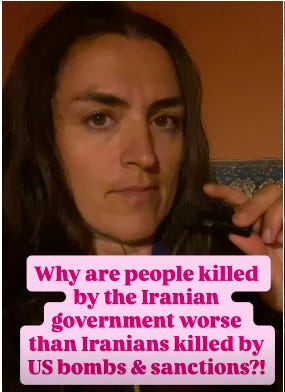
Florence Hazrat whitewashes an Islamist regime which tortured and massacred endless tens of thousands of its own people while funding terrorism worldwide. It’s hardly surprising that someone who denies brutal massacres in Iran invents them in Israel. It’s hardly surprising that such a person is consumed by irrational hatred of Jews, and uses punctuation as a launchpad for her Israelopathy. But it’s disappointing that so many reviewers of her book overlook this.
I think that the only reason her book has gotten any "positive" attention is because of her 3 page antisemitic rant.
I have never learned Hebrew, but have heard it said that there is no punctuation in the language - that it just flows. If this is true, then surely her book is surely nonsense. What else has she got wrong?