


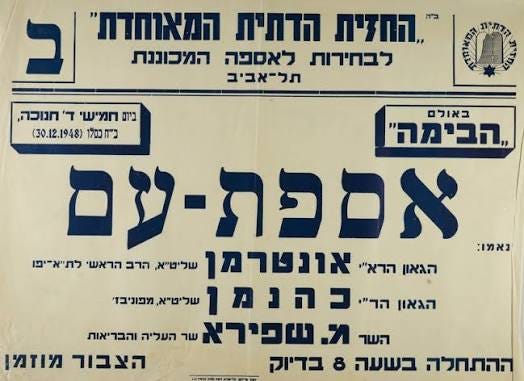
In the previous post, “When Daas Torah Was Different,” I discussed how the charedi party of Agudas Yisrael and the religious Zionist party of Mizrachi joined forces in a single party, the United Religious Front (URF), when the state was created. I pointed out how far today’s charedi community has strayed from the charedi rabbinic leadership of less than three generations ago, which was ready to praise the State of Israel as the beginning of redemption. In this post, I’ll show that many people in the religious Zionist community have likewise strayed from the approach of the original rabbinic leadership.
The URF published a platform. This was back in the days when such a thing was normative, because people were expected to make decisions based on actual positions, rather than personalities and tribal loyalties. And it’s a fascinating document.
Among such obvious things as promoting the sanctity of Shabbos, Jewish law and Torah study, and the provision of religious services, here is item #7 in the URF manifesto. Keep in mind that this was endorsed by rabbanim across both the charedi and religious-Zionist communities:
ז. מבנה דימוקראטי של המדינה, זכויות וחירויות האדם
תורת המוסר והצדק של ישראל שוללת בתכלית כל ממשל של עריצות דיכוי ושעבוד, כל שלטון האדם באדם לרע לו. השלטון בישראל שלטון הציבור הוא: שלטון העם על פי בחירתו ובהסכמתו. המבנה הדימוקראטי של המדינה לפי שיטת בחירות צודקת המשקפת את רצונה של האומה והכרעה ברוב דעות היא הצורה הנאותה הרצויה והמחויבת ברוח המסורת שלנו. “חביב אדם שנברא בצלם” ואנו מצווים לשמור שמירה מעולה על קדושת חייו חירותו וכבודו.
“7. The Democratic Structure of the State, Human Rights and Freedoms
“The Jewish teachings of morality and justice utterly reject every form of government based on tyranny, oppression, and subjugation, and every form of rule by one person over another to the latter’s detriment. Government in Israel is government by the public: rule by the people, according to their choice and with their consent. The democratic structure of the state, based on a fair electoral system that reflects the will of the nation and decisions made by majority vote, is the appropriate, desirable, and obligatory form of government in the spirit of our tradition. “Beloved is man, for he was created in the image of God,” and we are commanded to safeguard with the utmost care the sanctity of human life, liberty, and dignity.”
Now, maybe you’re thinking that maybe that this is only referring to Jews. Well, let’s look at item #11:
יא. זכויות המיעוטים ובני הדתות האחרות
לכל אזרחי ישראל יש להנהיג שיווי זכויות במדינה ללא הבדל דת וגזע. במיוחד לאחר סבלנו וייסורינו אלפי שנות נדודינו בארצות העמים בהיותנו משוללי זכויות־אזרח, נזכור היטב את הטעם המוסרי הנעלה שבדברי תורתנו “ואתם ידעתם את נפש הגר — כי גרים הייתם”. במדינת ישראל תובטח חרות מלאה לבני הדתות האחרות לחיות על פי דתם ואמונתם. יכובדו ויישמרו המקומות הקדושים להם.
“11. The Rights of Minorities and Members of Other Religions
“All citizens of Israel shall enjoy equal rights in the state, without distinction of religion or race. Especially in light of the suffering and hardships we endured during thousands of years of wandering among the nations, when we were deprived of civil rights, we must remember well the lofty moral principle expressed in the words of our Torah: ‘And you know the soul of the stranger, for you yourselves were strangers.’ In the State of Israel, members of other religions shall be guaranteed complete freedom to live according to their religion and beliefs. Their holy places shall be respected and protected.”
Today, significant portions of both the charedi and the national-religious community would never advocate for such things, with different reasons in each case.
For the charedi community today, the notion of democracy being the best way to run the country is ludicrous; the ideal is for The Gedolim™ to run it, of course. And the fact that Zionists made a democracy does not mean, as Degel HaTorah’s local representative Rabbi Elimelech Kornfeld explicitly wrote a few years ago, that people have the democratic right to choose who to vote for; you have to vote for who The Gedolim™ tell you to vote for.
Meanwhile, for an unfortunately growing number of people in the Religious Zionist community, there would be two reasons why such a manifesto would not be supported. First is that many people today would feel that such statements reek of “Leftism.” Second is that a shocking number of people now openly say that Israel should not be a democracy.
It’s astonishing to see how many religious people in Israel today - and again, I’m not talking about the charedi community - are perfectly comfortable talking about how Israel should deny political representation, voting rights, and even more basic rights, to its Arab citizens. True, in general this comes from younger people, who lack maturity, understand less about political systemss, and have been particularly affected by the last three years. But you can also hear it from adults that you would expect to understand the importance of Israel being a democracy, including those who present themselves as “Hasbara experts.”
And it’s actually openly been stated by Moshe Feiglin, head of the Zehut party, who was just sworn into the Knesset. Yesterday, Feiglin wrote a post about how we should relate to “the Arabs living in the Land of Israel in terms of their civic status in the country.” He declared that “whoever is not loyal to the State of Israel as a Jewish state cannot be a citizen of it. Perhaps a permanent resident, a kind of green card holder, but not a citizen.” Note that this clearly does not just refer to people who are engaged in offenses for which they need to be imprisoned. He’s saying that basically all Israeli Arabs should have their citizenship cancelled! This accompanies the messaging from numerous politicians that the elections were “stolen” and “illegitimate” because of the high Arab voter turnout.
(Feiglin elaborated that “Years of groveling, concessions, and preferential treatment have created a situation in which an entire sector of the public treats the law with contempt, scorns the symbols of the state, and refuses to recognize the founding ethos of 1948—a Jewish state in the Land of Israel.” He appears to be unaware that this is also a perfectly accurate description of the charedi sector. Meanwhile, there are plenty of MKs in Feiglin’s own sector who certainly treat the law with contempt, and scorn many symbols of the state, such as the judiciary and even the IDF.)
So, those people who advocate for cancelling democracy in Israel are going against not just much of the charedi rabbinic leadership of 1948, but the entire religious-Zionist leadership of that era. The great rabbis of Israel in 1948 were absolutely explicit and emphatic about how Israel needs to be a democracy, which means giving full and equal rights not just to all Jews but also to all members of other religions. Hopefully, we can encourage people to respect their teachings, and understand their importance.
Perhaps you should call the people you are describing as “observant” rather than “religious “
The rule of law has broken completely in sectors of Israel.