


“This Fight Is Different.” Such is the title of an article in Mishpacha magazine about the “campaign” against charedi society. It’s written by Rabbi Yitzchak Pindrus, a Member of Knesset for United Torah Judaism. And it’s a pack of lies. They are so tightly interwoven into the article that I’m going to have to dissect it almost line by line.
“It is no secret that the chareidi community in Eretz Yisrael is facing one of the most severe challenges it has known since the founding of the state.”
There was no challenge with charedi society at the founding of the state because there was no community of over a million charedim being deliberately underemployed and refusing to serve during a time of great defense need. At the founding of the state, and for many years following, there were only a few hundred charedim who received an army exemption, and the vast majority served in the IDF and worked for a living.
“Incitement and polarization have become routine, economic measures are increasingly wielded as political weapons, and pressure on those devoted to Torah study is no longer applied indirectly: It is systematic.”
“Incitement and polarization”?! Pindrus is apparently unaware, but there’s been a WAR going on for over two years. A thousand Jewish soldiers have been killed, tens of thousands have been injured, and hundreds of thousands (perhaps millions) have suffered immensely as a result of the repeated call-ups of reservists, which have collapsed careers, physical and mental health, and family lives. And throughout all this, the charedi community (as a community) has refused to share the burden, has not even shown any signs of caring, and has declared that anyone who objects to this situation hates Torah. For Pindrus to issue accusations about “incitement and polarization” is perverse.
As for the “wielding of economic measures as political weapons,” it’s simply a matter of applying Israeli law uniformly to the entire population, without the charedi community receiving the special exemptions and privileges that they received since Menachem Begin opened up the “Torah Umnato” exemption from a cap of 800 to an unlimited number of people, which is now a hundred times greater.
“In the Knesset, we work toward one clear objective, guided by the gedolei Yisrael in this struggle for the soul of the state: securing the status of Torah scholars, who have served as the spiritual shield of the Jewish People in every generation.”
Actually, the entire country would be very happy to go back to securing the status of Torah scholars as was practiced in every generation until very recently. There were a handful of Torah scholars who served as the leaders and teachers of the community. Everyone else led normal lives with normal responsibilities to their families and their nation.
“Yet we must confront reality honestly. The chareidi public is operating under a dangerous misconception. Many still believe this is merely another political round, sharper than usual, but ultimately solvable through tactical compromise. That belief is an illusion. The ground has shifted. This is no longer a technical debate over enlistment targets or budgetary clauses. It is a struggle over legitimacy itself: the legitimacy of a Torah-observant community to exist in Eretz Yisrael on its own terms.”
Well, yes. It’s shifted because the terms of this particular community shifted to becoming a lack of responsibility for sharing the defense burden during a draining war, while growing rapidly and demanding economic support from everyone else.
“The rhetoric of “sharing the burden” is not an end in itself, but a means to a far broader goal: the erosion of the foundations of chareidi life.”
Actually, although the economic issues are also of profound importance, the sharing of the military burden is indeed an end in itself. In my religious community, our boys are proud to serve in the IDF and do a few weeks of annual reserve duty. But those few weeks have ballooned to a minimum of two and a half months every year until they are 45, due to the manpower shortage. How are they going to get careers and hold down jobs and run families? Is it not legitimate to want to give our boys a chance at a normal life? How dare Mishpacha print Pindrus’ accusation of our having nefarious intent, when the charedi refusal to share responsibility creates such an overwhelming burden for so many people?
“Those who believe that another political deal can calm the storm are misreading the map. What we are witnessing is not spontaneous hostility, but a calculated and well-orchestrated campaign.”
It’s neither spontaneous hostility nor a calculated campaign. It’s the natural response to charedim refusing to contribute to a war while demanding billions of shekels.
“The method is neither new nor complex: the use of fear.”
It’s not “fear,” it’s justifiable resentment. Hundreds of thousands of people are suffering, and the charedi community does not care to help. Moshe Rabbeinu’s claim to the Bnei Gad and Bnei Reuven has never been more relevant.
But if you want to talk about “fear,” Mishpacha magazine itself ran an article by Jonathan Rosenblum pointing out that the charedi way of life, without radical change, presents a threat to Israel’s very existence!!! The policy of minimal or zero general studies, with avoidance of work, is simply economically unsustainable. And Israel cannot defend itself against its enemies without an advanced army, which in turn requires a strong economy.
“Over the years, different groups have served as convenient targets. Today, the chareidim have become the most accessible one. In the aftermath of a year marked by heavy sacrifice on the front lines, attacking the Religious-Zionist and broader right-wing public has become politically costly. This shift was evident when far-left leader Yair Golan once again called for cutting budgets to the settlements, and it was Yesh Atid’s Yair Lapid who rushed to rebuke him. Not out of newfound sympathy for settlements, but because even his camp understands that confronting the right-wing and Religious-Zionist public at this moment is a strategic mistake. The focus has therefore shifted to the group most easily portrayed as an economic and civic “burden” — the chareidi community.”
The charedi community IS an economic and civic burden. These are simple facts. The rate of enlistment among non-charedim is around 90%. The rate among charedim is under 10%.
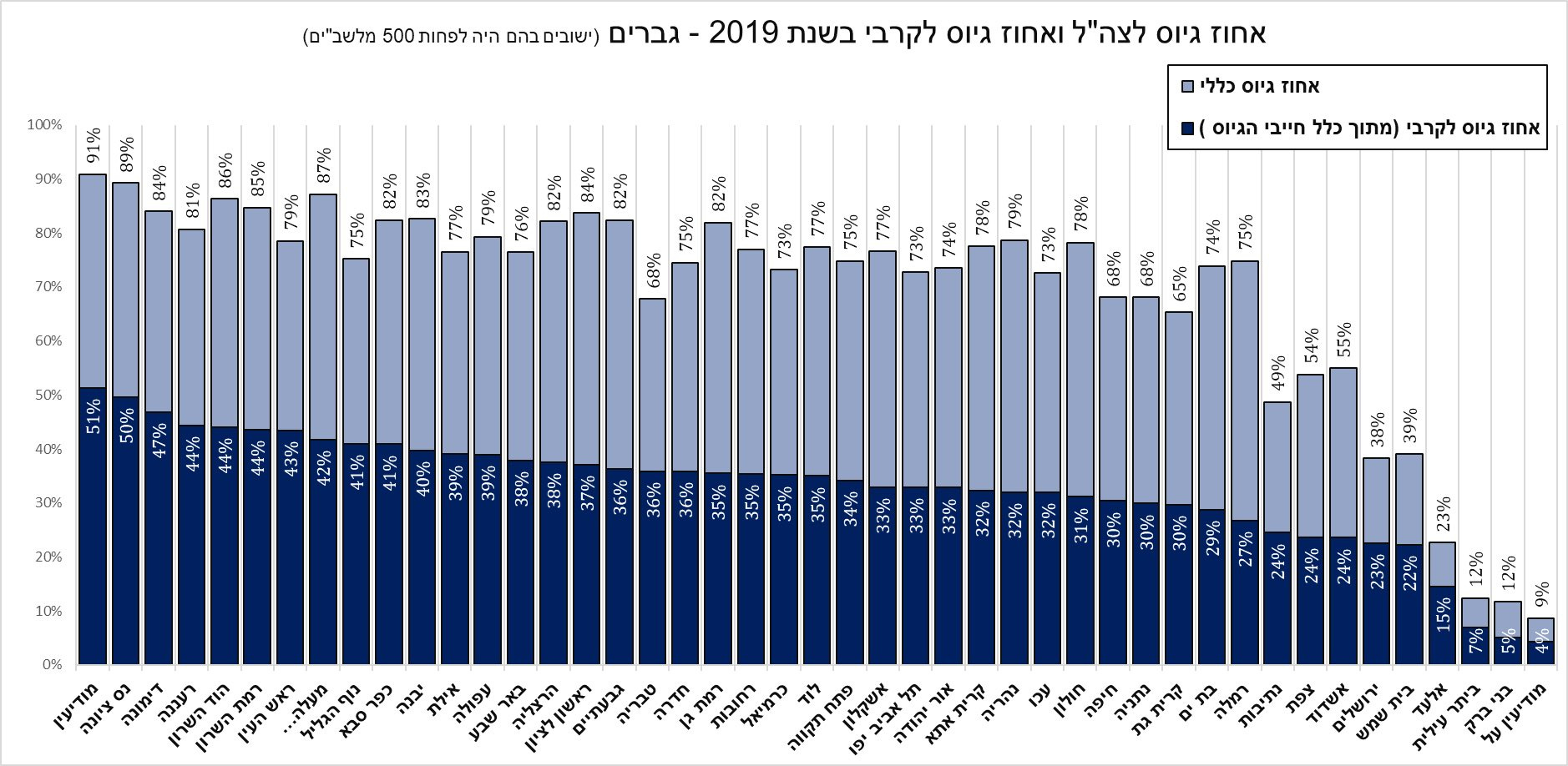
And this is not about a “secular” or “left-wing” attack. Right-wing religious Zionists are at the forefront of protests against the charedi community being exempt from helping relieve the burden that the Religious Zionist community is paying the highest price for.
“Contrary to common perception, this battle is not only playing out in the Knesset. A critical part of the struggle is being waged in a quieter, far less visible venue: the arena of data. What has emerged is a coordinated mechanism that operates as a strategic pipeline: manipulated data is produced, amplified, legitimized, and ultimately translated into policy. Each stage reinforces the next, creating a closed loop that tightens pressure around the chareidi home under the cover of professionalism and objectivity.”
Let’s see who is actually manipulating the data. (Surprise: it’s those who have zero professionalism, because they don’t have a professional education, and zero objectivity, because their community livelihood is at stake.)
“The first stage is the data factory. Research institutes funded by foreign foundations produce alarming figures that are quickly treated as fact. The most prominent example is the claim that chareidi men “cost” the Israeli economy NIS 54 billion — a figure dismantled by Dr. Eitan Regev, a senior economist at the Institute for Strategy and Haredi Policy and a lecturer at the Hebrew University of Jerusalem, yet endlessly repeated because it serves a narrative.”
And here’s the straw man. The claim that charedim cost the economy NIS 54 billion is not the most prominent example of an alarming figure. It’s not even a relevant example. That contested figure of NIS 54 billion is about the potential gain that the economy could receive if charedim entered the workforce. (And Regev disputes it because since charedim are not equipped for high-paying jobs, they wouldn’t help the economy that much anyway!)
But the actual relevant figure is how much charedim currently cost the economy, in terms of the amount of benefits that they receive versus the amount that they put into the economy with taxes and economic growth. And that figure is indeed alarming. It does not come from a “research institute funded by foreign foundations,” but rather from data from the Bank of Israel journal. See the chart below, which divides the population by Jewish non-haredi, haredi, and Arab. It shows the net difference per household between the money put into the economy via all kinds of taxes, and the money removed from the economy via welfare, health, education, sectoral allocations for religious institutions, and so on:
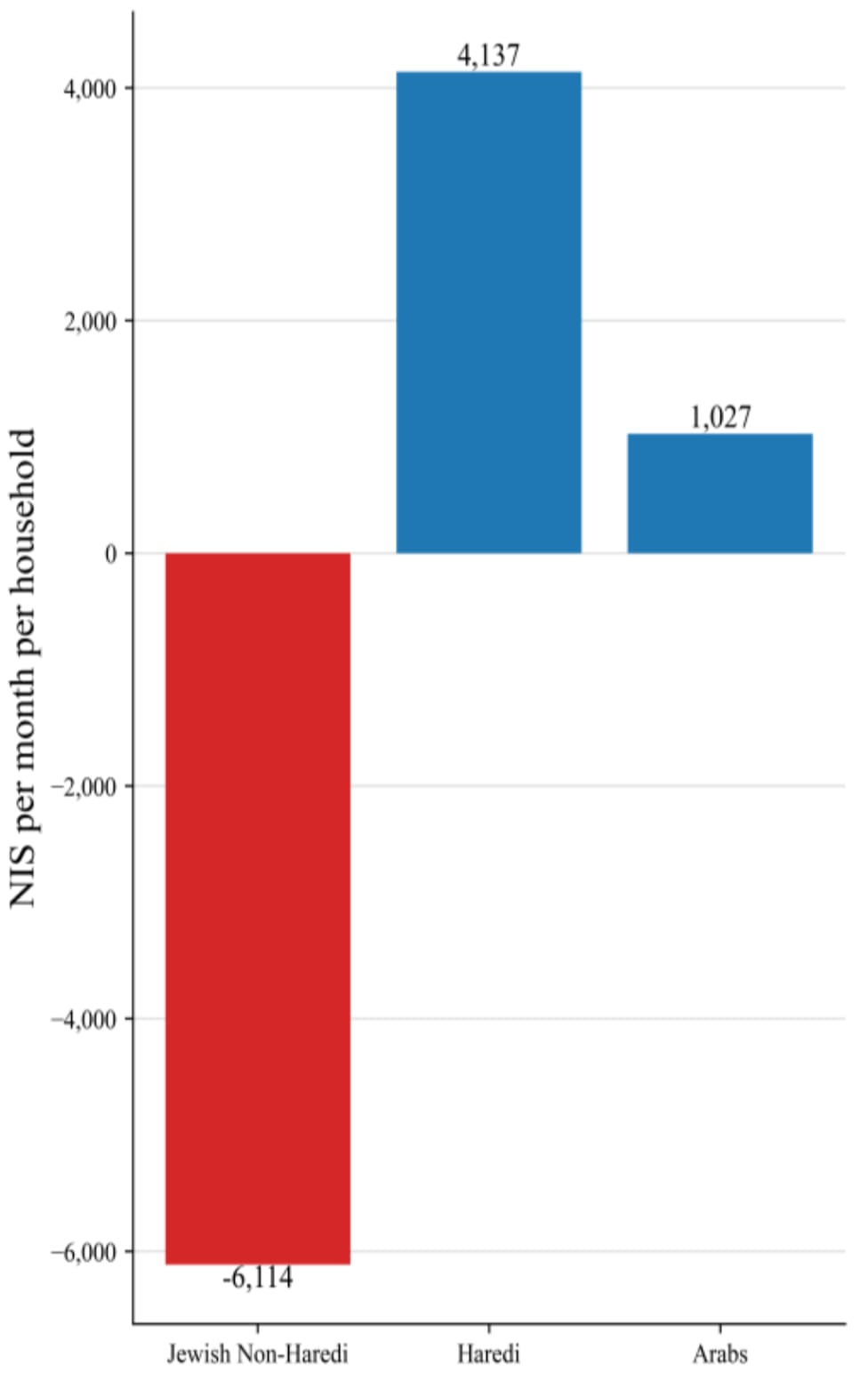
The amount that, as a community, charedim remove from the national economy in terms of financial assistance, is vastly greater than the amount that they contribute in taxes. Multiply all that by the total number of people in charedi society, and it’s billions of shekels each year that charedim drain from the Israeli economy.
And you don’t even need to read a fiscal report to know this. It’s the obvious result of a society in which the men are deliberately under-educated and underemployed, spending many years in kollel, with even many of those who leave only becoming rebbeim or mashgichim. And even though the wives work, they are not in the highest-paid professions, and it simply does not begin to compensate for the husbands’ underemployment. You don’t need to be an economist to realize that the money has to come from outside to prop this system up.
Building off his claim that the notion of charedim being a drain on the economy is false, Pindrus proceeds to complain about how this is amplified by the media and then wielded by the legal system. But it’s not a false claim. It’s the uncomfortable truth, which Pindrus is trying to obfuscate. (And he does not even attempt to address the other obvious problem, of charedim refusing to share in the burden of national defense.)
Pindrus then turns to the final stage:
“The fourth and final stage is the economic axe. Here, the narrative becomes policy. Budgets are frozen, benefits are conditioned, and sanctions are imposed, turning statistical fiction into real economic pressure on chareidi families. The consequences are tangible and escalating. The process begins with the cancellation of day-care subsidies, directly undermining the ability of chareidi women to work while sustaining their families.”
The attitude of entitlement here is staggering, not to mention the undermining of Jewish tradition in the name of Torah. It’s actually the job of men to support their families, as the Ketubah states, and as happened for thousands of years until the previous generation. Nobody outside the charedi sector gets daycare subsidies if the husband refuses to work. The purpose of daycare subsidies is to grow the economy, not for non-charedim to subsidize charedim in the modern phenomenon of mass kollel.
“It continues with cuts to yeshivah budgets and the removal of basic benefits such as public transportation discounts and municipal tax relief.”
Well, yes. Why should non-charedi Israel support an endlessly growing number of people who have decided to innovate a system of mass kollel? Nobody else gets tax relief by choosing not to work!
“But this is only the opening stage. A NIS 1.1 billion freeze targeting the entire chareidi education system, alongside a pending petition that could dismantle the system altogether and leave almost 100,000 chareidi children without any educational framework, signals a far broader intent.”
This is a lie. The freeze does not target “the entire charedi education system.” It targets that part of the charedi education system - which is indeed the majority part - that refuses to give children the education that they need in order to be self-sufficient, thereby harming the children, harming the nation, and going against Chazal’s own directives. The minority of charedi schools that have adopted the core curriculum receive full funding. Nobody is stopping the rest of charedi society from doing the same.
“What is taking shape is an expanding sanctions regime that conditions housing assistance, tax credits, and social benefits on “earning capacity” and enlistment, turning daily life itself into a pressure mechanism.”
Yes, that is correct, and that is as it should be. It’s called running a country, which requires economic contribution and civic duties. If you have a rapidly-growing sector of over a million people that refuses to take responsibility in these areas, the country will collapse.
“Let us be clear: This is not a sincere attempt to resolve the issue of enlistment. It is a deliberate strategy aimed at undermining the educational institutions and economic foundations of chareidi society. The goal is not equality, but coercion: to make the chareidi way of life in Eretz Yisrael impossible.”
Enlistment is one very important part of this, and Pindrus does not address it at all. But economics is a separate and no less important part. The charedi way of life is indeed impossible as the charedi community reaches a quarter of the population and continues to exponentially grow. There is no economic foundation to chareidi society, because the so-called educational institutions exist to raise young men without the ability or interest in earning a living.
This will collapse the country, as Rosenblum’s column in Mishpacha warned. The rabbinic and political leaders of charedi society show not the slightest interest in addressing or even acknowledging this problem. And so the only remaining tool for the nation is to coerce them.
“Beyond its direct targets, this campaign has a corrosive impact on Israeli society as a whole. It gradually normalizes dismissive, and at times openly hostile, attitudes toward the chareidi community, even among traditional and religious publics that are not opposed to Torah life and have historically identified with us. As this narrative spreads, it erodes not only factual understanding but also basic respect for the world of Torah.”
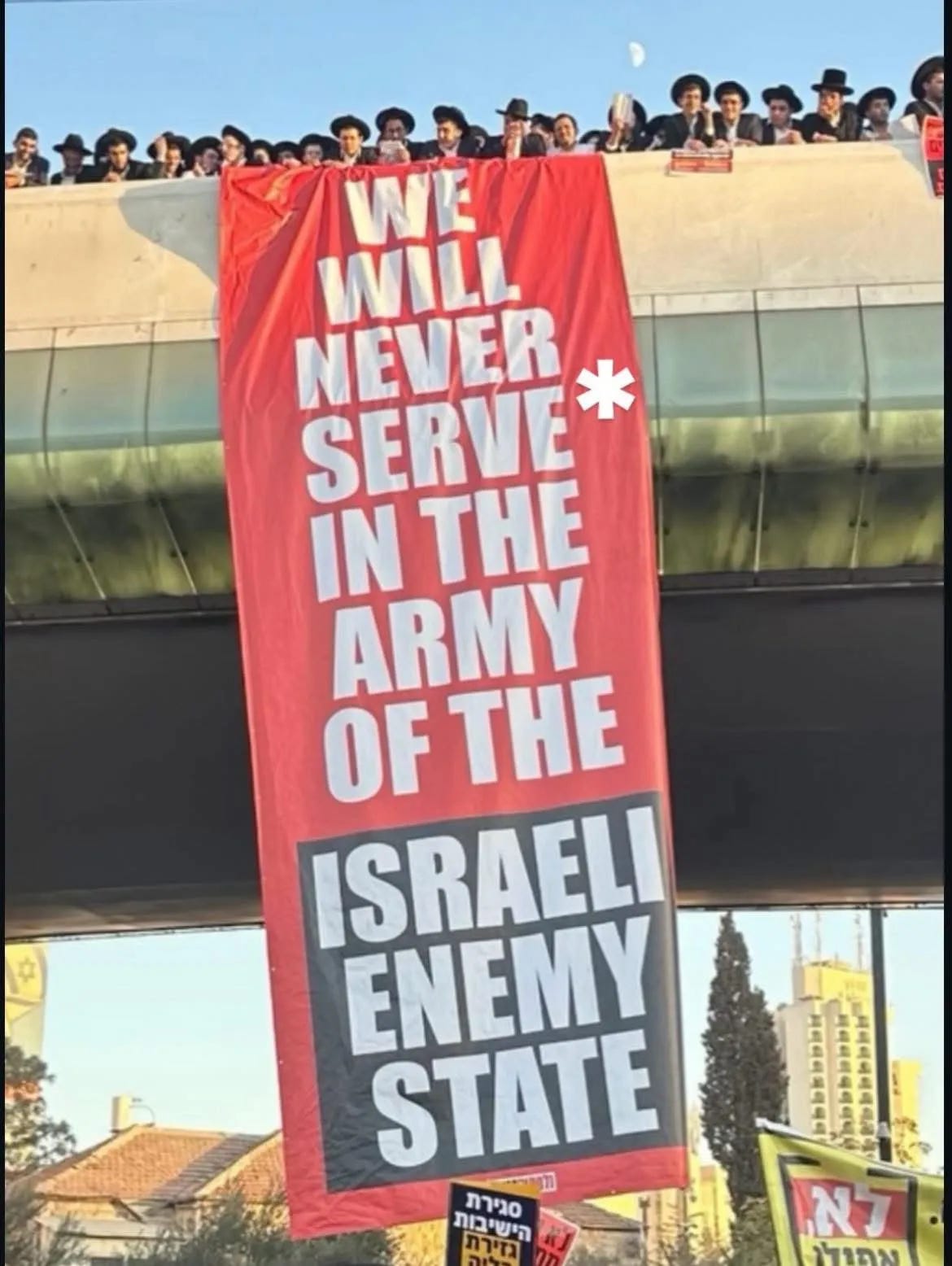
The people responsible for the total lack of respect for charedi society, and hostile attitudes towards it, are the leaders of charedi society itself. A terrible war broke out and they refused to help. And they refused to care. And they held mass protests against efforts to get them to help.
Pindrus concludes his article with a mix of more lies along with a strategy that I strongly support:
“This reality makes engagement with these audiences especially urgent. They are not adversaries, but natural partners, increasingly exposed to a distorted picture that turns pressure into policy and coercion into “common sense.” Faced with this reality, we must acknowledge that the rules of the game have changed. One side is running a tightly orchestrated campaign powered by massively funded research institutes, amplified by a mobilized media ecosystem, and reinforced by both the judicial and political systems. The other side cannot afford to respond with moral outrage alone. Koheles reminds us that every struggle has its time and its tools: Arguments about the importance of Torah learners are no match for engineered data, and a battle fought through systems and statistics must be answered in kind. The center of this struggle, the fuel that drives the entire mechanism, is the industry of fabricated data. Challenging manipulated numbers with rigorous facts and uncompromising data-driven analysis will not deliver an immediate victory. But it is an essential strategic step. Exposing the machinery behind these narratives is the only way to disrupt the cycle, halt destructive policies, and restore the legitimacy that has been deliberately stripped from the chareidi public.”
I couldn’t agree more. We need to challenge manipulated numbers with rigorous facts and data-driven analysis. We need to expose the machinery behind these narratives. We need to disrupt the modern phenomenon of charedi mass kollel and avoidance of civic responsibility, we need to restore the legitimacy of traditional Chazal-based values of economic self-sufficiency and the Torah’s directives of military responsibility, and we need to halt the destructive policies of charedi society. You can start by sharing this post with others.
There are a few foundational issues at the heart of this issue.
A -the inability of Chareidi thought to wrap the reality of a secular Jewish State and its success around its brain
B- the clear fear that interaction with broader Israeli society will dilute the lifestyle
C-Years of living on handouts from a government that is looked upon with disdain. Sounds a bit like the conundrum of the American welfare system to which so many are addicted generationally.
D- the fear of a loss of power and influence on the youth by the Roshei HaYeshiva and other institutions
E- a brainwashed zeal of being at the forefront of fighting the “ Wars of the Lord”
On a personal note, I am so alienated now from a society and leadership that I once respected. The system is broke and the Emperor has No Clothes.
I assume this was written before today's events in Bnei Brak.
My daughter (serving in a very different capacity in a very different place) called me in tears. One of the 2 women soldiers who was almost lynched is a close childhood friend.
The only thing I could say that somehow made her feel a little better is that when asked who we are closer to, Hareidim or Hilonim, I used to give some weight to the Shabbat Table Test, which would have us Datiim more closely aligned to the Hareidim.
Obviously, that has eroded over the past 2 years, but today it has become clear that whatever Jewish-like things they may do, they are simply a different religion.