


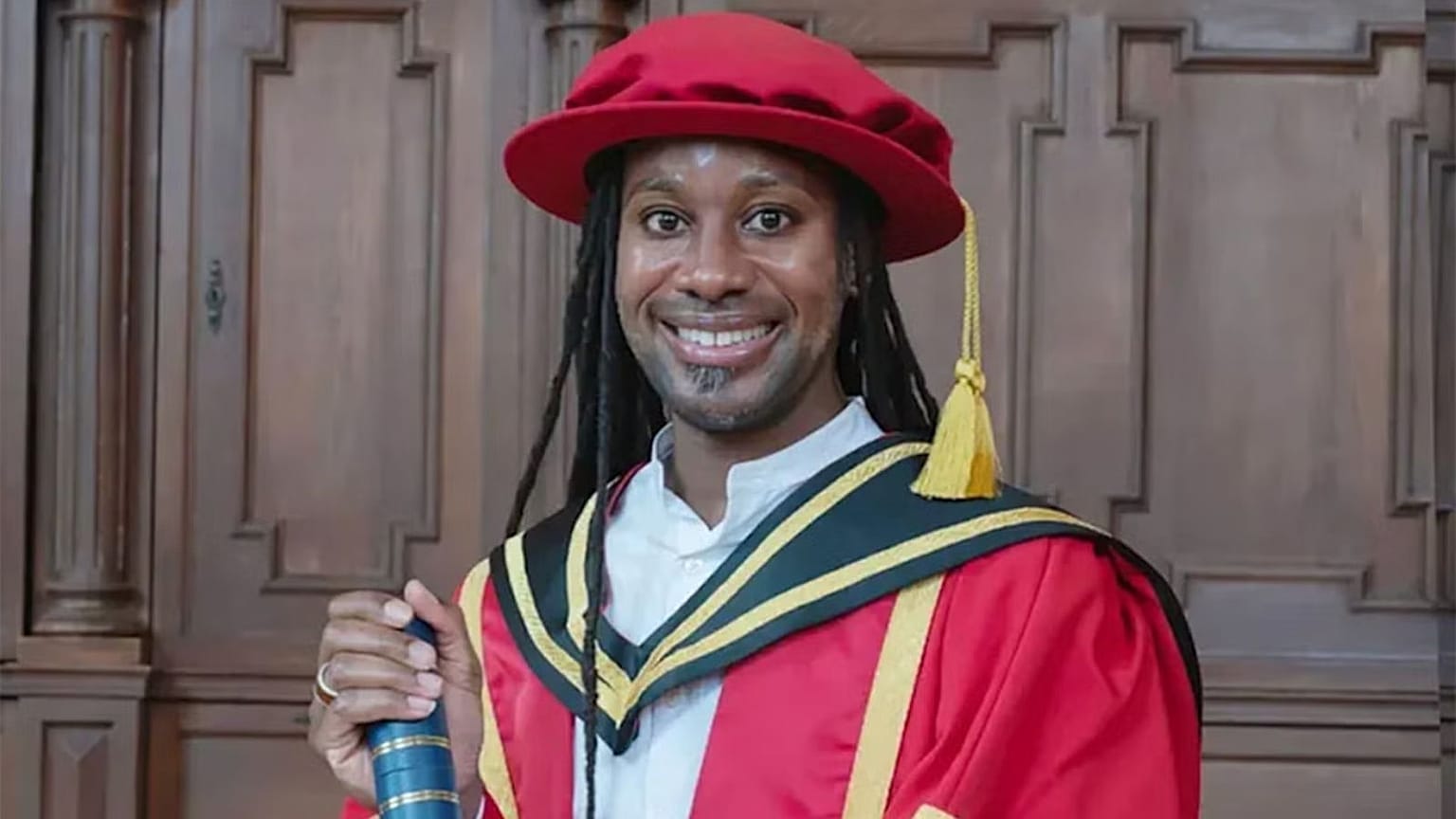
If you’re not British, you might not have heard of Jason Arday, Britain’s academic superstar, whose work focused on dismantling institutional racism, decolonizing academia, and diversifying representation within higher education. He was the esteemed University of Cambridge’s youngest-ever black professor, at age 37, with dreadlocks down to his waist. He was a television favorite and received several honorary doctorates, all kinds of awards, and important roles in various organizations. He even carried the Olympic torch. And his latest book, a memoir titled Great and Unfortunate Things, was just published by Simon & Shuster, following an advance payment of 1.4 million pounds.
As Professor Arday told it, his life was an extraordinary story of overcoming obstacles and challenges while trying to do good:
Diagnosed with autism as an infant, he did not speak until he was 12 and could not read or write until he was 18.
He won professional snooker tournaments at age 10.
As a child he was beaten by youths into a weeks-long coma, during which medics told his parents to switch off life support. When he later miraculously recovered, he begged the judge to spare his assailants, who later became his students.
He completed thirty marathons. In 35 days. With a fractured leg for the last eight.
He raised five million pounds for charity, even before he became famous.
He installed water points overseas for the needy with the WaterAid charity organization.
He had a brain tumor while completing his PhD, which was removed just before having to defend his thesis, requiring him to re-learn the material.
He was threatened by masked men with knives who cornered him at the university - twice.
A severed pig’s head was sent to his parents’ home to harass and intimidate them.
If this list of challenges and accomplishments sounds unbelievable, that’s because it is unbelievable. Every claim that he made in the list above was a lie. Even his dreadlocks were fake.
This was first suspected by Times Higher Education journalist Jack Grove a few years ago, who also found that much of Arday’s academic work seemed to have been plagiarized. He contacted Arday with questions, whereupon Arday reported Grove for harassment to the Metropolitan Police, who engaged in a four-month investigation and warned Grove to stop. Arday also hired an aggressive law firm specializing in defamation which warned the Times Higher Education that Grove’s inquiries may have been “racially motivated” and intimidated them into dropping the story.
But soon others also started investigating and revealing Arday’s lies and plagiarism. Cambridge responded by describing Arday as the “victim of a vile campaign to undermine his credibility.” (Speaking as someone who has actually been the victim of a vile campaign to undermine my credibility, I don’t think that this is a remotely accurate description of what happened to Arday.) A petition to the same effect, accusing Arday’s critics of racism, gained twenty thousand signatures, including from leading academics and other important figures.
Eventually, as was inevitable, the house of cards collapsed. The lies were just too many, the plagiarism too rampant, the fraud too obvious. It also emerged that students at Cambridge had been complaining that Arday wasn’t actually teaching them anything in class, to no avail. Last week’s British press was full of the revelation that Arday was in fact a fraud.
Arday responded on Friday by killing himself, leaving behind a wife and two children, along with a still-fawning fan base who insist that he was bullied by racists into suicide. I have enormous sympathy for most cases of suicide, but not this one. This was Arday’s final act of doing something that he excelled at: harming others while emotionally manipulating people into thinking that he was a victim. The blame lies with Arday and those who enabled him.
But the story here is not Arday; delusional people and scam artists are two a penny. Nor is it a story about those who exposed him, who were simply doing their job. And nor, contrary to what many are still claiming, is it a story about racism.
Rather, the story here is the rotten state of the academic establishment (and much of the media). They uncritically accepted all his claims, did not care about his lack of ability, hired him at the expense of other candidates, elevated him to the highest levels, had him teach students that had paid a fortune for an excellent education, and attacked anyone who dared question him as being racist, because he perfectly satisfied their desire to show aversion to racism. Even after he was exposed and Cambridge acknowledged that an investigation was required as to how he was hired to begin with, they still insisted - before an investigation had even started - that Arday was an aberration and not reflective of DEI causing a wider problem.
Personally, I found all this oddly reassuring. I used to have great respect for the world of academia. My late father was a brilliant physicist who spent his life in academia, with two doctorates, and had exceptional integrity. My own professors in Jewish Studies at the Jerusalem Lander Institute and Bar-Ilan University were impressive and honest scholars.
As such, after Gaza’s brutal invasion of Israel, when I started researching academic writings on Israel, it was shocking. Article after article, in prominent publications by accomplished academics, condemned Israel, presenting Jews as the eternal oppressors and Palestinians as the eternal victims. The charges seemed to be false, but when so many prestigious scholars are in agreement, it’s only natural (and even important) to question whether perhaps they are indeed correct and it is oneself who is subject to bias. The Arday case superbly illustrates the sham that is modern academia, especially with regard to its ideas about colonialism and victimhood.
When I was preparing my book The Lions Of Zion: Biblical Natural History and the Significance of Israel, half of which is a response to academic delegitimization of Israel, I wrote to the authors and journal editors that I was disputing, pointing out the serious flaws in their work. They dismissed me out of hand, not bothering to respond to my challenges or publish my critiques. (And I found that Israeli and Jewish academics were some of the worst offenders!) One of my goals with the book is not just to dispute specific examples of academic attacks on Israel, but also to demonstrate the broader problems of a false populist ideology that brooks no critique.
The brainwashing and pressures on people, especially young students, to applaud woke values and oppose Israel are immense. We must exert ourselves to counter them.

You can purchase my book The Lions Of Zion on Amazon or preferably from the website store of the Biblical Museum of Natural History. Meanwhile, I am visiting the US later this week for two weeks (first Los Angeles and then NJ/NY), and will be doing some parlor meetings in Teaneck and Lawrence on behalf of the museum; please write to Ellen at advancement@BiblicalNaturalHistory.org if you would like to participate.
1. Common to every analysis of l’affaire Arday is that all of his enablers - at every stage - accepted him and his fantasies because they were eager (over-eager!) to believe his story - it fitted what they wanted to hear. Same, i believe wjth Israel and its critics. They WANT to believe that Israel/Jews are no better than their oppressor
2. I made this point in a comment in The Times, wbich was rejected!
From Commentary today; Catch Cambridge If You Can
By Abe Greenwald
You can’t say that Jason Arday, who was found dead of an apparent suicide 10 days ago, wasn’t sufficiently educated to be a sociology professor at the University of Cambridge. It was his first-class education that got him the job. Arday had learned exactly what white liberal academia prizes most and how easy it is to simulate. They wanted a magical black colleague with a compelling story of triumph over adversity. So he redesigned himself to be exactly that. That Arday conned his way into Cambridge means he knew more about sociology than anyone else in his department.
It’s no mystery why Arday’s lies were so outlandish or his plagiarism was so flagrant. He understood that his life and work would never be subjected to scrutiny by the colleagues and supporters who made up his universe. In fact, the bigger the better—the more superhuman he made himself, the more he flattered the egos of those who took pride in spotting his greatness. So Arday said he was nonverbal until 11, illiterate until 18, had run 600 miles in six days, and much more. For a long time, he got away with it.
But what Arday and his colleagues failed to realize is that the elite liberal bubble is not entirely self-contained, and people outside it can see in. Beginning in June, both Arday’s fraud and Cambridge’s complicity in it were exposed to the wider world. The British and American media seized on the story. Arday resigned on August 5 and was found dead nine days later.
After his death, thousands of people came together at rallies in Cambridge and London to defend his memory and hold the media responsible for his death. Cambridge’s chancellor, Chris Smith, called the reporting on his misdeeds a “racist feeding frenzy.” Lord Simon Woolley, head of Homerton College, Cambridge, accused the press of “public assassination” and “lynching.” Others circulated a petition calling for a government investigation of the media’s role in Arday’s death—it’s got more than 100,000 signatories so far.
Arday was not killed by those who exposed his falsehoods and plagiarism. Nor was he killed by the academics, administrators, and publishers who turned him into a celebrity. Adults are responsible for their own actions, and Arday was 41 years old.
One cannot honestly defend Arday either for his deceptions or his apparent suicide. And, in fact, no one really is. What the protesters and petitioners are doing is defending themselves. University administrators, professors, writers, and other liberals are out in the streets screaming at the press for revealing the depths of elite academia’s racism, gullibility, and dishonesty. They’re focusing on the media to take themselves out of the spotlight. Because what the Arday affair revealed is that Cambridge and similar institutions are run by desperate adherents to the bigotry of low expectations. Higher education is obsessed with credentials, yet Cambridge looked at Jason Arday’s minimal, unimpressive, and suspicious record of achievement and decided that he was the very best black candidate they could possibly get. They not only hired him—they made him a star. When their investment turned into farce, they were made objects of humiliation. Once it became a tragedy, they appeared as carriers of a dangerous ideological sickness.
I like to imagine Jason Arday’s story with an alternate ending. In my fantasy version, he admits to the whole thing and pats himself on the back for orchestrating a brilliant social experiment illustrating the bigotry and fatuousness that prop up elite education.
At the least, he could have gone on to make a passable living as a pop-culture celebrity. We love our conmen. George Santos, the former congressman and convicted identity thief, will make his debut next month on a Fox reality show titled Special Forces: World’s Toughest Test. Don’t forget Frank Abagnale, who spent his young adulthood as a petty criminal, passing bad checks and scamming his way through the U.S. and Europe. He impersonated doctors and airline pilots to impress his marks and pick up women. After a few stints in prison, he used his skills to go legit, educating banks and other businesses on how to spot fraudsters. Abagnale’s autobiography, Catch Me If You Can, which itself was largely fabricated, became a hit movie directed by Steven Spielberg and a Tony-nominated musical.
But Arday would have had a shot at a second act even more spectacular than that. Because he was really the one who caught them.
Abe Greenwald is the executive editor of COMMENTARY.