


What do camel feet look like? This will be a topic of interest for those learning Daf Yomi, which reaches the topic of the signs of kosher animals later this month. (The Biblical Museum of Natural History will be releasing a free study aid, and we are also hoping to do a presentation at the museum; write to office@BiblicalNaturalHistory.org for details.) But it’s also a fascinating example of how misinterpretations of the Torah evolve.
There’s a picture of the camel’s foot which appears in the overall very well-done and useful ArtScroll Schottenstein Talmud on this topic, as well as in the color edition of the Stone Chumash. (I was actually the zoological consultant for ArtScroll for this part of the Talmud, way back when I was known as “Nosson Slifkin,” but I wasn’t involved in the illustrations.)
The picture is to illustrate the Torah's description of animals that meet the criterion of possessing split hooves, and those that don't. Instead of photos, ArtScroll contracted a talented artist to produce high-quality artwork. And the illustration of the camel’s foot is this:

But what is that? The illustration shows a big black hoof that is described as split at its tip, with two gray nails. This does not match any of the three known species of camelid (the Arabian camel, Camelus dromedarius; the domesticated Bactrian camel, Camelus bactrianus; and the wild Bactrian camel, Camelus ferus). Here are photos of camel feet:
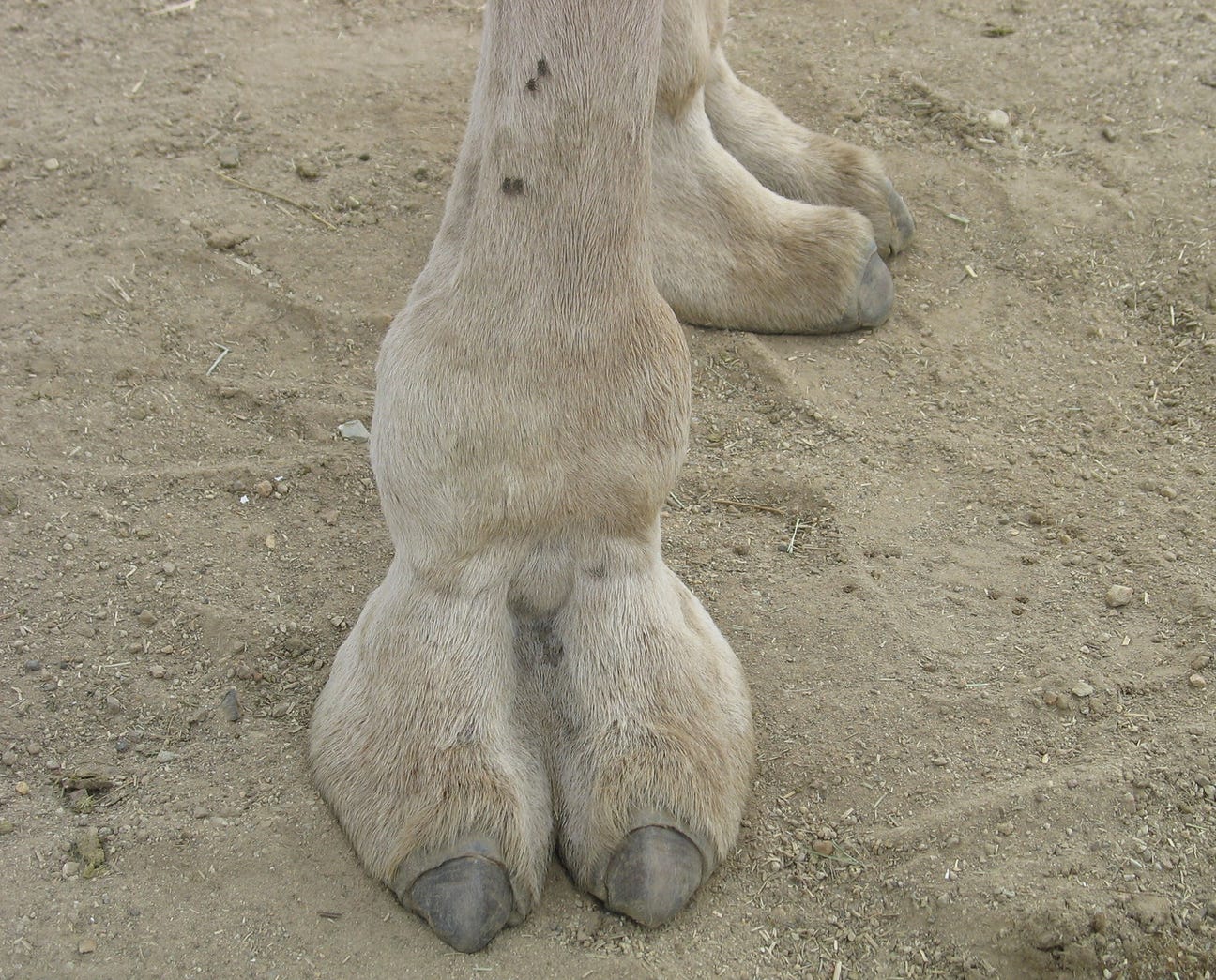
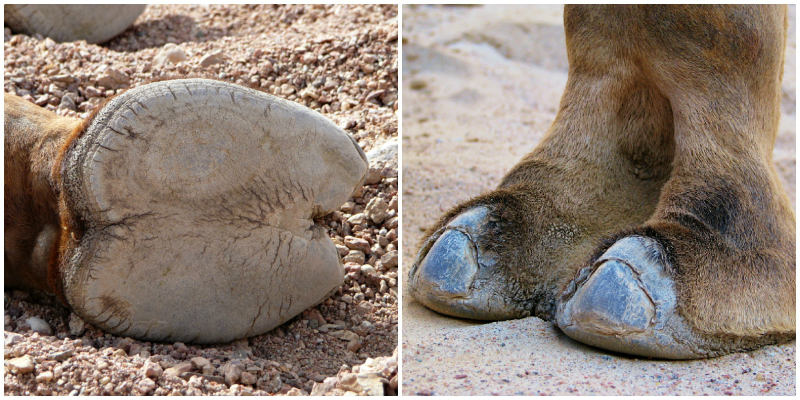
As you can see, there is no lower black section to the camel’s leg, and the camel doesn’t actually have a hoof at all. Instead, there is a just a big brown furry foot, with two nails on the tips of the camel’s toes.
I think that the ArtScroll species should be named Camelus ArtScrollus Hoofus, the ArtScroll hoofed camel. Meanwhile, in ArtScroll’s Stone Tanach, another novel species of camel appears. Just take a look at this:
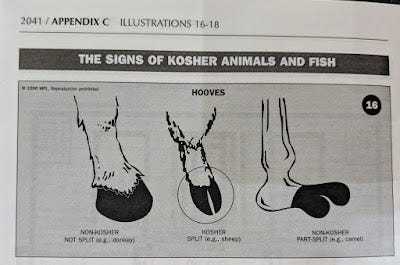
The donkey hoof is perfectly illustrated, and so is the sheep hoof. But what on earth is that camel foot on the right, which is black for half its length, just before it splits into two bulbous toes? I’d like to name this one Camelus ArtScrollus Cartoonus.
How did these ArtScroll species of camels evolve? The answer is that they result from a common mistaken translation of the Torah.
The Torah’s first requirement for an animal to be kosher is that it is mafris parsah. This is often translated to mean that the animal must possess a split hoof. However, as I explained in great detail in The Camel, The Hare And The Hyrax, there are actually two different classical explanations of this phrase, and neither of them translates it this way.
According to Rashbam, the word mafris is based on the same root as parsah, which refers to a nail-like covering. Accordingly, the phrase mafris parsah means that the animal “hooves a hoof,” or to put it in better English, “forms a hoof.” The requirement of it being split is expressed in another phrase, shosa'as shesa.
According to Rashi, on the other hand, the word mafris is not based on the same root as parsah. Instead, mafris means “split” (and shosa'as shesa means “fully split”). Parsah is defined by Rashi (to Vayikra 11:3) as having the meaning of the Old French word plante. This refers to the sole of a foot - not necessarily to a foot that is hooved (i.e. encased by a hard covering). Accordingly, the phrase mafris parsah means that the animal “has a split foot” and makes no reference to a hoof.
Thus, according to neither view does mafris parsah mean “split hoof.” It either means “has a hoof” or “has a split foot.”
Now let us turn to the Torah’s account of why the camel is not kosher:
אַךְ אֶת זֶה לֹא תֹאכְלוּ מִמַּעֲלֵי הַגֵּרָה וּמִמַּפְרִסֵי הַפַּרְסָה אֶת הַגָּמָל כִּי מַעֲלֵה גֵרָה הוּא וּפַרְסָה אֵינֶנּוּ מַפְרִיס טָמֵא הוּא לָכֶם
This verse is often translated as meaning that the camel's “hoof is not split” - i.e. that it has a hoof, but the hoof is not adequately split. But that’s not what it means at all, according to any view. According to Rashbam, it means that the camel does not have a hoof at all - instead, it has a big furry foot with nails. According to Rashi, on the other hand, it’s not saying that it doesn’t have a hoof, which doesn’t matter anyway; instead, it’s saying that the camel’s foot is not adequately split, as Rashi explains there:
מפרסת פרסה ושסע איננה שוסעת - כגון גמל שפרסתו סדוקה למעלה אבל למטה היא מחוברת:
“Which divides the foot but is not split” —such as the camel, whose foot is split at the tip but is joined at the back. (Rashi to Leviticus 11:26)
(Rashi’s explanation of the camel having a foot which is only partially split is consistent with camel anatomy, but one does wonder whether Rashi, living in France, ever actually saw a camel in the flesh.)
Thus, ArtScroll’s reference to a camel having “a hoof that is split at the tip” is not actually based on any single Rishon - and therefore its corresponding illustrations are not rooted in any zoological reality.
The problem is that most people are not aware that there are two different explanations of the Torah here, and they blur both explanations together in their minds. So most people read the requirement of mafris parsah as meaning that the animal must have a split hoof. And then when the camel is described as “ufarsah einenu mafris,” they understand this to mean that it has a hoof that is not split. Thus emerges the creation of Camelus ArtScrollus, which has a big black hoof. But there ain’t no such thing!
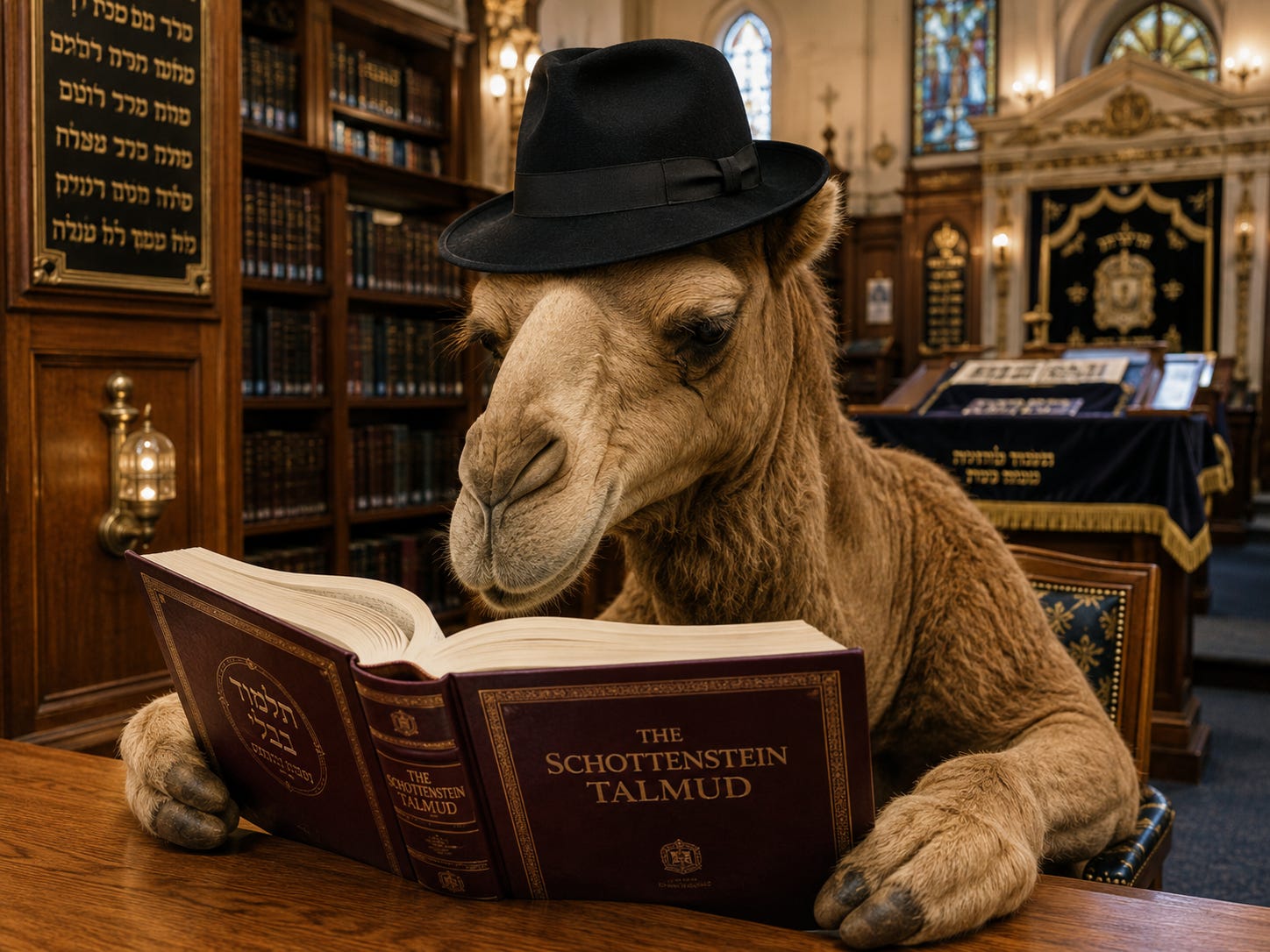
Meanwhile, here’s another new species of camel, which I came across on a stock image database while searching for photos for this post:
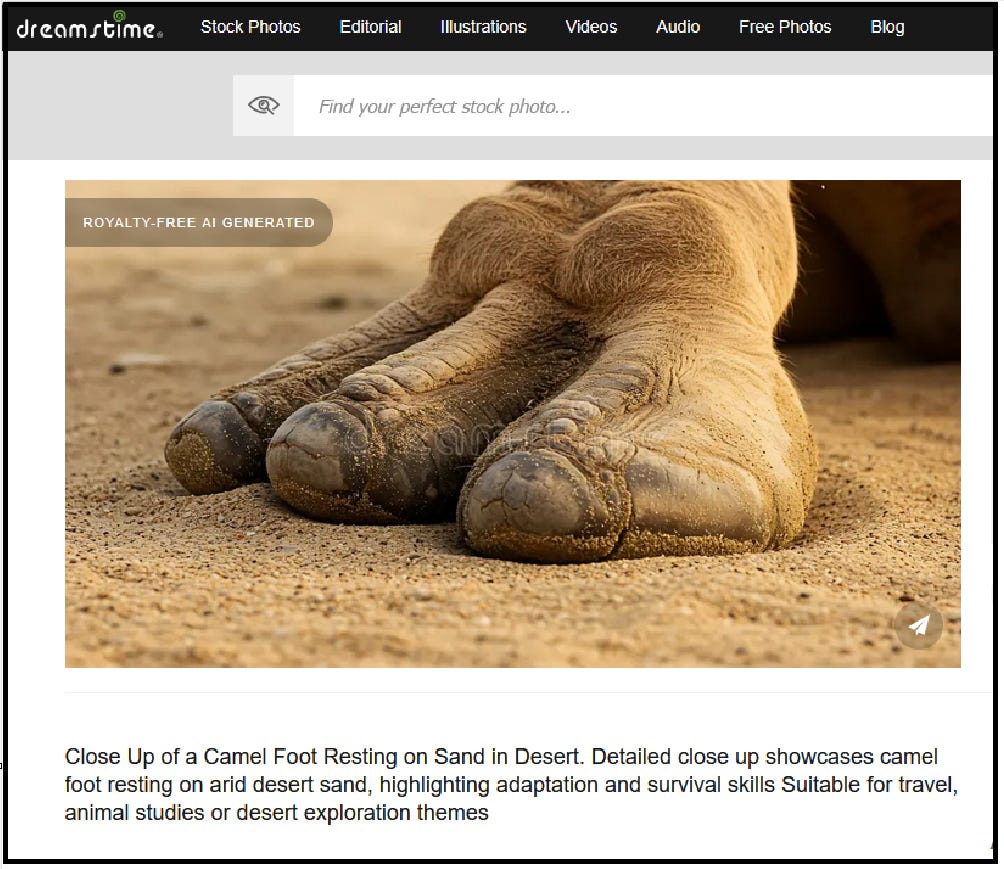
What on earth is that?! A three-toed camel?? I did a double-take when I came across it!
The answer is that that’s what happens when you use AI to generate animal photos!
I think part of the confusion here is that people do not have a clear idea of what a "hoof" is and how it differs from a foot/toe in general.
I think it is indeed likely Rashi could have seen a camel. This was during the crusades and they could have been brought back to Europe with returning knights. They would have been part of the traveling circuses that went from town to town to entertain.