


There are some truly wonderful people in the charedi community. There are people who live amazing lives of chessed for Jews across society. There are people who created organizations like Yad Sarah which have been transformative for Israel. There are all kinds of gemachim. There were many acts of kindness done in the aftermath of October 7th.
But how significant a contribution is all this chessed? To what extent is it true of the charedi community as a whole? And does it counter the fact that the charedi community barely serves in the IDF and is underemployed (due to many men either not working, or not having the education to work in high-pay jobs)?
Well, we don’t need to speculate. There’s actual data available on this. There’s a report by the IDI (Israel Democracy Institute) on various studies of charedi society, along with data from 2024 on volunteering from the CBS (Central Bureau of Statistics). It turns out that 46% of charedim engage in volunteer work. At first glance, that sounds like an impressive charedi accomplishment. But let’s analyze it further.
Charedim aren’t the only ones who volunteer. 37% of secular Jews also volunteer, which means that the entire difference between charedim and secular Jews is merely 9%. And 39% of dati’im volunteer, so the difference between charedim and datiim is just 7%!
And even for those who volunteer, how many hours of volunteer service are there? There is data for about two-thirds of volunteers, of which half do less than ten hours a month. Thus, the total additional “chessed offset” of charedim with regard to volunteer work is not particularly significant.
And it’s also misleading to talk about “the charedi community” as if this is universal. Volunteering is done by a minority, often the same highly motivated people everyone cites, while the majority neither serve nor do large-scale chessed. Charedi yeshivos actively discourage young men from doing chessed.
It should also be noted that much of this chessed is to serve charedi communities themselves, who due to large families and poverty are in dire need of much more chessed than non-charedim. I have received numerous solicitations from charedi “chessed organizations” which turn out to be about supporting families in kollel (and such enabling of deliberate poverty is arguably not even a chessed at all). The charedi “Gedolim” have not encouraged chessed for soldiers and their families, and in some cases have condemned those who engage in it.
Now let’s turn to the other form of chessed: helping protect people’s lives via army service, described by Rav Aharon Lichtenstein as the most basic and fundamentally significant chessed that a person can do, and thus an obvious requirement of religious Jews.
Mandatory army service for men is around 32 months for men (even Hesder is about 18 months) and two years for women - i.e. many thousands of hours of compulsory service, not just a few hundred! Plus there is risk, loss of freedom, disruption to education and career, and reserve duty afterwards, which has now gone up for combat soldiers to two-and-a-half months every year until they are 45. Even on very conservative assumptions you’re talking more time by at least an order of magnitude. And it’s incomparably greater sacrifice in other ways. A few hours a week of voluntary chessed just isn’t in the same universe.
There’s also a basic category error. Chessed is valuable, but it doesn’t address the state’s binding constraint, which is defense manpower. You can’t replace infantry, intelligence units, logistics, or reserves with baking challos, gemachim or even being an on-call hatzalah medic. They’re not interchangeable inputs. The IDF is suffering an acute manpower shortage. If there is an attack and people are killed because there were inadequate defenses, it doesn’t help that people were doing chessed.
And meanwhile, a consequence of the manpower shortage is that reservists are called up for many months on end, often leading to financial collapse, severe PTSD, family problems, divorce, and even suicide. As Rav Tamir Granot has said, the war has not just created many literal widows and orphans; it has also turned hundreds of thousands of people into effectively being widows and orphans, with the husband/ father being away for so long. Where’s the chessed in contributing to such a situation?
And finally, when it comes to the society as a whole, the most important chessed is things such as medical services, social services, education institutions, and governmental aid. Hospitals are much more important than medical equipment gemachim! And all these national institutions are funded by the taxpayers, and that is the non-charedi community - exclusively.
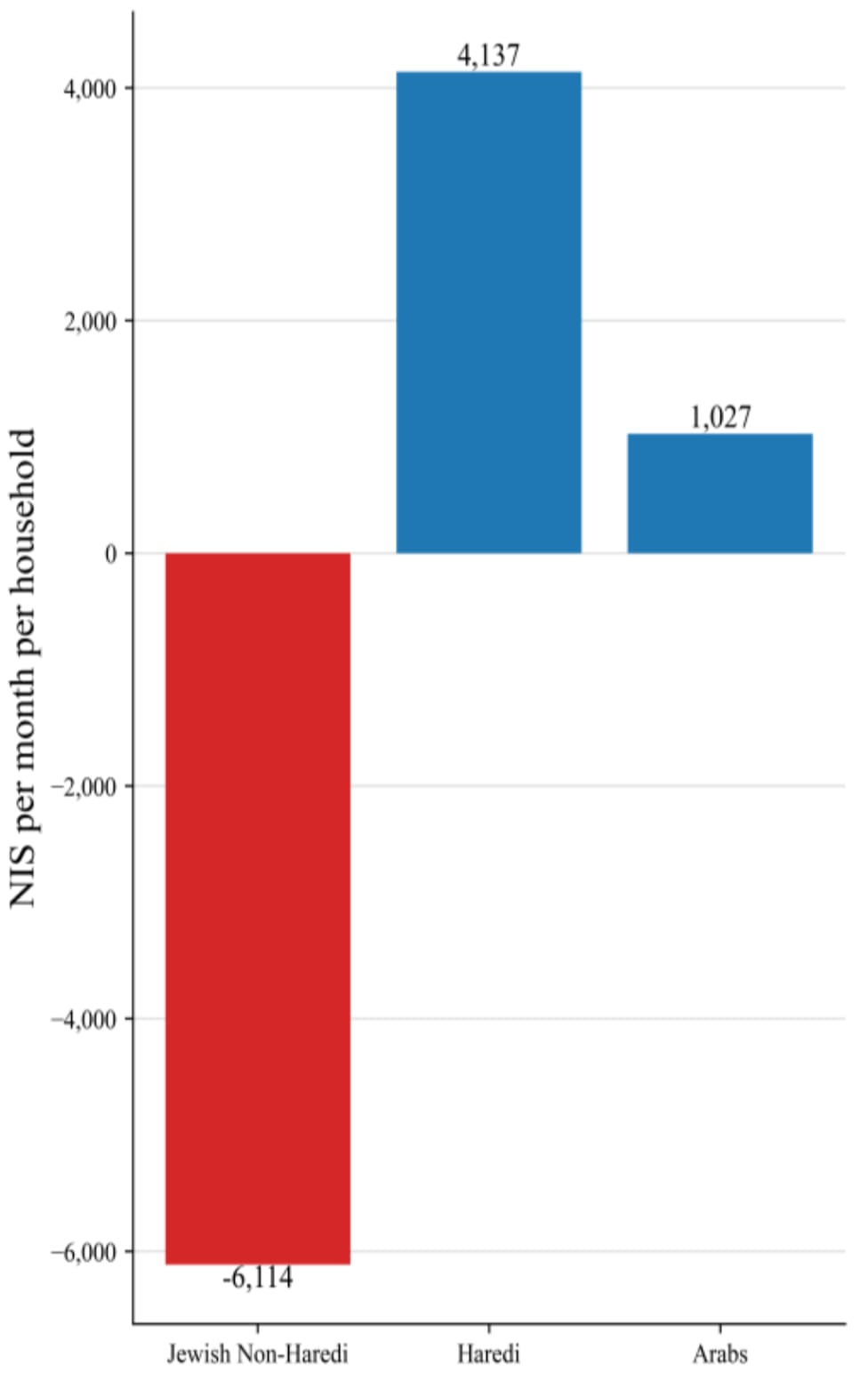
What do I mean by “exclusively”? The net result of the charedi community, as data from the Bank of Israel journal shows, is a drain on the economy. The amount that, as a community, they remove from the national economy in terms of financial assistance, is vastly greater than the amount that they contribute in taxes. See the chart below, which divides the population by Jewish non-haredi, haredi, and Arab. It shows the net difference per household between the money put into the economy via all kinds of taxes, and the money removed from the economy via welfare, health, education, sectoral allocations for religious intitutions, and so on:
Chessed matters. And charedim, as a society, might do a tiny bit more volunteering for society in general than others do. But it does not come close, in scale, necessity, or sacrifice, to compensating for non-participation in national defense and supporting the economy. That is accomplished by the vastly greater chessed performed by everyone else, whose suffering is being increased by the general indifference of charedi society.
These are the facts, as painful as they may be. And it’s important that people are aware of them.
Based on the graph and numbers in the article, here are some rough calculations:
The median charedi volunteer does 10 hours volunteering per month. 46% of chareidim (adults, presumably) volunteer so the average volunteering per person is 10*.46=4.6 hours. Assuming a household contains two adults, that's 2*4.6=9.2 volunteering hours per household.
Most volunteer work is not highly skilled work, rather it is closer to minimum wage work in skill level. Minimum wage in Israel is 34 shekels/hour. Thus, charedi volunteering has a monetary value of 9.2*34=312 shekels per month.
According to the graph, the average charedi household gets 4137 shekels per month from the state. So even assuming that all charedi volunteering goes to non-charedim, we see that charedim are given 13 times as much as they give. In a more realistic scenario where half of volunteering is to help other charedim, they are given 26 times as much as they give.
An entire community of people שאינן עוסקין ביישובו של עולם. Ironic, because they talk so much about the value of giving and not taking, and נהמא דכיסופא