


I’m please to announce that the “Art of the Ark” exhibit is now open at the Biblical Museum of Natural History! Turn up the volume and click the image below for a preview!
Our collection includes over 100 artistic representations of Noah’s Ark from all over the world. The exhibit is divided into several sections, illustrating different aspects relating to art, geography, Biblical interpretation, and conservation.
One section, “The Beauty of the Ark,” displays a variety of artistic models. These range from minuscule pewter figures to enormous elaborate arks with many dozens of hand-carved animals. Some of them feature unusual species such as sloths, anteaters, and duck-billed platypuses, concentrating many dozens of species together in an amazing display of the diversity of the animal kingdom. One model is an ark under construction, with Noah and his family diligently hammering away, rhinos and elephants hauling the lumber, and beavers gnawing it into shape! (The notion of even the animals cooperating in the mission reflects a Midrash which describes how wild animals circled the ark to protect it from being taken over by wicked people. )
Another section, “Arks around the World,” features an extraordinary range of Arks that are divided according to the geographic region in which they were made. The arks reflect both the human culture and the wildlife of those regions. African arks, carved from hardwood or woven from plant fiber, feature African Noahs and Na’amas (Noah’s wife), along with giraffes, wildebeest, warthogs, and other such African creatures. A Chinese ark in the form of an ancient oriental dragon boat features Chinese Noah and Na’ama along with pandas, tigers and Asian water buffalo. South American arks, with Spanish architecture, feature llamas, toucans, and are adorned with panpipes. North American arks house bison, skunks and bald eagles. There is even an Arctic ark, with reindeer, snowy owls, and polar bears! All these reflect a central theme of the museum, which is that everyone’s perception of, and cultural relationship with, the animal kingdom is influenced by the region of the world in which they live.
A third section, “The Biblical Ark,” displays a scale model of the Ark as described in the Bible. There are also reproductions of ancient mosaics depicting the ark from synagogues in Israel and Turkey. And in “The Symbolism of the Ark,” visitors learn about how this Biblical story has become a motif for conservation worldwide, along with a model ark that features exclusively endangered species – and a dodo who stares forlornly at the boat that he missed.
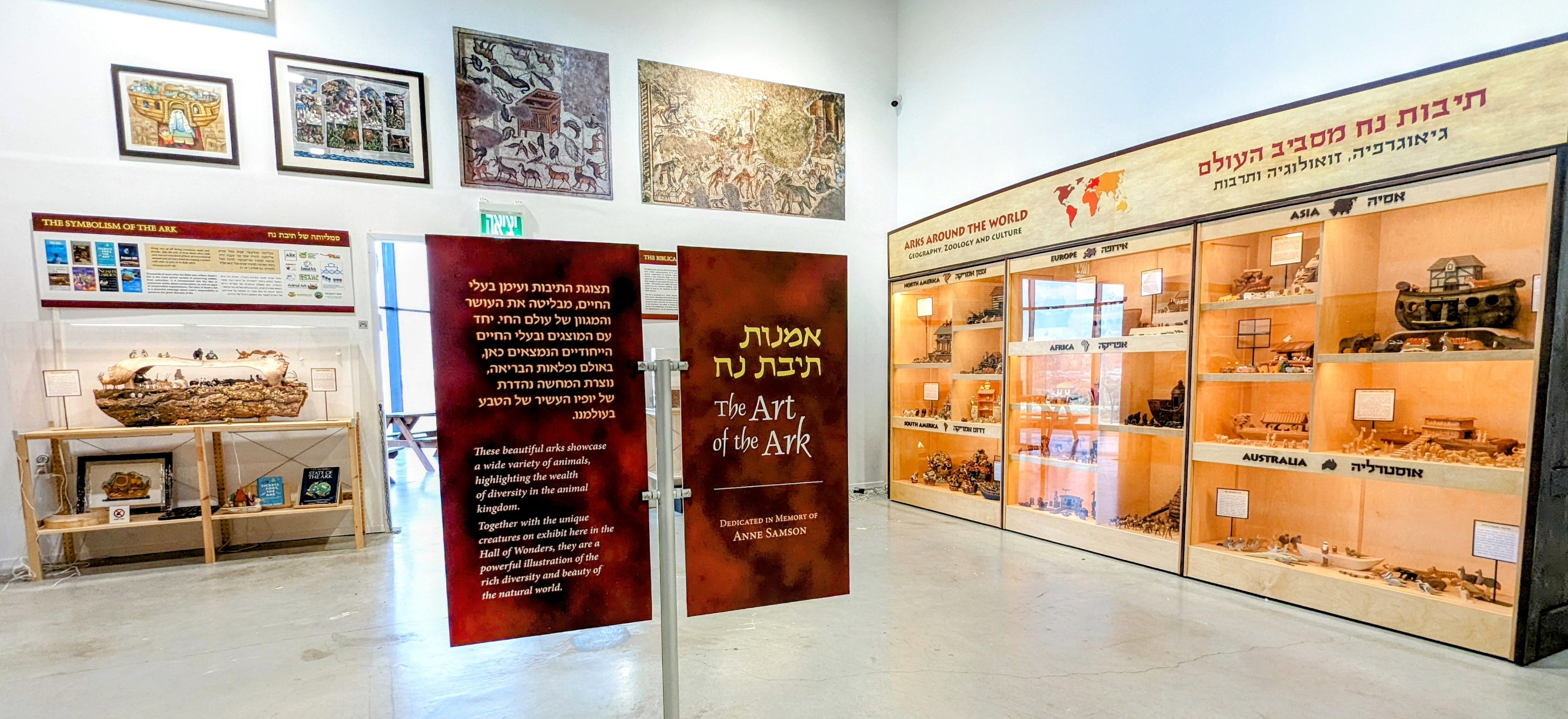
Partial view of exhibit
The museum has a general strict policy to be sensitive to the entire spectrum of society and to avoid anything controversial - the exact opposite of this blog! Accordingly, the exhibit focuses solely on artistic representations of the ark and the messages of the story, and does not remotely discuss scientific/ historic aspects.
While the exhibit just opened at the museum in Israel, I myself am currently in Teaneck, speaking this Shabbat at Arzei Darom. I’m available to meet with museum supporters over the weekend, and we are having a parlor meeting on Sunday, following which I travel to Los Angeles. If you’re interested in either the parlor meeting or a personal meeting (in NY or LA), please write to Tobey at advancement@BiblicalNaturalHistory.org
You just had to make it controversial 😆
Here Rabbi Dr. Slifkin writes:
"All these reflect a central theme of the museum, which is that everyone’s perception of, and cultural relationship with, the animal kingdom is influenced by the region of the world in which they live."
But in a previous post,
https://www.rationalistjudaism.com/p/noah-and-dragon?utm_source=%2Fsearch%2Fregion%2520of%2520the%2520world&utm_medium=reader2
he said the following with an additional point:
"The latter ties in very closely to one of the museum's fundamental messages. Different parts of the world have different wildlife which become part of cultural heritage of the people in those regions. <b>And the wildlife of the Bible and of the Jewish People is the wildlife of Biblical Israel, not that of Europe of North America.</b>"
It is a shame that the comments from the old blog posts from the previous Blogger format did not get carried over to this Substack format. Because if they were brought over, you would see a certain "traditionalist" call out Rabbi Dr. Slifkin for that line as contradicting the claim that his museum is intended to avoid anything controversial. By saying the wildlife of the Bible is limited to the wildlife of Biblical Israel, he completely contradicts the traditional understanding of Noah's Ark which saved all the land animals on the entire planet!
I am heartened that Rabbi Slifkin amended his statement here and omitted that phrase, but now, this message of the "Biblical Museum" becomes incoherent. What does the fact that different people's perception of the animal kingdom is influenced by their region have anything to do with the central theme of this Biblical Museum?