


Now that Israel has settled down to a stable state of prolonged utter uncertainty and governmental chaos, I can get back to other topics!
Jews seem to be particularly fascinated by the Amish - those people with such strong apparent similarities with ultra-Orthodox Jews, and yet still profound differences. A popular story in yeshivish circles is about a secular Jewish woman who sees a yeshivish-looking man on the subway and starts berating him for his backwards ways. After a while, he responds that he’s Amish, at which point she immediately backtracks and congratulates him on preserving his traditional lifestyle.
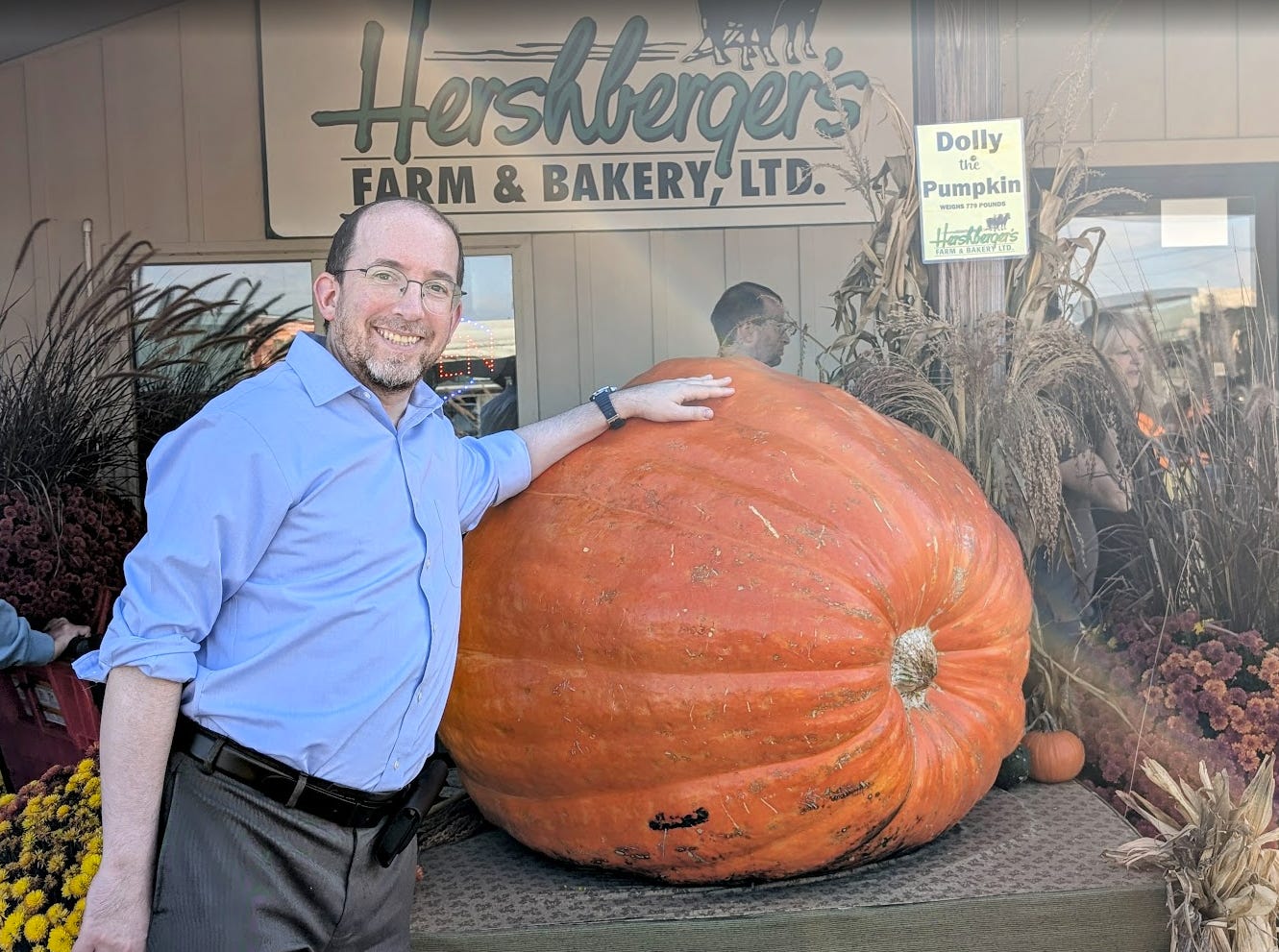
Last week, I was in rural Ohio, visiting America’s last remaining Noah’s Ark workshop. One of the artists mentioned that they get their wood from nearby Amish country. Having never encountered the Amish, I leapt at the opportunity to visit. I ended up being surprised, and not just because I saw a pumpkin that weighed nearly eight hundred pounds.
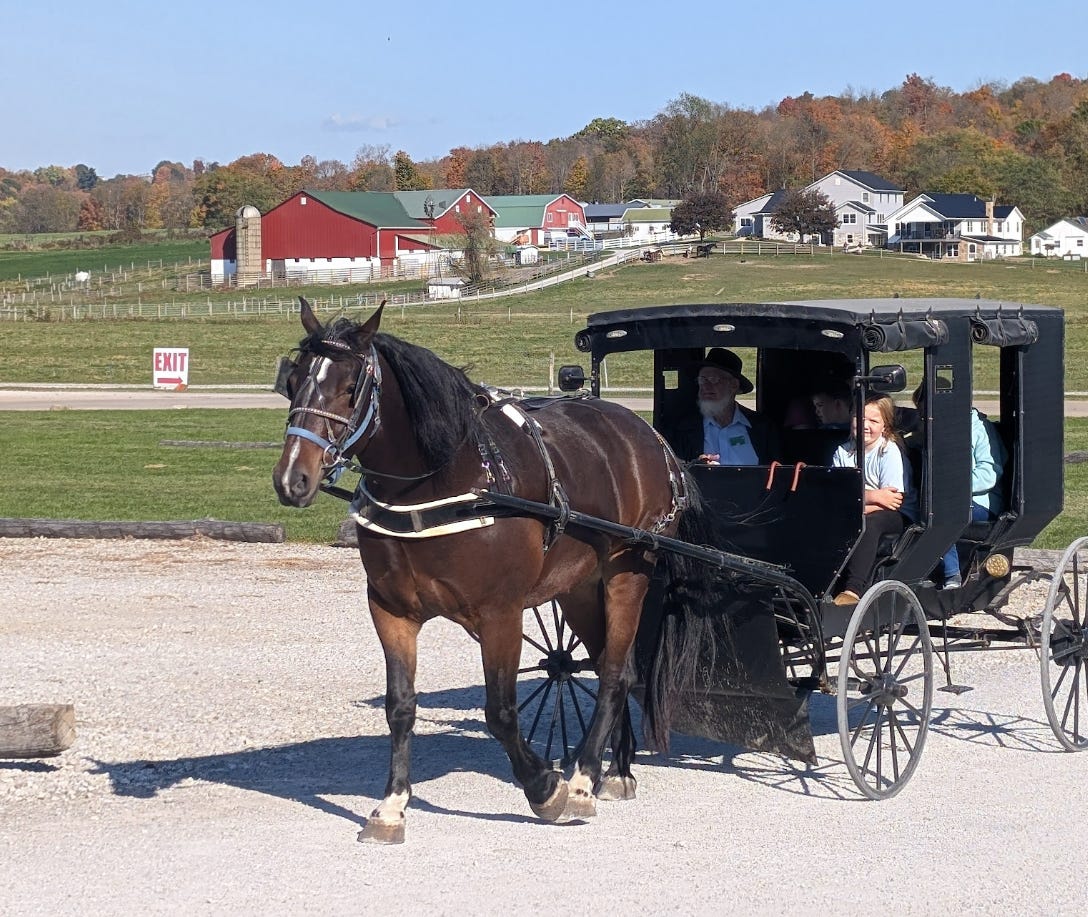
Yes, there was a huge emphasis on agriculture. Yes, the women wore bonnets. Yes, the one man that I saw, pictured at the top of the post, had a beard and no moustache, and was in a horse and buggy. Yes, the stores sold books with titles like Happily Ever Amish, B Is For Bonnet, and Once Upon A Buggy (though these books are actually published for a non-Amish readership). Yes, there were no movie theaters. And doubtless if I would have spent more time, or gone deeper into Amish country away from the tourist sections, or seen different types of communities, I would have seen more culturally unique aspects.

Still, overall it seemed pretty clear that many of the Amish have undergone considerable modernization. The wood that they are churning out for the Noah’s Ark workshop was clearly produced with the aid of electric machinery, although this may well have been running off a diesel engine rather than the electrical grid. Some of the authentic locally-produced Amish crafts on sale were 3-D printed using a wood-based filament!
I also saw a car which bore the license plate “Mohel 1.” The owner turned out to be a frum Jew who makes most of his living from performing brissim for the Amish - around a thousand annually! But they don’t do it for religious purposes, and the only reason that they use a Jewish mohel is that he does home visits.

It’s a good business, especially because the Amish have a very high birthrate. They also a very high retention rate. The Amish population is exploding, but a difference from ultra-Orthodox Jews is that they spread out far and wide in the country rather than building up enormous concentrations in a few urban areas.
And then there is of course the single biggest difference between the American Amish and Israeli charedim. I was wondering why I had only seen one horse-and-buggy, and one Amish man who was driving it for tourists. I asked someone, and the answer was that I had visited during the day, when the men were all out at work.
Now, Amish society is far from self-sufficient. Nobody is allowed to become a doctor or dentist or any kind of professional like that; unlike with charedi society, in which people also cannot become doctors, you can’t even have a baal teshuvah Amish doctor, becuase they would have to give up their profession.
Still, comparing it to Israeli charedi society, Amish society is leagues ahead in terms of its ability to grow and survive. And the reason is very simple: they are economically self-sufficient. They are not dependent on enormous government hand-outs, which in turn eventually leads them to be an enormous and potentially lethal economic burden.
The Amish church actually forbids its members from accepting government welfare! It views such things as expressing a lack of faith in God, but also as a failure of responsibility by the community to be self-sufficient. Of course, Chazal and the Rishonim also strongly upheld the importance of economic self-sufficiency, but modern charedim have somehow managed to do away with all that. Can you imagine how different Israeli society would be if they went back to traditional values?
Meanwhile, when I was ready to leave the area, I asked an Amish woman where I could go to find a certain store. She pulled out a smartphone, looked uncertainly at my large kippah, and asked, “Do you know how to use Google Maps?”
(Thanks to Debbie Grashin of Alaska/ Columbus for driving me for a day of arks, Amish, and angry animals that will appear on the Biblical Museum of Natural History’s social media pages.)
https://youtu.be/pEAXGY_HFU0?si=MIvHeI9zYnHPOHrR