


After a hitch in my plans last week due to a flight connection problem, I received a last-minute invitation to be scholar-in-residence at the Center for Jewish Living at Cornell University. As a British-Israeli, I didn’t know anything at all about Cornell, but they were offering to pay close to my usual honorarium, and I figured that since it is in New York, it would be a convenient short journey from where I am staying in Lawrence. How big can New York be? And even if it’s a little far, there’s planes and trains everywhere!
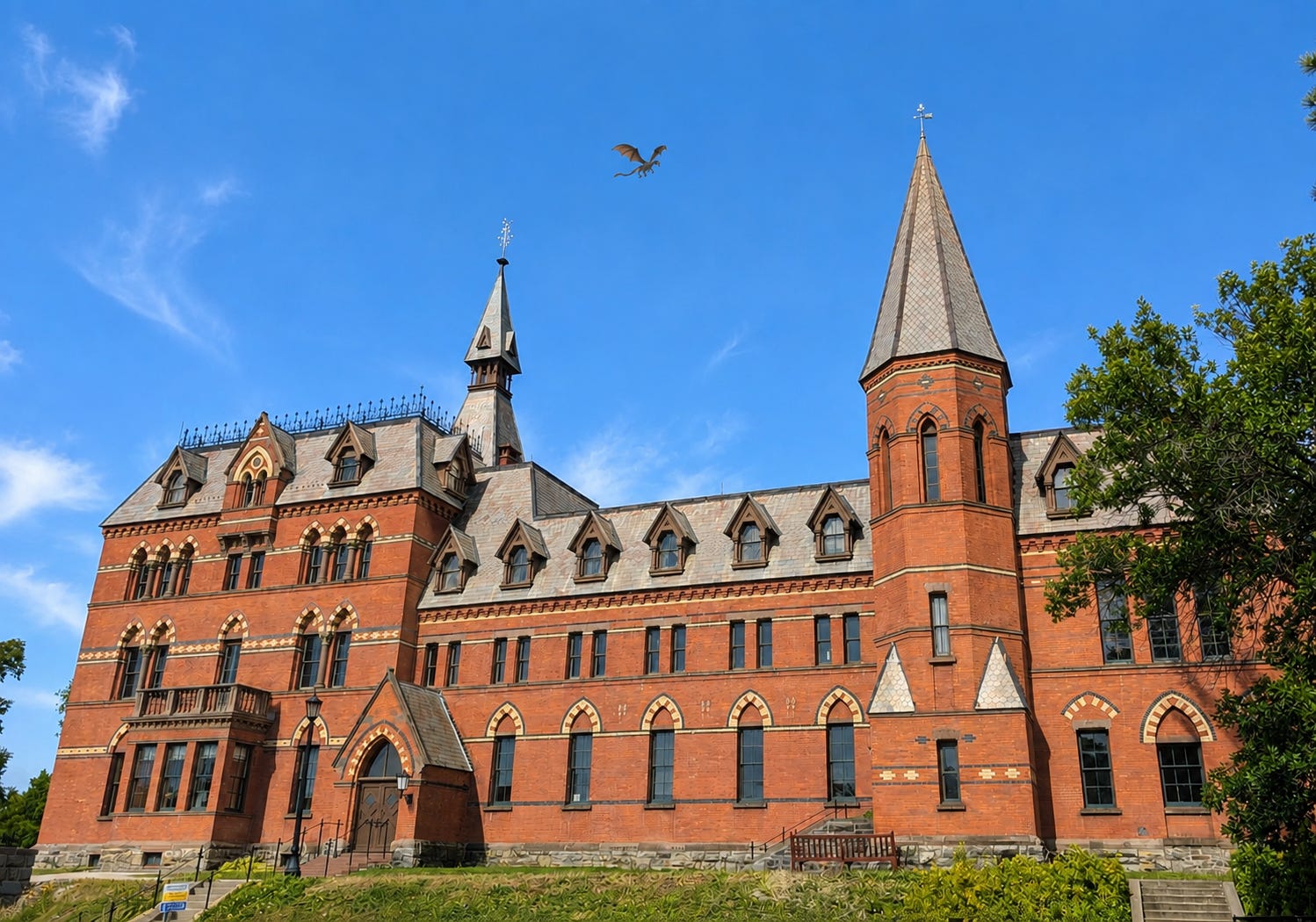
Following a one-hour train ride and five-hour bus ride (which was admittedly extremely comfortable, with spacious seats, wifi, and a no-talking rule), I arrived at the Cornell campus. I was staggered by its extraordinary beauty, and indeed a Google search revealed that Cornell is considered to be one of the most beautiful college campuses in America.

The campus is bordered by a lake system featuring waterfalls and osprey nests. The buildings are magnificent, straight out of Hogwarts, with a clock-tower and ringing bells. I noticed a street name that was in Welsh!
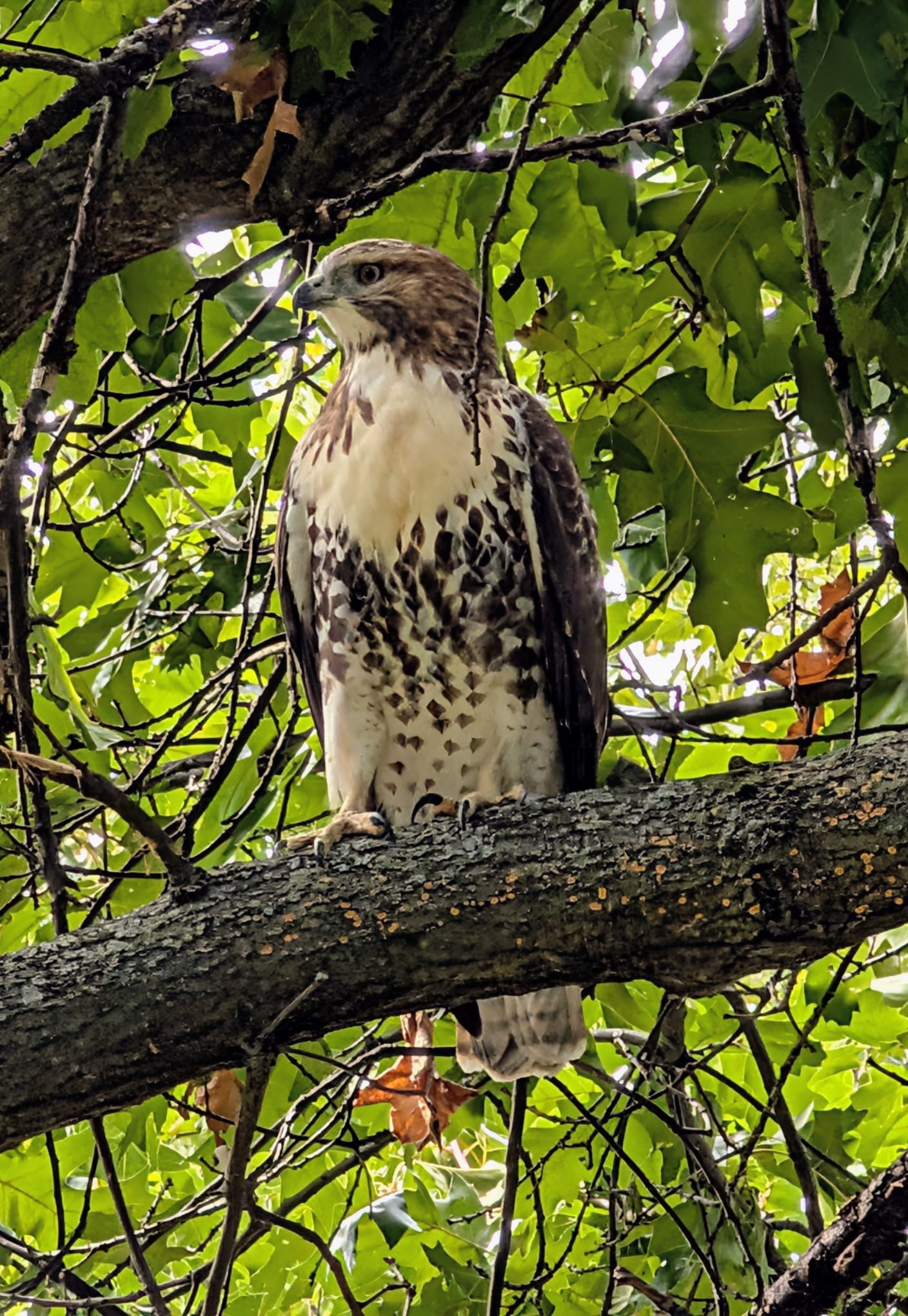
The grounds are spacious, with enormous spruces, elms, and maples. I saw an awe-inspiring oak that I later discovered is four hundred years old. A marmot (not to be confused with Marmite) scampered into the bushes, and a red-tailed hawk flew past me and conveniently perched in a nearby tree so that I could take this photo:
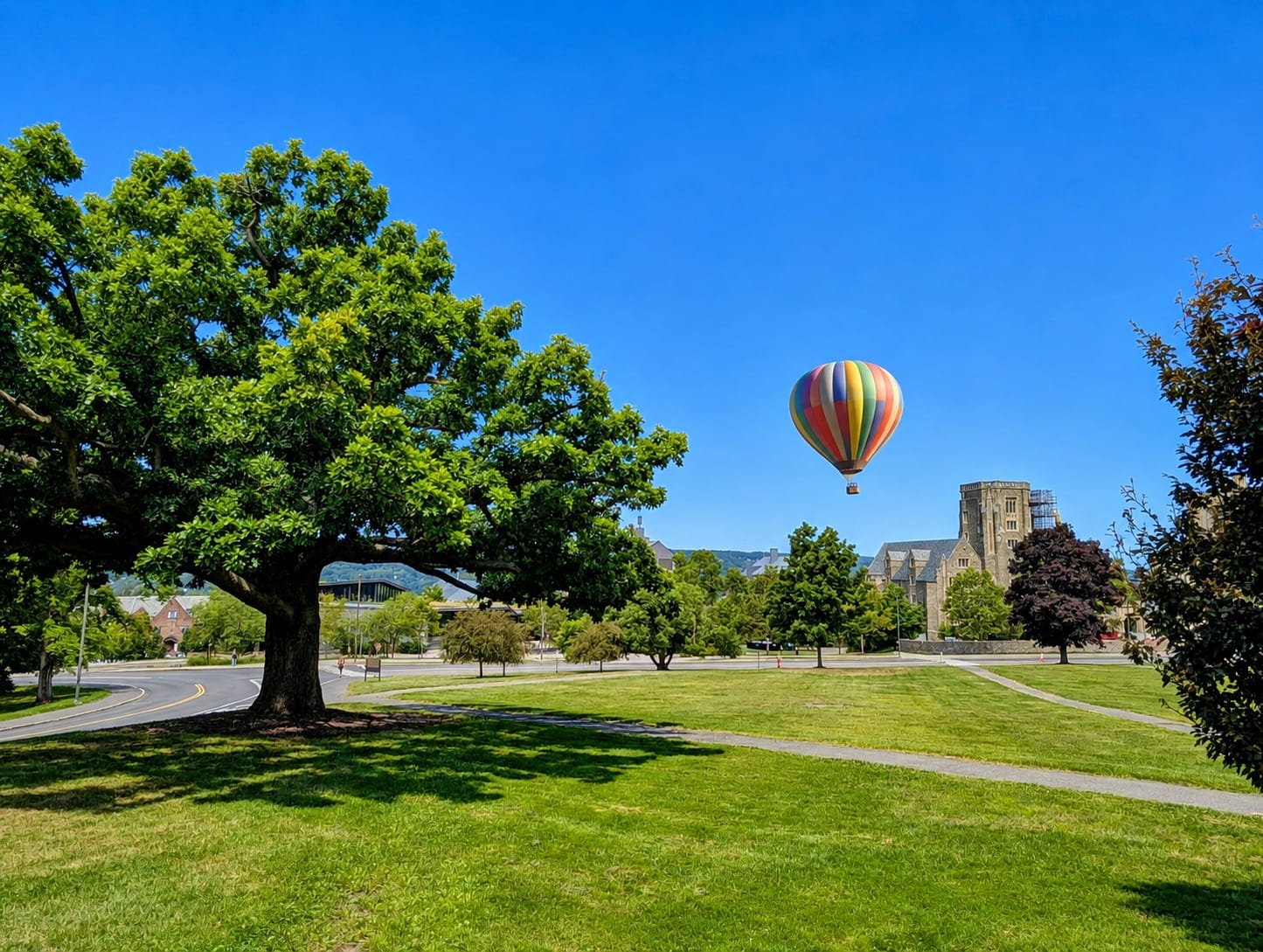
On Shabbat afternoon, I went for a walk. I looked out at the rolling lawns, the buildings and trees, and I thought to myself, “Wow, this scene could not be any more beautiful!” I was proved wrong exactly one minute later, when a colorful hot-air balloon drifted past, so low that I could hear the burner firing.
Having heard so much about antisemitism on college campuses in America, I was a little nervous. Just a few days earlier, I had had dinner with a professor at UCLA, who told me that for many months after October 7 she was warned that it was not safe for her to walk across campus. I came to Cornell wearing the traditional Orthodox camouflage/ dead giveaway of a baseball cap. But my fears were entirely unfounded; Jews at Cornell have no problems whatsoever.
The Center for Jewish Living is itself unique. Entirely student-run, it features a synagogue, Beit Midrash, and residence based in a beautiful 1890’s building, resplendent with hardwood floors, oak paneling, and stained glass windows. The meals were attended by Jews from across the religious spectrum, with a smattering of non-Jews joining for the experience - which can only be Good For The Jews.
The CJL also has a remarkable library of old books on Judaism and Israel. I picked up one that was called “Israel Revisited,” written in 1950 by Ralph McGill, a Pulitzer-prize-winning anti-segregationist journalist from Georgia. It was a remarkable record of life in a state that was less than two years old, and the author spent several pages stressing how utterly necessary and appropriate it was for the Jewish State to come into existence.
But what I found particularly interesting was the Foreword by Billy Rose, who explained why this journalist from Georgia was suited to write such an incisive and insightful commentary on such a complicated topic. His first reason was that McGill is an Irishman, “which means that while he has a lively sense of justice in general, he has no axe to grind about Israel in particular.” If you’ve been following any of the news from Ireland’s attitude to Israel lately, can you imagine anyone writing this about an Irish journalist today?!
An oak tree might live unchanged for four hundred years, but society does not. And while Cornell might be fortunate in not suffering from antisemitism or Israelopathy, the attitude of the West in general, including America, towards Israel is going to be increasingly hostile over the next few decades. Accordingly, I spoke to the students about the topic of my book The Lions of Zion, explaining how Biblical natural history and a proper understanding of wildlife in Israel helps refute so many anti-Israel attacks.
Following my presentations to the students, I told them how much I had enjoyed visiting the charming campus. I mentioned my delight on seeing a street on the campus that had a Welsh name.
I got blank looks in return.
I said that I didn’t remember the name exactly, but it was definitely Welsh because it began with two “L”s, like so many Welsh towns - Llandudno, Llangollen, and of course Llanfairpwllgwyngyllgogerychwyrndrobwllllantysiliogogogoch.
Blank looks.
Then one student said, “Oh! Do you mean Llenroc Road?”
“Yes! That’s it!” I said.
He smiled, and said: “That’s ‘Cornell’ backwards.”
Charming essay--so nice to read something positive involving Jews, Israel, and our Jewish young people. Glad you had a good time.
As a resident of western New York State, I'm relieved that you enjoyed your Cornell experience, and that you found the environment unthreatening as a Jew. Unfortunately, as they may have told you, things have not always been so pleasant lately. There was an ugly incident soon after October 7, 2023, where a student was arrested and charged for posting a series of antisemitic online threats against Cornell's Jewish community, and specifically, the Center for Jewish Living. More recently, the university set up an antisemitism "task force" and has taken disciplinary actions against some pro-Palestinian students. Cornell is indeed a beautiful and special place, and I hope things can remain safe and under control there.