


I want to take a break from war to talk about something a little lighter and timely for Pesach: the Ten Plagues.
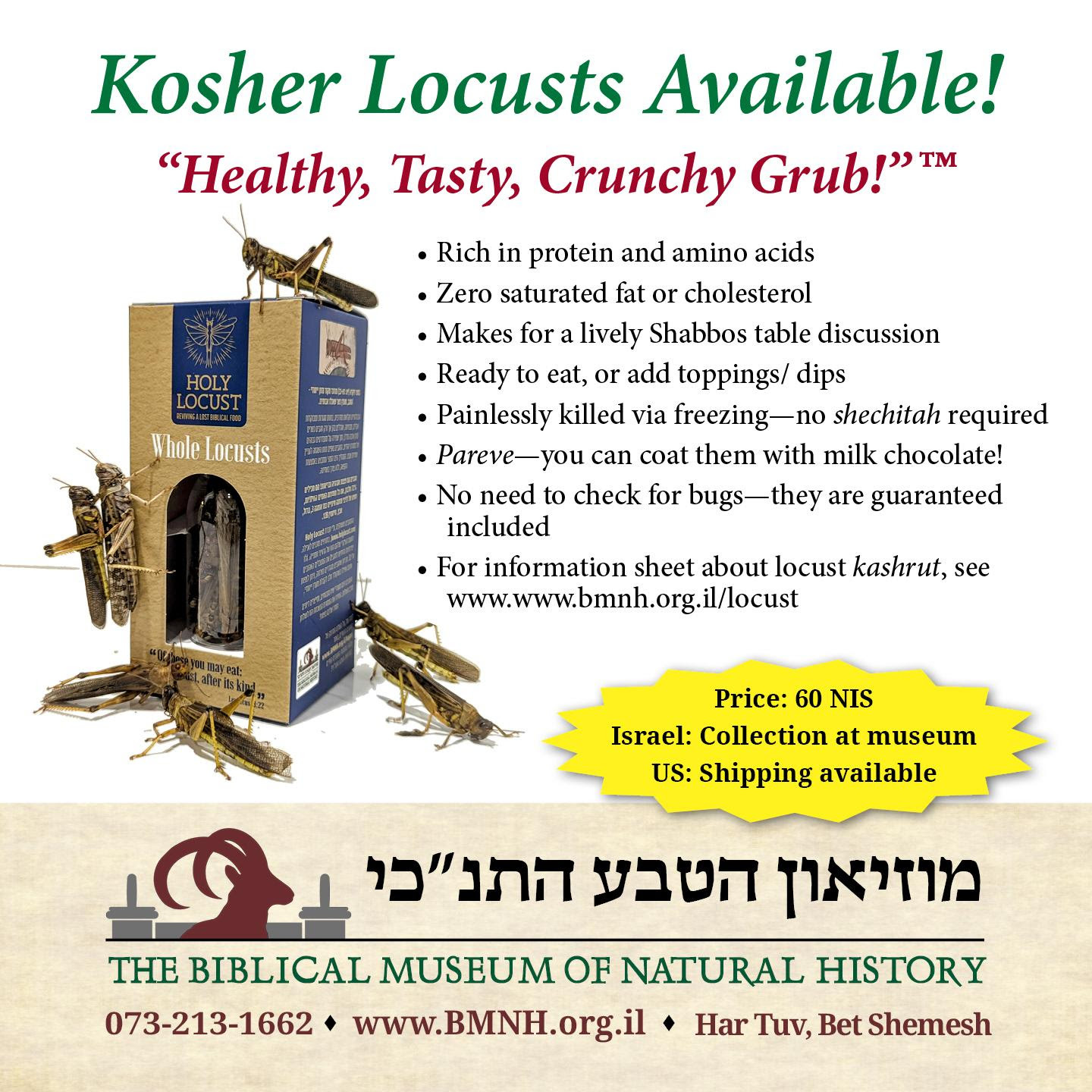
First, please note that once again the Biblical Museum of Natural History is selling kosher locusts to liven up your Seder table! In Israel, they can be collected from the museum (and we might arrange collection points elsewhere due to the travel challenges caused by the war). In the US, you can order them online; DHL is due to get them to our US distribution office in time for them to get to you by Pesach, but please note that this cannot be guaranteed. While you’re ordering your locusts, note that you can also order my books at a discount.
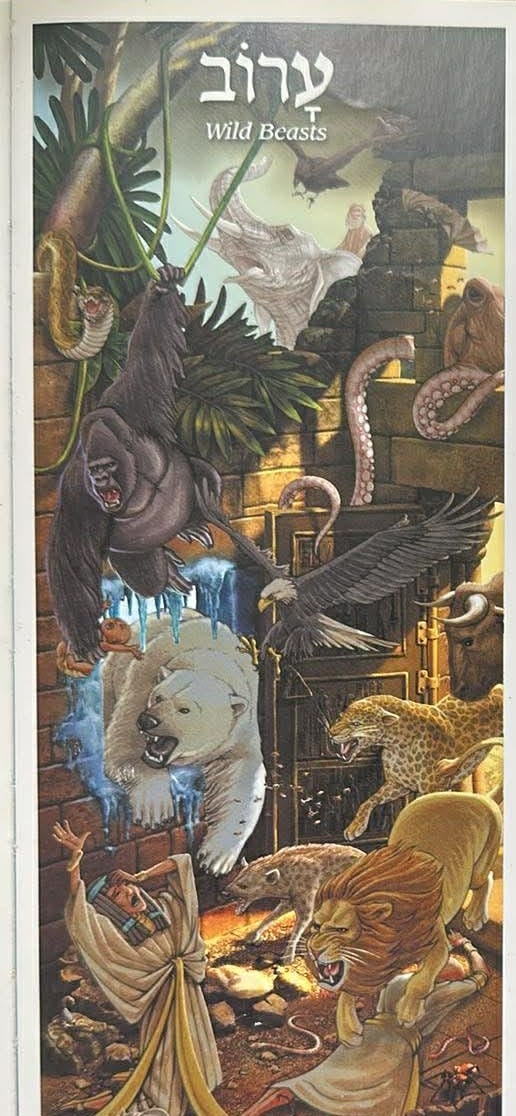
Now let’s turn to the fourth plague, arov. “Everyone knows” that this plague was wild animals. If you’re more into supernatural extremes, it was polar bears arriving on ice from the North Pole, along with giant octopuses coming out of the ocean and using their tentacles to unlock the Egyptian homes from the inside (as presented in one illustrated haggadah below, based on the Gra and various midrashic lore). If you’re more into naturalistic miracles, it was the wild animals of Egypt - lions and leopards and hyenas (not tigers or bears, which did not live in Egypt).
Except that there is very good reason to believe that it wasn’t any of these. And I’ve come up with a new idea about what it may well have been.
The word used in the Torah, arov, simply means “mixture” or “swarm.” The Sages disputed whether this was a swarm of wild beasts, or of birds and flying insects, or of both:
“I will let loose swarms against you” (Ex. 8:17). From where did they come? Some say, from above (i.e. birds and flying insects), some say from below (i.e. animals), and R. Akiva says from above and below. (Midrash Shemot Rabba 11:2)
Another view is that it was a mixture of specific types of insects alone:
R. Nechemiah says, They were types of wasps and mosquitoes. (Midrash Shemot Rabba 11:2)
The notion of a plague of birds or insects is far less exciting than a plague with wild animals, and these views became largely forgotten. It became popularly accepted that the plague involved wild animals. While one view is that it was only wolves (see my book The Torah Encyclopedia of the Animal Kingdom), others are of the view that it was a mixture of different animals:
“R. Shimon b. Lakish said: The Holy One said [to the Egyptians], You massed yourselves against My children, I shall also mass the birds of the skies and the beasts of the land against you, as it says, “I will let loose a mixture against you” – beasts and birds mixed together. (Midrash Shemot Rabba 11:2)”
But if there’s one thing that’s clear from all these differing views of Chazal, it’s that there is no clear mesorah as to what the plague actually was. This is why different Sages came up with different ideas. And, as per their usual style, the purpose of their explanations was to present ideas about divine justice, quid pro quo in action, rather than focus on pshat.
I’d like to present my own idea, based on what seems to me to be the most reasonable pshat explanation, and on thinking about what people so often fail to think about - what the text doesn’t say.