


For much of history, people in Europe were very confused about why so many birds disappeared in winter. It was widely believed that swallows and other small birds plunged into the mud at the bottom of ponds to go into hibernation. Aristotle and subsequent scholars believed that birds hid in tree hollows or cliffs, with some even claiming they stopped breathing during this period. Some others believed that birds transformed into different species in winter.
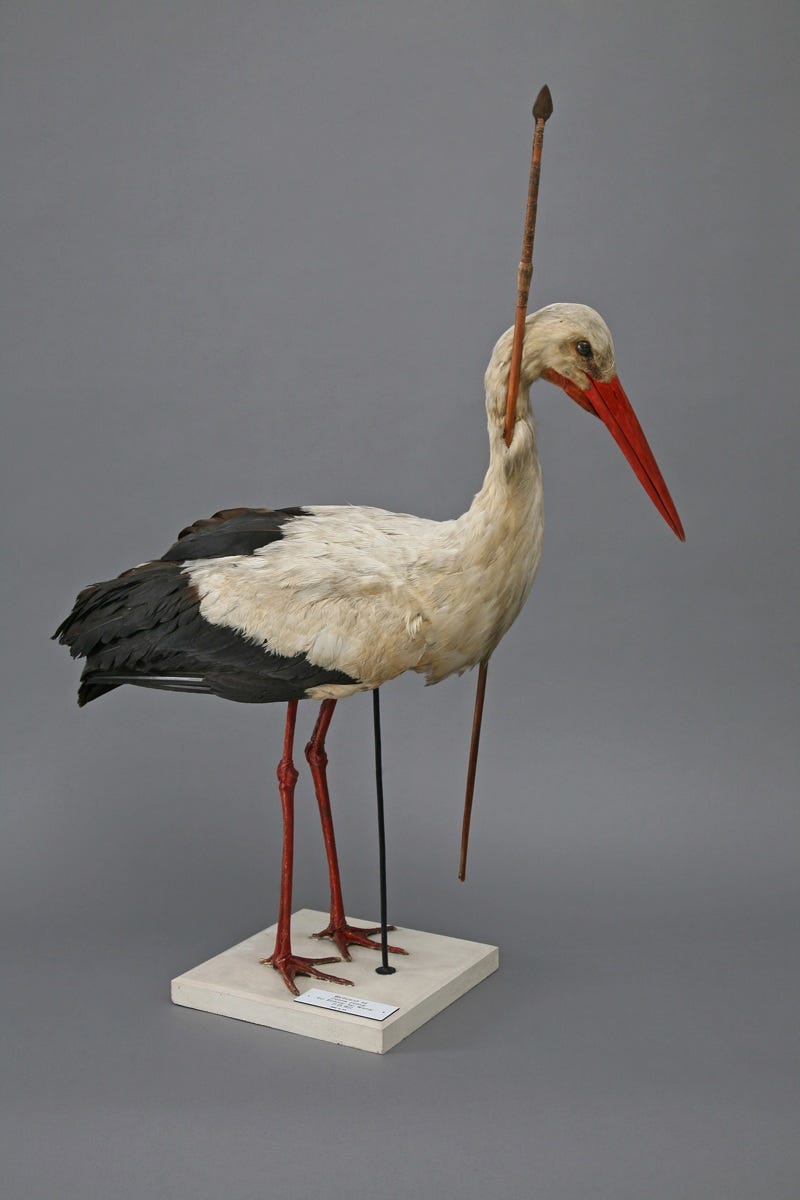
In the 17th century, Charles Morton hypothesized that the birds were leaving every year and traveling somewhere. His specific theory was that they were spending winter on the moon. Confirmation of the travel hypothesis, albeit with a different destination, came in 1822. A stork was found in Germany with an African spear through its neck - which hadn’t stopped it from flying to Germany! It was shot, stuffed and sent to a museum, where it can still be seen today.
But thousands of years earlier in Tanach, people knew that birds were traveling every year (which might be because Eretz Yisrael was the place of a twice-annually migration route, rather than the home for birds for half the year). Possibly the earliest reference in recorded history to bird migration was made by the prophet Jeremiah. This was when he contrasts the reliability of birds with the disloyalty of the Jewish people that led to the destruction of the First Temple and Jerusalem:
“The stork in the heavens also knows her appointed time, and the turtledove and the swift and the crane have observed the time of their arrival...” (Jeremiah 8:7)
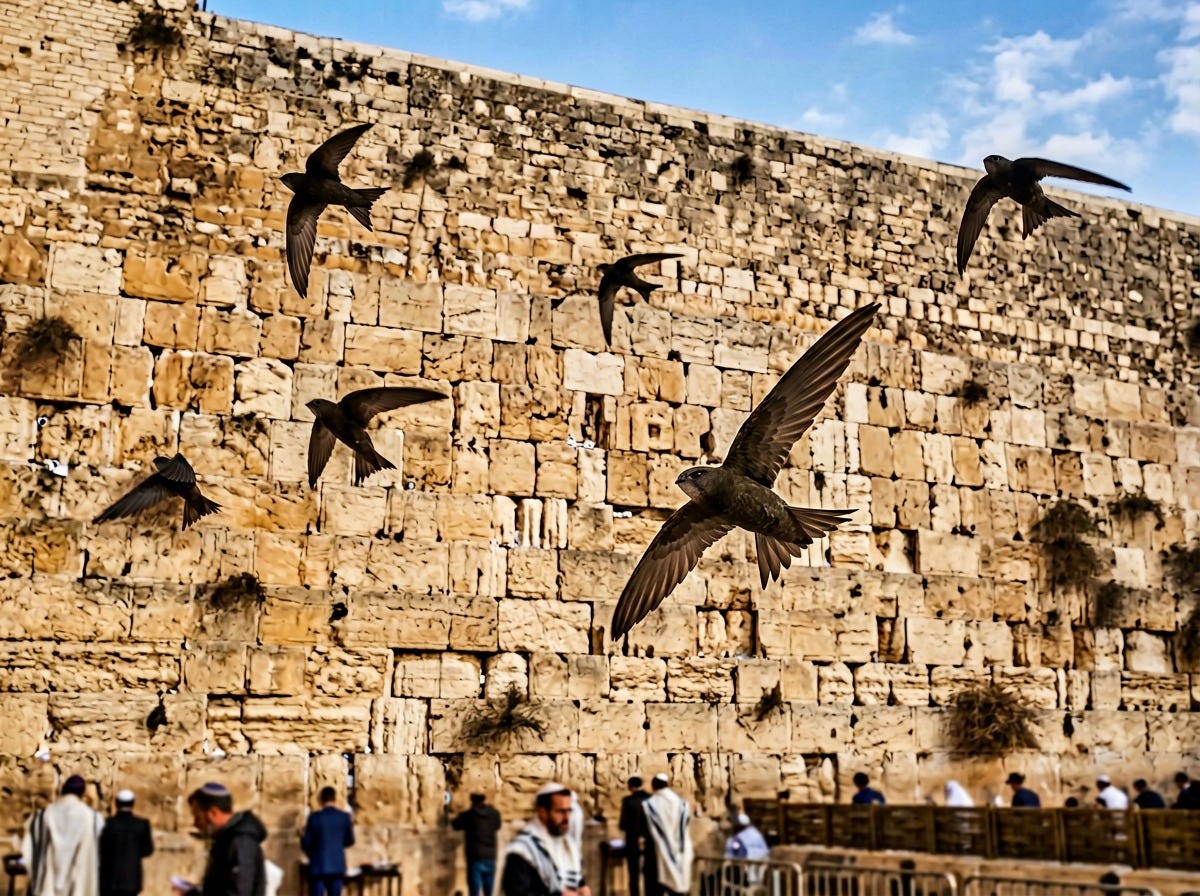
One bird mentioned by Jeremiah in this verse is the swift—a fast-flying bird similar to a swallow, with long narrow wings and a forked tail. Their speed and agility in the air as they catch insects is astonishing. And they never stop flying, even to sleep, other than to nest.
In Israel, the annual swift migration is prominently visible at the Western Wall in Jerusalem, where there are about eighty nests in the upper section of the wall. A chick ready to leave the nest drops itself from a height, gathers momentum, and takes flight. The nest accordingly needs to be high up, making the great Western Wall an ideal location. Another advantage is the large number of worshipers, who create a rising current of hot air that helps the swifts fly.
I find all this absolutely extraordinary. Jeremiah mentioned this in Biblical times. And here we are, descendants of Jeremiah’s people, in the very same land, seeing the descendants of Jeremiah’s swifts in the same migration!
A few years ago, the Rabbi of the Western Wall and the Mayor of Jerusalem, along with the Society for the Protection of Nature and representatives of youth movements, initiated a ceremony to welcome the birds. Their annual return to Jerusalem, observed by the descendants of Jeremiah nearly three thousand years after he referenced it in the context of the fall of Jerusalem, is celebrated as a reminder of the yearning that Jews felt over the millennia to return to Jerusalem and rebuild it. It is a dream that, miraculously, finally came true.

(Adapted from my new book, The Lions of Zion: Biblical Natural History and the Significance of Israel, which you can purchase from Amazon but preferably and more cheaply from the museum website.)

Perhaps this is an example of one of the “minor of tragedies performed for the sake of a museum.”
A stork survives an arrow in its neck, then flies from Africa to Europe and then, after all that, someone shoots it so they can put it into a museum and say, “isn’t this amazing?!?!”
These days someone would just make a video of the bird flying, upload it, and then be accused of using AI.
But cruelty to a stork it doesn’t hold a candle to the reason the man from Capistrano was honored. I never understood the concept of “warrior Franciscans.”
https://i.pinimg.com/originals/11/17/33/111733081ec60ddcbf149fab01669a9b.jpg
The swallows return to mission San Juan Capistrano in March,where the Catholics celebrate one of their saints.
The swifts in Jerusalem as other migrating birds are built with the cytochrome 4 protein that reacts to the magnetic field in receptors that guide the
migration process.Their electrons in their eyes sense the required process of where they are headed,like a computer programmed drone.
Monarch butterflies enroute to North America from Mexico also have guidance systems to propel the journey.They need to generations for the spring trip north,but on return,the butterflies have a hormone that stimulates a survival of eight times of the previous generation in order to get to Mexico and live to migrate again in the next spring.
The real miracle is that 99.9% of all life that ever existed is today extinct.The idea of squaring the circle to belief in an already accepted biological evolution.of either the punctuated equilibrium,very rapid,then millions of years of dormancy as Stephen Jay Gould requires,or neo Darwinism,combination of Mendel and Darwin of a very slow gradual entire process of change as Erwin Mayr required is contradictory,especially with the catastrophic destruction many times including the last 15,000 years as well as the Toba volcanic destruction which left only a thousand living humans.
Gould was puzzled by the scant fossil record and the advanced Cambrian fossils.Mayr also was not satisfied with his belief.