


How do you represent different types of Jews in Israel? I saw a fascinating illustration, but first an introduction is required.
The Kiddush Times is a wonderful new weekly publication. It’s printed in English and distributed to about 400 Anglo communities in Israel, and available online for others. The magazine represents the more open side of the Dati-Leumi spectrum (which is still very different from Modern Orthodoxy in the United States). It features articles by such figures as Rav David Stav, Rav Tamir Granot, Rav Yaakov Meidan, and Rav Sacks ztz”l, along with female Torah educators such as Rabbanit Michal Tikochinsky, and an eclectic range of columns including political commentary by Ben Shapiro, insights into the Arab world by Dr. Mordechai Kedar, a dating column, perspectives on aliyah, a monthly column by yours truly, and more.
Anyway, this past week’s issue discussed a topic that was prominent in parashat Bamidbar. It’s something in the Torah that is remarkably shocking and unthinkable for the community which calls itself “the Torah community”: that the entire nation is counted for military service (except for the Levites, who were not included in the fighting for the conquest of the land, but were certainly involved in other ways and fought in wars of survival). The magazine included a fascinating essay by Rav Stav, but it’s the cover art that I want to discuss. I don’t know to what extent it was AI-generated, but it’s fascinating!
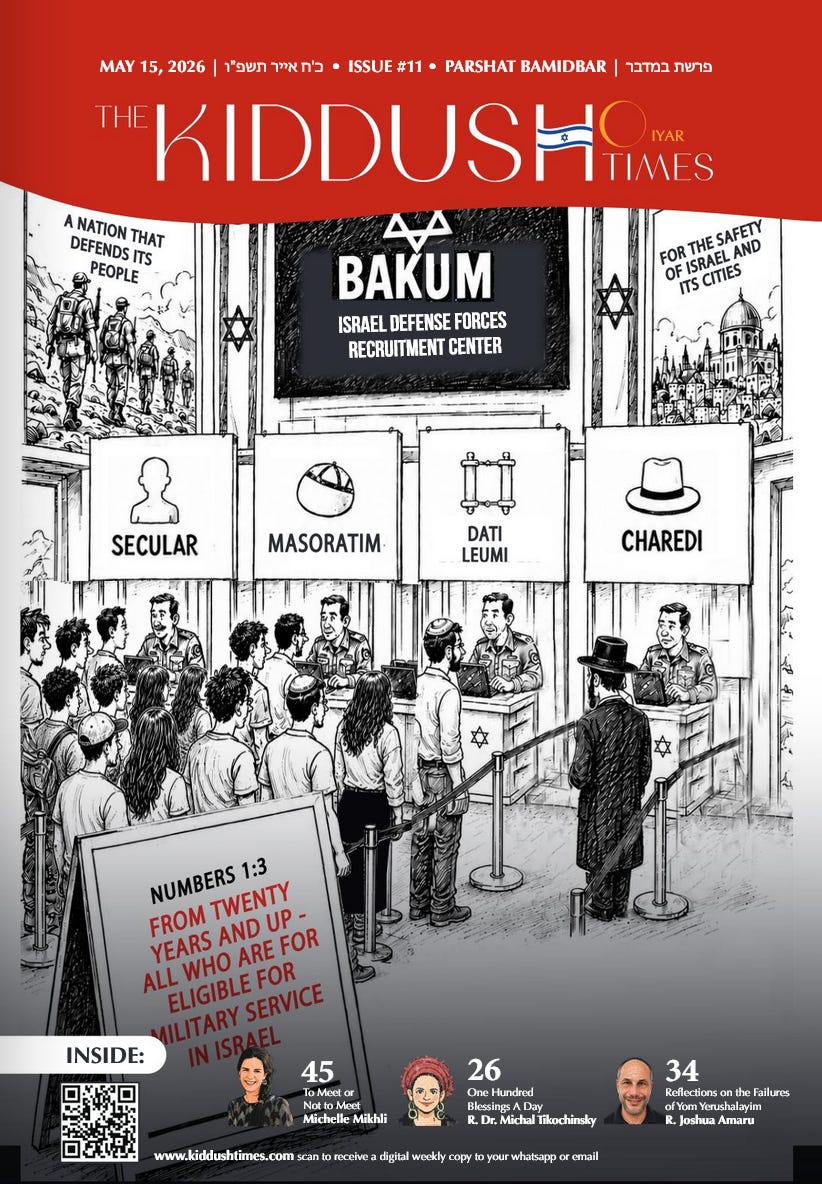
The picture portrays four lines at the “BaKuM,” which stands for Basis Klita u’Miyun, the IDF military base where new recruits are processed. Sadly, but reflecting reality, the charedi line has only one person it. But let’s focus on the graphics used to symbolize the four streams of Israeli society.
We’ll start with “Secular,” represented by the blank outline of a person. I presume that this meant that secular people are the “basic level” of person without additional identity. But I’m not thrilled about this, because this image is not about random people, it’s about Zionist Israelis who are enlisting in the IDF. So I would have liked to see something which illustrates that - perhaps a Star of David.
Then we get to “Masoratim” - traditional Jews. The image is of a person wearing a kippah. This is interesting, because such Jews often do not wear a kippah, as indeed you see with the people standing in line! Still, I think it’s effective, because it conveys the idea that the person has a strong connection to religious identity, which is true of mesoratim.
Then we get to Dati-Leumi (national-religious) and charedi. And here’s where it gets really interesting.