


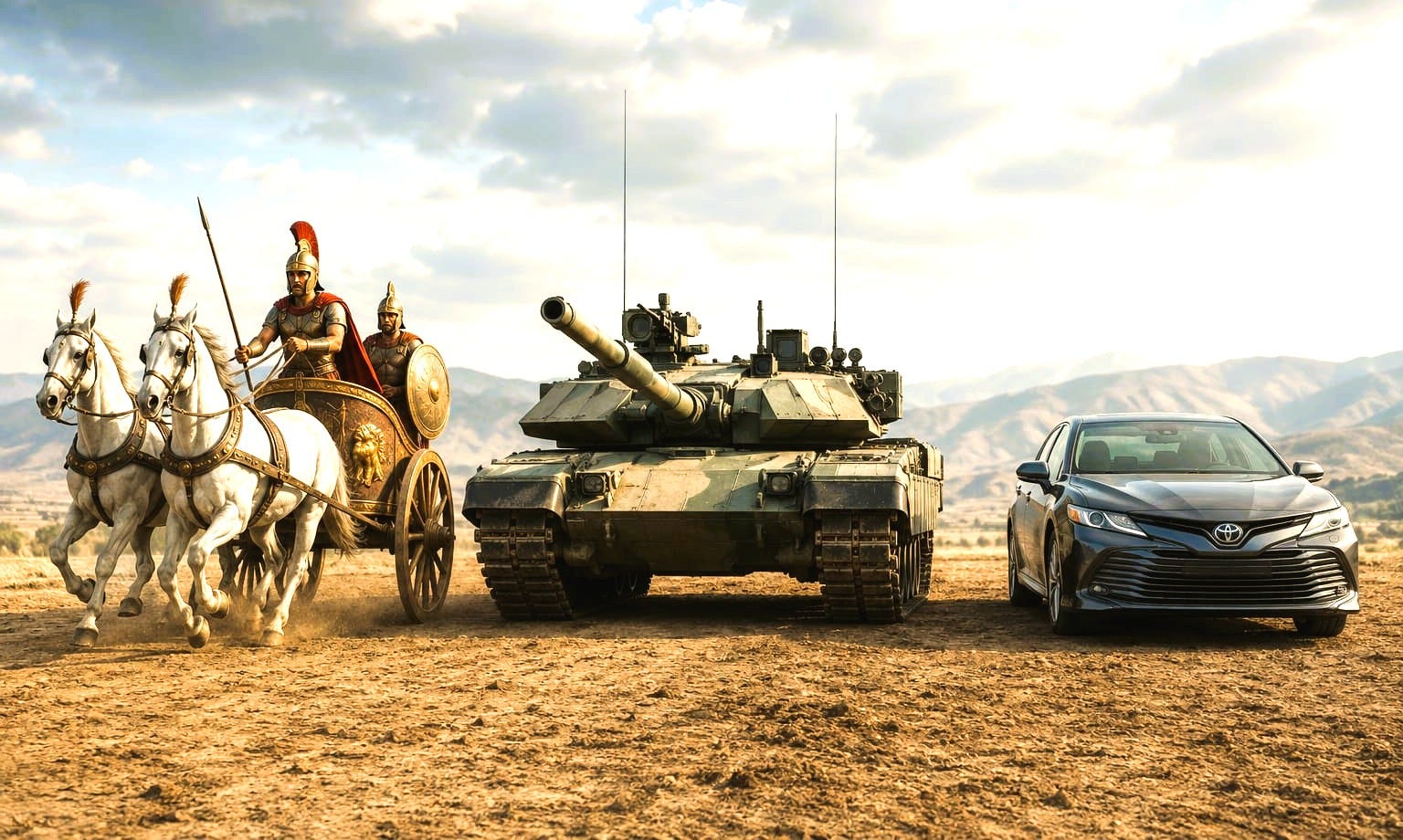
Eileh va-rechev, v’eileh va-sussim, v’anachnu beShem Hashem Elokeinu nazkir!
“These [rely on] chariots, and these on horses, but we call in the Name of the Lord our God!” (Tehillim 20:8)
This verse is endlessly invoked by charedim to (attempt to) justify why their Torah study and prayer is more valuable to Israel’s security than fighting with guns and tanks and planes. “In antiquity our enemies relied on chariots (rechavim), today the Zionists rely on tanks (merkavim), but we know that such physical efforts are meaningless - our weapon is Torah!”
Of course, the verse itself is saying no such thing; throughout Tanach, Jews fought as soldiers, and there is no mention of learning Torah as any kind of substitute. While the Torah warns against amassing horses due to their origins in Egypt and the subsequent risk that it would lead people back there, King David nevertheless had a small cavalry numbering a hundred strong, and King Solomon massively expanded it to 1,400 chariots and 12,000 horses that were strategically positioned around the land. The aforementioned verse in Tehillim is simply saying that we do not rely on the size of our forces, and we are not intimidated by a larger force on the other side, because God can help us overcome the odds. But learning or praying never replaces worldly effort, contrary to the charedi claim.
Battle-horses are also mentioned in Mishlei: “The horse is prepared for the day of battle; but victory comes from God” (Proverbs 21:31). As I discussed in my post “Prepare Your Horses,” Rabbeinu Bechaye explains this verse to mean that “everybody must do whatever is in his power by using natural means to achieve his success, and leave whatever is beyond that in the Hands of Heaven. A miracle occurs only when all natural means have proven to be inadequate to produce the desired result. Man was created to exist in the framework of the laws of nature, and therefore he needs to do whatever actions and arrangements are ordinarily required to achieve his desired aims. This is just as if a person wants to go to war against his enemies, he should equip himself with weapons and horses and chariots for the day of war, for if he does not do so, he will be delivered into the hands of his enemies.” Thus, the charedi idea that learning Torah replaces horses and chariots has no basis in traditional Judaism.
Yet what I find most fascinating is not the warped theology, but rather the hypocrisy.
Tomorrow, the charedim are planning the next stage of their war against the legal requirement for them to enlist. And this time, they’re using rechavim, which in Modern Hebrew refers to the modern equivalent of chariots: cars.

Their plan is to drive a thousand cars from 19 different cities around Israel towards one of the prisons where a charedi draft-dodger is being held. And they will drive them very slowly, so as to cause maximum disruption to the rest of Israel.
Leaving the Beis HaMidrash, fighting in the streets, using massive forces of vehicles - they might as well just enlist, they’re nine-tenths of the way there already.