


This past Shabbat, my wife and were in Akko (Acre), staying on the campus of the yeshivah while we joined our second daughter for a Shabbaton with her Midrasha (seminary). The Akko yeshiva is a hesder yeshiva, and I was once again struck at the profound contrast between the charedi yeshivos that I attended for many years, and dati-leumi hesder yeshivot. Two things in particular stood out to me.
One was a sefer that was on the desk of many students. It was a question/ answer sefer by a leading dati-leumi rosh yeshiva on a broad array of questions. These were not questions about unusual halachic situations, but rather questions about fundamental aspects of Jewish identity as it relates to modern life. The answers reflected deep thoughtfulness rather than being knee-jerk responses, but I was struck by the questions themselves; so many were not questions that any charedi rosh yeshivah would remotely ever address or even have the ability to do so.
One question was asking whether there is anything for dati-leumi Jews to learn from other types of Jews - whether charedi or secular. Again, in the charedi yeshivos I attended it would have been unthinkable to even ask if one can learn from other types of Jews, because the constant message was that one stays away from other types of Jews as much as possible. But the answer in this work was that one can learn good things from anyone. It pointed out that Chazal say that there are even things to be learned from animals - kal v’chomer from people!
This did come with an interesting caveat, though. It said that in contrast to learning from secular Jews, one must be careful about learning from charedim. Because nobody will ever think that secular Jews are presenting a complete role model of what Jewish life should be. Whereas charedim, on the other hand, purport to be representing Torah, and yet actually represent a warped approach to Torah which totally neglects our responsibilities to society.
And this brings me to the second thing that struck me, which I went back after Shabbat ended to photograph: the Aron HaKodesh. Here it is:
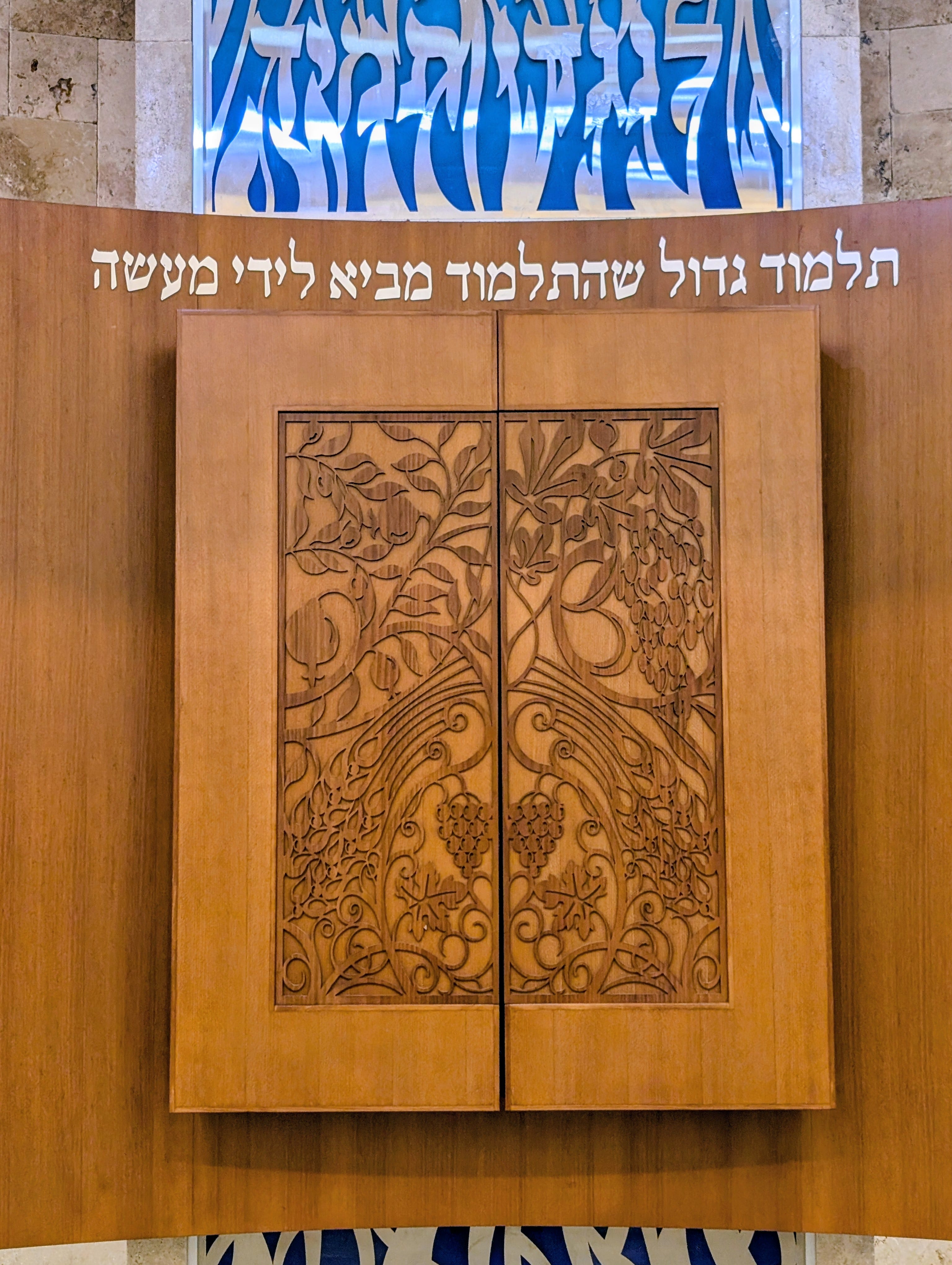
Above the exquisitely carved relief of the Seven Species is a phrase about the importance of Torah study, as befitting a yeshiva. Now, in all the charedi yeshivos that I attended, the message was absolutely clear: Learning Torah is by far the most important thing in the universe, but specifically as an end unto itself. This is as per the radical interpretation of “Torah liShmah” innovated by Rav Chaim of Volozin.
Yet on this Aron HaKodesh, the phrase about the importance of Torah study is “Study is greater, because study brings one to practice.” This is a citation from a story in the Gemara:
“Rabbi Tarfon and the Elders were already gathered in the upper chamber of Nitza’s house in Lod, when the following question was raised before them: What is greater, study or practice? Rabbi Tarfon answered, saying: Practice is greater. Rabbi Akiva answered, saying: Study is greater. All of them answered, saying: Study is greater, because study leads to practice.” (Kiddushin 40b )
The Talmud’s conclusion is not merely that study is greater; it is that study is greater because it leads to practice. But if study is greater because it leads to practice, then this effectively means that practice is more important! Many authorities thus explain this to mean that study is “greater” only in the sense that it takes precedence; you have to study the Torah in order to know how to practice it.
This is reflected in many other statements by Chazal and the Rishonim. For example, Chazal say that “It is not the study that is the main point, but rather the practice” (Pirkei Avot 1:17). And this in turn is explained by Rabbeinu Bechaye as follows:
“That is to say, the goal of a person’s knowledge and toil in Torah is not that he should study much Torah. The goal is nothing other than that it should bring him to practice. And that is what is written, “And you should study them and guard them to fulfill them”—it comes to teach that the purpose of study is for nothing other than practice.”
We see that the importance of studying Torah is due to it teaching us how to apply the Torah (and, I would add, motivating us to do so), which is the ultimate goal. It’s so radically different from what is taught in charedi yeshivos. But it’s the clear message of Chazal and the Rishonim. And this is what is taught, and implemented, in the eighty or so dati-leumi hesder yeshivot, along with the small number of charedi hesder yeshivot. They learn Torah, and then they live Torah.

(For further discussion, see my book Rationalism vs. Mysticism. Incidentally, with regard to my books, I decided with a heavy heart to have them put them on Amazon. It’s frustrating, because all the revenues from my books go to the Biblical Museum of Natural History, and Amazon takes so much away from that. But I discovered that so many people assume that if a book is not listed on Amazon, then it’s not available anywhere! However, my books can still also be purchased from the museum website, distributed from the same US warehouse that the Amazon listing uses - and if you buy them from the museum website, then aside from supporting Jewish education rather than Jeff Bezos, there is a discount!).
So beautiful
What's the name of the ספר that so many of them had on their tables?