


A teenager from the charedi community was tragically killed just now when a speeding bus ran over him during a charedi “We Will Die Rather Than Enlist” rally/riot in Jerusalem. There is a horrific video of another person being hit by the same speeding bus and dragged underneath it, which I will not share as it is too gruesome.
I am not a fan of bus drivers. There was a terrible tragedy a few years ago involving a bus hitting people at the side of the highway, in which the driver turned out to have had a string of driving offenses and yet was nevertheless employed by the bus company. And one of my children was once seriously injured by a negligent driver.
Many charedim and Likud MKs are predictably seizing the opportunity to talk about incitement against charedim and about how the bus driver must be prosecuted to the full extent of the law. But is this really a story about incitement against charedim? While of course there must be an investigation into the driver, I think it’s also clear that there may well be mitigating circumstances, and there is certainly blame to be attributed to others.
In the video of the incident, there are huge fires burning in the street! Here is a still shot from the video:

And there is a video from just before the incident which shows the kind of thing that was happening to buses in the area:
This follows numerous other such violence by charedi zealots; in my own town, they recently injured several police officers and turned over a police car. And my oldest daughter was once on a bus passing through a charedi neighborhood while wearing an Israeli flag (it was the day before Yom Ha-Atzma’ut), whereupon the bus was surrounded by a mob which was hammering on the sides, and my daughter saw one man who even opened the fuel tank and tried to set it on fire with his lighter.
One can understand why a bus driver caught up in a violent charedi riot, amidst fires, might have panicked, sought to flee, and lost judgment. And where is the judgment of people in the charedi community (including leaders) who incite violence with their words, who refer to non-chareidim as “enemies and murderers of the Jewish People” and even as “Nazis,” who demonstrate a total disregard for the rule of law, and whose followers engage in physical violence?
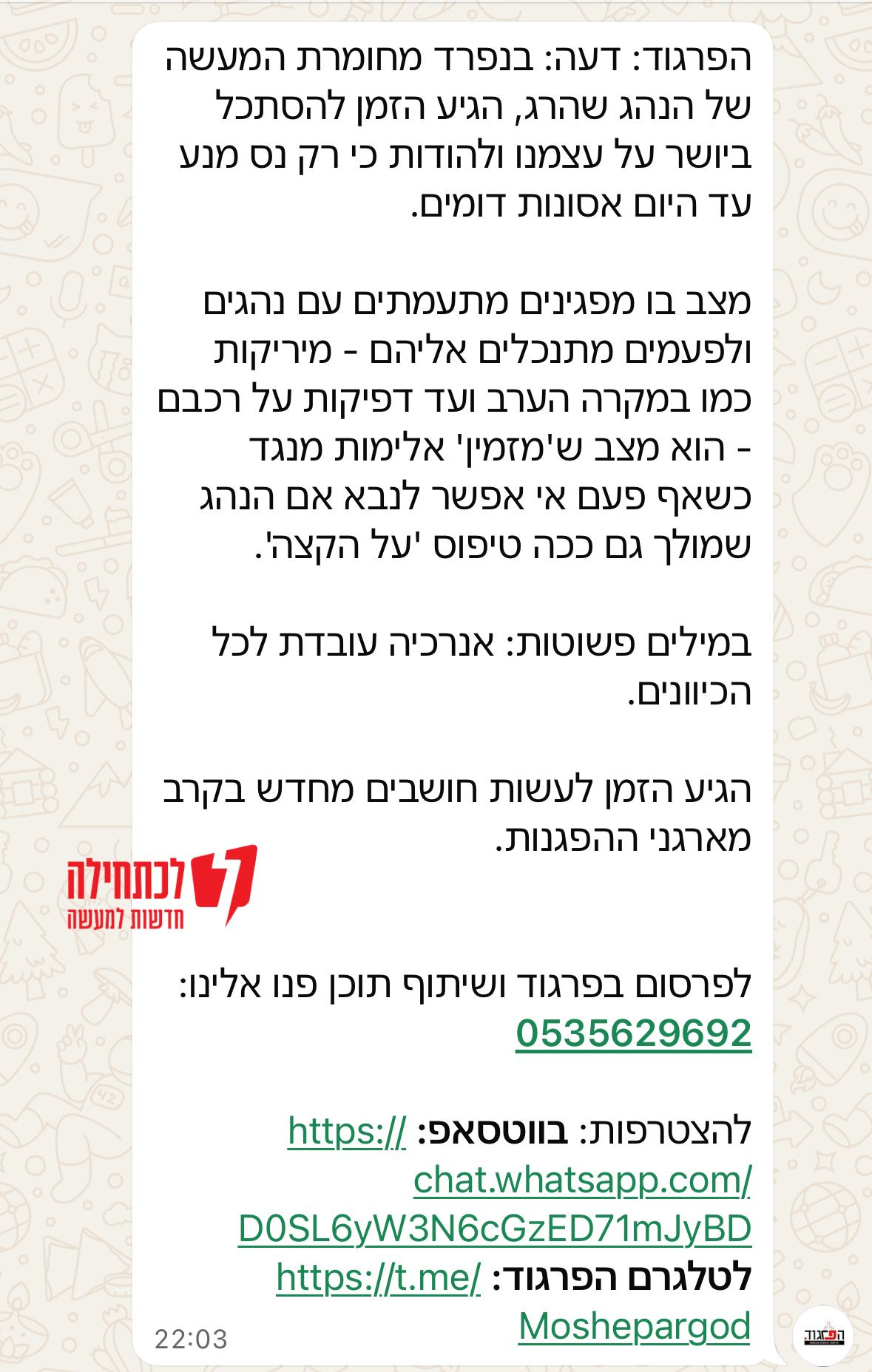
As the more level-headed charedi news outlets such as HaPargud and Lechatchilah have just said - when you unleash craziness and violence and anarchy, it is only to be expected that it will spiral out of control in all directions.
I wish people would learn the correct lessons. But I fear that they won’t. The charedi rabbinic and political leadership only knows how to play the victim, not how to take responsibility. Which is the cause of the entire draft problem in the first place.
Every death and injury can be laid at the door of the gedoilim. They have blood on their hands….so much blood
This from Leah Zach Aharoni
I am writing this as a mother.
Yesterday, a 14 year old Yossi Eishenthal was run over by a bus during a demonstration. A child. A life. A family that will never be the same.
Let me be clear. The only person at fault for the actual act of running over a boy is the bus driver who did it. Period. I am not interested in spreading blame in all directions or hiding responsibility behind slogans.
And at the same time, we have to be brave enough to look at the atmosphere we are creating, because atmospheres have consequences.
I strandle the dati leumi and the charedi community. I love and cherish both deeply. Both communities raise beautiful, ehrlich, menchlich kids.
And in both communities I am witnessing a trend, especially when it comes to boys that is unsettling.
When we raise children inside an atmosphere that tells them they embody the highest value of the community, certain behaviors are bound to follow if humility is not taught alongside it.
This is not about Haredim alone. I see this pattern across communities.
Hilltop youth feel that they are protecting the land of Israel and making it flourish. That is a powerful ideology. It often comes with a feeling that the ends justify the means. And no, I reject out of hand the accusation of blanket "settler violence", but I see kids engage in rhetoric and sometimes actions that are somewhere between stupid, unruly, and dilusional.
In the mainstream dati leumi world, boys grow up knowing that at 18 or 19 they will go to the army, defend the country, and possibly make the ultimate sacrifice. Most are amazing beyond belief. Many scorn at authority and think they know better than their officers, teachers and parents.
In the Haredi world, boys are raised to learn Torah, the highest ideal of their community, and they know from a young age that they are carrying something sacred and elevated. Sometimes, it makes them feel entitled like everyone around should back over backwards to accommodate them.
I am not here to argue whose values are better, purer, or more correct. That argument gets us nowhere.
What I am saying is this: when boys grow up believing they represent the highest value of their community, and no one teaches them humility, accountability, and basic menschlichkeit, entitlement creeps in.
I see it in my own children at times. I see it in the kids I work with in our organization. And I have seen it too many times to ignore.
A 25 year old married kollel student who takes a job and assumes three women his mother’s age should bend their schedules around his learning hours.
A young man using a nonprofit corporate card, donor money, to buy cigarettes (we made him pay it back!)
Eighteen year old boys assuming they should be driven everywhere in taxis and reimbursed for it without authorization (they were not).
Yeshiva boys at demonstrations being violent, unruly and disrespectful of authority.
These are not monsters. These are our sons. And this is exactly why this is painful to say.
There are many wonderful, earnest, respectful boys in every one of these communities. Truly. They give me hope every day.
But there is also a growing pattern of excessive self-assurance, entitlement, and unruliness that we, as parents, cannot keep excusing in the name of ideology.
Living a value does not grant special privileges. Making sacrifices does not excuse bad behavior. Carrying a holy mission does not place you above basic responsibility and restraint.
When a group of yeshiva students thinks it is acceptable to attack a bus because they are angry about the draft, something has gone deeply wrong before that moment. And that failure does not start in the street. It starts at home.
If we do not teach our sons humility, respect for others, and limits, no ideology will save them. And no slogan will protect them from tragedy.
This is not about blame. It is about responsibility.
As parents, the atmosphere we create is the world our children grow up in. And if we do not change that atmosphere, we should not be surprised when it explodes in our faces.
May we all be worthy of making a tikkun and may that tikkun be leilui nishmat Yossi Eisenthal.