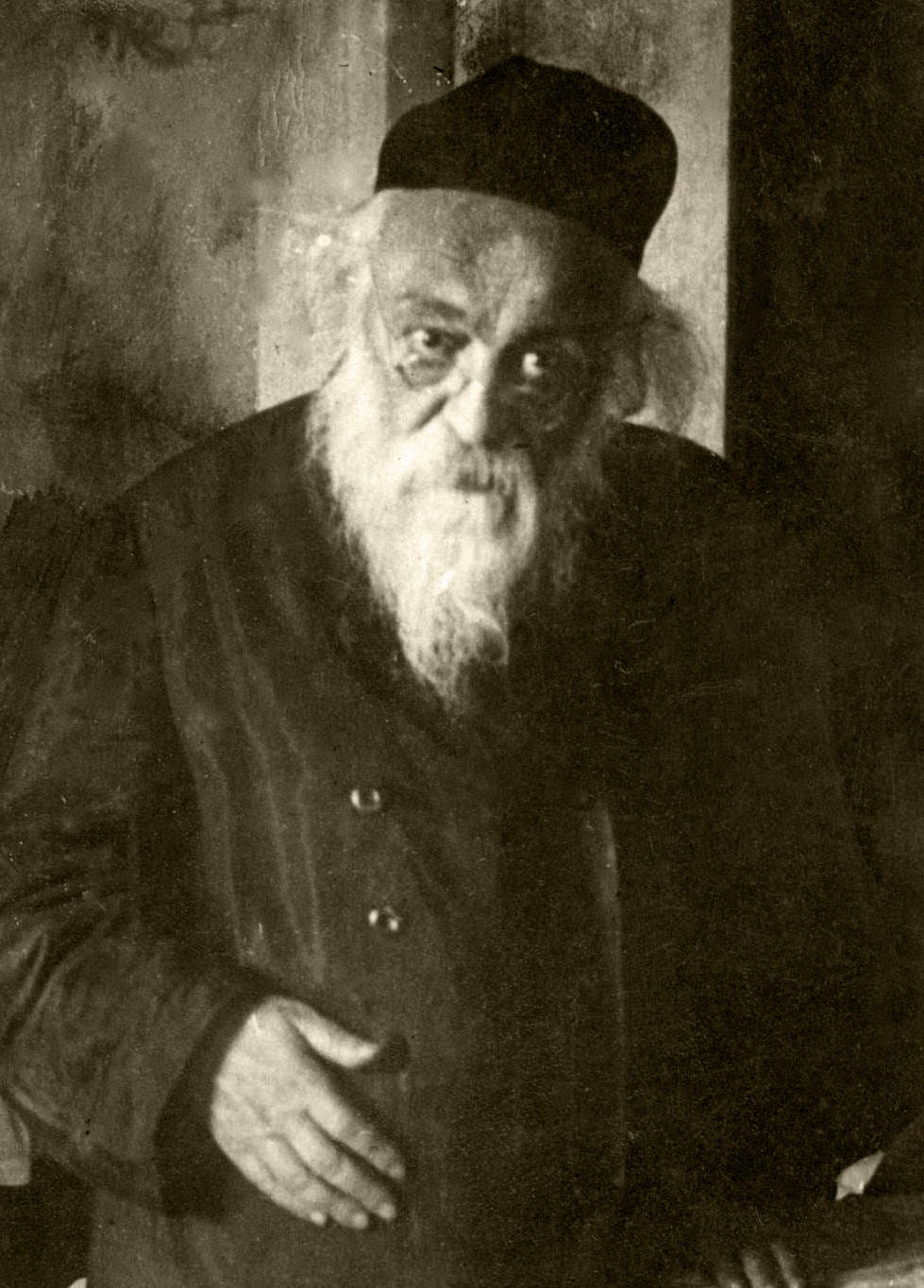
When I was in yeshivah, one of my favorite sefarim was Chiddushei Reb Chaim on the Rambam. I was always fastidious about taking notes, and did so with this work too. Later, when I was teaching at Ohr Somayach, I found it very useful to teach Chiddushei Reb Chaim - not from the original Hebrew, but instead presenting the arguments in English. My notes came in handy, too, not just for myself, but also for my students.
Reading R. Gil Student's latest post reminded me that I still have these notes sitting on my computer. I am making them freely available here. The document includes ten sections of Reb Chaim's work, translated and also presented in outline form in order to make the arguments easier to follow. I converted the notes from an old Word file, so the formatting is not up to my usual standards. I haven't checked it over in the last ten years, either, but I probably wouldn't get around to doing so, so I am making it available as-is.
When I wrote these notes, I took it for granted that Reb Chaim was getting at what Rambam actually meant. I was aware of the Chazon Ish's glosses in which he disagrees with Reb Chaim, but I was taught in yeshivah that this was a sign that wherever he didn't write a gloss, he agreed with him, and showed that he fully supported his basic approach. I was taught the same about Raavad and Rambam.
Twelve years later, now that I am older, wiser, and more historically aware, I realize that all this was wrong. The Raavad fundamentally disagreed with Rambam's approach, the Chazon Ish fundamentally disagreed with Reb Chaim's approach, and Rambam did not have Reb Chaim's concepts in mind.
Does awareness of this fact mean that there is no value to learning Reb Chaim? Does it mean that there is less value? My initial thoughts are to say no to the former and yes to the latter, but I am open to hearing what people have to say.
90 comments:
I remember seeing your translation when I was in Ohr Samayach years ago. It's nice to see them again. Thanks for making them public.
In your estimation, did Reb Chaim maintain that the Rambam had his (Reb Chaim's) concepts in mind?
Good Shabbos.
I disagree with your last claim - I think there are certain places where R Chaim is actually getting at the Rambam's intended meaning. For example, the famous one on kavvanah in tefilah. Just because the Rambam didn't hav all these concepts in mind every time doesn't mean he didn't have any of them in mind at any time.
and Rambam did not have Reb Chaim's concepts in mind.
=========================
Is this your conclusion or your understanding of Raavad/ci?
when you say in mind, does that include subconciously?
KT
Joel Rich
If I remember correctly the comment about it being impossible to have the status of a murder passively is yours rather than Rav Chaim's. It seems to me since the gemara in Sanhedrin counts confining someone in a place of lethal danger to be murder, that it is possible. For example, a person is squatting in a shallow pond peacefully tending the water lilies. A gunman comes along, and threatens to kill him if he gets up, and then wedges someone else's head under the squatter's rear. If passivity is the governing factor, the squatter is passive and should remain rather than rise; if the governing factor is the difference between committing murder and being a murder weapon, he should rise and allow the gunman to shoot him rather than remain squatting.
"Rambam did not have Reb Chaim's concepts in mind."
How do you know that?
"Does awareness of this fact (see prior paragraph) mean that there is no value to learning Reb Chaim? Does it mean that there is less value? My initial thoughts are to say no to the former and yes to the latter"
I'd be interested if you would "quantify" that. For instance, if "no value" = 1 and "great value" = 10, would you say that your newfound awareness of this fact (I'll assume it's a fact based on your say-so) changed your rating from a 10 to a 8? An 8 to a 2?
Thanks! And I look forward to reading your notes on Reb Chaim.
Post-modernist hashqafa (which in frum circles has been around for along time)often implies that great hachamim "are all right." Anybody who uses one's brain understands that this can not possibly be true, at least not a great deal of the time.
If I may cite my teacher Rav David Bar-Hayim-Reb Chaim on the Rambam does have value and his methodology does as well-but there is absolutely no need to assume that he is always correct in his interpretations. Sometimes, yes, sometimes, no.
Reb Chaim's methodology can be useful, but should be seen as a tool which sometimes works and sometimes does not.
That R' Chaim's approach is not necessarily what the Rambam had in mind does not minimize the value of learning R' Chaim one iota. It does, however, minimize the value of learning R' Chaim as a tool to understand the Rambam's point of view.
I am no expert in his work, but there's no question that RYBS often interpreted the Rambam in extremely non-historically accurate ways (indeed, in at least one of his later shiurim, the Rav explicitly stated something to the effect of "I'm going to take the Rambam and distort him to analyze him."). A classic example of this is the Rav's resolution of the machloket between the Rambam and the Ramban on whether tefillah is d'oraita or d'rabbanan, where he interprets the Rambam as an Existentialist (see, e.g., "Worship of the Heart" and many of the Rav's Boston and New York shiurim on tefillah). There's no question that this is historically dubious at best, but it provides great insight as to the Rav's take on t'fillah and it certainly is a brilliantly inspiring take.
I don't think that even a major critic of R' Chaim's approach such as the Seridei Eish (see section 8 of this post for an example) would deny the value of studying him.
I would pose that the way to teach Rav Chaim has to become more about how the particular mehalech reads the Rambam instead of it being about elucidating the correct approach to the Rambam. The goal would be to study Rav Chaim and the Hazon Ish, as well as other works on the Rambam to come to a reading which would be closer to the original line of thinking. Rav Chaim then becomes another in the long line of commentaries on Rambam as opposed to being the stand alone. I think the same can be said for most acharonim. While the 20th century has seen the production of countless shiurim like writings in the acharonim, they are by and large still commentary, especially for those who collect sources.
Of course studying Reb Chaim still has value, not for insight as to what Rambam thought but rather as a later dialogue, an example of an important work grappling with Rambam's arguments and approach.
I remember this from Medrash and perused much of it. I still have it.
Thanks for the memories!
There are two ways to measure truth. if our intent in learning R Chaim is to figure out what Rambam himself meant, then many parts aren't correct. but truth does not have to mean original intent. we can honestly debate the 'shittah' using Rambam and ultimately understanding his words in a different light.
Similarly, (lehavdil) legal scholars in america debate if the constitution should be understood in its original intent or according to our understanding.
halachick scholarship is full of this, R Y Karo in Kessef Mishneh defends using gemmarros to understand the Rambam, although Rambam wrote that it is unnecessary. Since Shulchan Aruch is based mostly on the Rambam, I would conclude that although Rambam meant to read MT literally, R Karo felt that he can use the it not that way. Same is true in Shulchan Aruch, there are numerous times where Rema limits, or expounds on the Mechaber (vedavka or vehu hadin)even though from the Bais Yosef, it obvious that the mechaber disagreed with that. Rema isn't trying to explain original intent, rather his view of that shittah. Same goes for many 'noseh keilim.'
its close to Shabbos, so i'll leave it with this. i'd love to write a good essay on this one day.
gut Shabbos.
What do you mean that the Ravad fundamentally disagreed with the Rambam'a approach? Why do you say that?
Do you also mean that he disagreed with many of his decisions without explicitly arguing with him?
In your estimation, did Reb Chaim maintain that the Rambam had his (Reb Chaim's) concepts in mind?
Excellent question. My feeling is yes, but I am not certain.
"Rambam did not have Reb Chaim's concepts in mind."
How do you know that?
Because there is nothing remotely resembling Reb Chaim's types of arguments in any of Rambam's writings (or, for that matter, in the writings of pretty much anyone preceding Reb Chaim.)
Furthermore, when Rambam replied to the Chachmei Lunil regarding their questions on his rulings, instead of employing Brisker-style arguments, he simply said that he erred, or changed his mind, etc. Marc Shapiro reports that there is a tradition in the Soloveitchik family that Reb Chaim did not like Rambam's responses to the Chachmei Lunil, for this reason.
Of course studying Reb Chaim still has value
I didn't say otherwise. But the question is, once one accepts that he is not shedding light on what Rambam actually meant, then does it make it a little less valuable.
What do you mean that the Ravad fundamentally disagreed with the Rambam'a approach? Why do you say that?
See Twersky's "Rabad of Posquieres"
Excerpted version of R' Weinberg's take on R' Chaim's derech (copied from here):
אמת הדברים כי ר' חיים הזרים זרם חדש של פלפול ע"ד ההגיון לישיבות. בהגיון יש לכל אדם חלק, ולפיכך יכולים כל בני הישיבה לחדש חידושים בסגנון זה, משא"כ בדרך הש"ך ורעק"א צריך להיות בקי גדול בשביל להיות קצת חריף ולכן משכל אנשי הישיבות מתאוים להיות "מחדשים" הם מעדיפים את ר' חיים על כל הגאונים שקדמו לו... הגר"א מבקש את האמת הפשוטה לאמתתה, ולא כן ר' חיים. הגיונו וסברותי' אינם משתלבים לא בלשון הגמ' ולא בלשון הרמב"ם. ר' חיים הי' לכשלעצמו רמב"ם חדש אבל לא מפרש הרמב"ם. כך אמרתי להגאון ר' משה ז"ל אבי' של הגר"יד שליט"א.
Whether or not R' Chaim himself believed he was providing p'shat in the Rambam is a subject of no small debate, and one worth exploring.
It's also worth noting that creative interpretation of a halachic source goes back to the gemara and possibly even earlier. IIRC, R' Schachter noted in one of his shiurim that, while the convention was that amora'im did not directly argue with tana'im, they often did so indirectly by creatively parsing the latter's statements.
The bigger question is: how do we relate to historical halachic literature? Do we venerate it on its own (in which case we try to figure out pshat using every tool at our disposal), or do we venerate it as the source of our mesorah, which has (you should pardon the expression) evolved in ways outside of the original intent? In that case, R' Chaim's derech is crucial to understanding the Rambam as we currently use it, even if it deviates substantially from the historical reality.
Rambam did not have Reb Chaim's concepts in mind."
How do you know that?
Because there is nothing remotely resembling Reb Chaim's types of arguments in any of Rambam's writings
==========================
Yes but that doesn't prove that subconciously the Rambam wasn't thinking this way (or even conciously but using a different approach for others not at his level)
In general on R' Chaim correlation vs. causation – statistical analysis requires an underlying hypothesis as to what is generating the data (OK I know it’s modernish etc.) – think klal prat klal vs ribbui miyut.
R’ Chaim assumes an underlying TOE is generating all the data – either conciously or subconciously – in the Rambam’s unified mind which is reflecting HKB”H’s will to the extent we can understand.
However it is possible that other constructs can yield the same data points, or that some of the data points are data errors or generated by more than one TOE.
All the above gibbersish is to say that R’ Chaim is certainly at least an approximation of the truth but I don’t think one could prove he is “The Truth”
KT
Joel Rich
R. Chaim presumably believed that his were accurate interpretations of "Rambam" the sefer, not "Rambam" the man.
He essentially believed that as the work was ultimately accepted, its words were correct on a divine level, not necessarily on a personal intellectual level, even if it was the Rambam's.
"In your estimation, did Reb Chaim maintain that the Rambam had his (Reb Chaim's) concepts in mind?
Excellent question. My feeling is yes, but I am not certain."
Did R Chaim really hold that according to the Rambam a sick person may eat more than the shiur on Yom Kippur?
Did he also really hold that one who davened without kavanah that he is before Hashem must repeat the tefilla?
1. Did R Chaim pasken that way for others?
2. Did he really believe that Rambam as a person held that way?
" A classic example of this is the Rav's resolution of the machloket between the Rambam and the Ramban on whether tefillah is d'oraita or d'rabbanan, where he interprets the Rambam as an Existentialist (see, e.g., "Worship of the Heart" and many of the Rav's Boston and New York shiurim on tefillah). "
============
The Rav provided arguments supporting his view of the Rambam as an existentialist in other places - see the footnote about the existence of God in TLMOF. Also note the Rambam himself at the end of the Guide.
R Slifkin - I suspected you were working off the same basis I was - namely the Shapiro article. I just wasn't that impressed by the article, because (to memory) he didn't bring any examples of R Chaim saying one thing and the Rambam saying another. Again, I think the example of the tefilla one is an example of where R Chaim got him right, just not exactly in terms the Rambam would have used. Another example, to my mind, is the one about kiddushei davar shelo ba le'olam - again the rambam probably wouldn't even approach R Chaim's categories, but I think he would agree with R Chaims analysis, at the very least, as a good interpretation of the Gemara.
One cool evening in Jerusalem, Reb Haim and RAMBAM were taking a stroll together. A Yeshiva bochur came running up to them. Rabosia! Help me! We have a shver RAMBAM and we're all farbungeled. Can you make it pas? RAMBAM took a look and explained that there is a problem with the girsa. Reb Haim scoffed abruptly and cried: No! no! no! Don't you know how to learn RAMBAM? S'iz tzvei...
Regarding the question which commentators, if any, taught and thought like Reb Chaim. I have heard that the Minchas Chinuch was much admired by Reb Chaim and that the Minchas Chinuch was actually popularized and brought to public awareness by Reb Chaim. The Ketzot is also seen as an influence. It is said in the name of the Rav that the rishon on Shas most like Reb Chaim is Ramban. Would you agree Rabbi S.?
"Because there is nothing remotely resembling Reb Chaim's types of arguments in any of Rambam's writings."
Can you define what are Reb Chaim's types of arguments that are not found in Rambam's writings?
"Furthermore, when Rambam replied to the Chachmei Lunil regarding their questions on his rulings, instead of employing Brisker-style arguments, he simply said that he erred."
If the Rambam changed his mind should he try to defend his old halachos with Brisker-stylye arguments or be honest and tell Chachmei lunil that the text needs to be corrected?
Moshe
Rabbi Slifkin: "Rambam did not have Reb Chaim's concepts in mind."
Eric: How do you know that?
Rabbi Slifkin: Because there is nothing remotely resembling Reb Chaim's types of arguments in any of Rambam's writings (or, for that matter, in the writings of pretty much anyone preceding Reb Chaim.)
This is not a convincing argument, to my mind. Why should we expect to find Reb Chaim's types of arguments in the writings of the Rambam? The Rambam was not trying to present such analysis for study in the way that Reb Chaim was. In no way does this diminish the possibility that conceptual underpinnings and categorical distinctions were underlying his writings.
Furthermore, when Rambam replied to the Chachmei Lunil regarding their questions on his rulings, instead of employing Brisker-style arguments, he simply said that he erred, or changed his mind, etc. Marc Shapiro reports that there is a tradition in the Soloveitchik family that Reb Chaim did not like Rambam's responses to the Chachmei Lunil, for this reason.
This line of reasoning strikes me as flawed, as well. In responding to these particular questions from the Chachmei Lunil (assuming that they are actually authentic, which is a matter of some dispute), the Rambam clearly thought that he had either erred, or changed his mind -- in these cases. This is not an indication that every problem arising from the Rambam should be solved this way. It is not even an indication that many or most should be solved this way. Again, I don't find any indication that the Rambam did not have Reb Chaim's concepts in mind.
Further, I would just make one more note. Reb Chaim Soloveitchik clearly knew that, as you put it, "there is nothing remotely resembling Reb Chaim's types of arguments in any of Rambam's writings (or, for that matter, in the writings of pretty much anyone preceding Reb Chaim)." He also was aware of the teshuvos to the Chachmei Lunil. In his estimation, these did not detract from the possibility that the Rambam had his concepts in mind.
The way I heard the joke was, R' Chaim comes to Shamayim and is greeted with Kavod.
"Before we show you to your spot, is there anyone you'd like to meet first?"
"Yes! The Rambam."
So the Rambam is brought to see R' Chaim.
"What did you do in Olam HaZeh?"
"I wrote chiddushim...about you!"
"About me? Like what?"
"I solved Chakiras in the Rambam."
"Chakiras? What do you mean?"
"Well, here you say x, and here you say y..."
"Of course! I was talking about two different things."
"Eh. A baalebatishe answer."
Rav Eliyahu Soloveitchik has an article in which he claims that Reb Chaim knew for sure that his interpretation was not that of RAMBAM himself. There is a Teshuva where RAMBAM says differenly explicitly, and Reb Chaim brings the teshuva, but omits the part which contradicts his pshat. Rav Soloveitchik's conclusion is that Reb Chaim didn't care about what RAMBAM meant. Once he wrote it, it became Torah for anyone to interpret. Same if you have a Maggid Mishna based on a faulty girsa. It is still torah. Historical truth is not a factor. It is a revealed type of mysticism.
If you claim that R. Chaim held that he was explaining the Rambam as the Rambam really meant it, and you yourself hold that R. Chaim was not explaining the Rambam as the Rambam really meant it, why should one follow you over R. Chaim with regard to what the Rambam really meant? Can you demonstrate that you have better knowledge of the Rambam than R. Chaim did?
I don't think anyone can seriously argue that the Rambam and Reb Haim were coming from two totally different directions, and that the entire Ashkenazi yeshiva system artificially molded opinions like the Rambam to fit their particular hashkafa.
Whats important is that A)No, of course his Hiddushim haven't lost all value and B) Yes, that value is reduced significantly when one realizes the sefer's proper context and doesn't put it on a pedestal as many in the yeshivish world do.
Really most "yeshivish" sfarim are inflated in terms of value since they reflect only one specific and narrow perception of Judaism, ie, that of the E. European yeshiva system that evovled out of the early 19th century. Since then all facets of that world have become sanctified and gained the status of 'meMoshe meSinai'.
Take the tzurath hadaf of the talmudh. Since the rise of the big E. Euro yeshivas, the Vilna dfus (which is riddled with mistakes above and beyond early printings), which came into existence around the same time, has become the only permitted source for torah sh'baal peh. Even similar texts of the gemara which have merely been rearranged (like the steinsaltz gemara) are decried as heretical (and of course the yerushalami is utterly exiled from the beith midrash, its mention is only permitted when quoted by tosafoth).
R' Slifkin,
Did you happen to read R' Buchmann's article in Hakirah, in which he produced a number of examples from the Rambam's writings in which he did, in fact, explicitly employ conceptual Brisker-like reasoning in explaining parts of the Mishneh Torah? Why assume that the exceptions to this are the rule?
Demonstrate that you understand ONE Reb Chaim.
Take one hu'urah of the Chazon Ish and explain how it is relfective of a different derech. Just one!
You believe, hook line and sinker, everything they write in academia.
Rabbi Maroof - I haven't read the article. But why do you assume that those examples are the rule, and the others are exceptions?
Feivel - I think that the very first section and the first comment of the Chazon Ish are a pretty good example. (incidentally, I have never read any academic literature on this.)
With regard to other questions here - I think that they are already answered by other comments.
"With regard to other questions here - I think that they are already answered by other comments."
I do not believe that my question was answered by any other comment. Just a reminder -
"Can you demonstrate that you have better knowledge of the Rambam than R. Chaim did?"
Rabbi Joshua Maroof: Did you happen to read R' Buchmann's article in Hakirah, in which he produced a number of examples from the Rambam's writings in which he did, in fact, explicitly employ conceptual Brisker-like reasoning in explaining parts of the Mishneh Torah? Why assume that the exceptions to this are the rule?
Rabbi Slifkin: I haven't read the article. But why do you assume that those examples are the rule, and the others are exceptions?
I have not seen this article, either (it would be great if you could provide a link or reference, Rabbi Maroof), but let us for now assume its validity.
There are obviously two possibilities in this situation. Either the conceptual reasoning that the Rambam employs in some cases are the rule or the exception.
If these conceptual reasonings are the rule, then it makes perfect sense that in a few particular other cases, the resolution to a contradiction would be a faulty girsa or a change of mind. In these cases, the Rambam did not resort to a conceptual answer because it was not necessary or appropriate -- the true answer lay in the faulty girsa et al.
Maybe the conceptual reasoning is the exception, as Rabbi Slifkin suggests? This is not a tenable possibility. Conceptual reasoning is not simply a way of reaching a teirutz to a question, or something that one happens upon accidentally. It is a derech in thinking and learning. If the Rambam employs such methods in answering even one question, it is an indication that this is his method. It cannot be the exception.
Zohar said:
There is a Teshuva where RAMBAM says differenly explicitly, and Reb Chaim brings the teshuva, but omits the part which contradicts his pshat. Rav Soloveitchik's conclusion is that Reb Chaim didn't care about what RAMBAM meant. Once he wrote it, it became Torah for anyone to interpret.
So then, recent examples of this wouldn't be the first... do you have a specific reference?
Rabbi Slifkin: With regard to other questions here - I think that they are already answered by other comments.
I may be missing something, but I do not see how some of the other questions have been answered. I wrote a post earlier questioning your reasons for thinking that the Rambam did not have Reb Chaim's concepts in mind. You stated that you felt that way since the Rambam never wrote anything resembling the Rambam's arguments, and because of the style of the replies to the Chachmei Lunil. I questioned both of those replies (and an anonymous user who signed his name as Moshe asked a similar question), and do not see how my questions have been answered.
It is true that Zohar noted that R' Eliyahu Soloveitchik wrote an article claiming that Reb Chaim didn't care what the Rambam was actually trying to say (I would like to see the article and examine his evidence). However, this fact does not defend the issue to which my questions were addressed. They do not show how your arguments (for believing that the Rambam did not have Reb Chaim's ideas in mind) are valid.
And it is true that Dawidh wrote that he doesn't think that "anyone can seriously argue [with the fact] that the Rambam and Reb Haim were coming from two totally different directions." With all do respect to him, though, his saying so does not make it fact.
And so, I still don't see how my questions have been addressed. Thank you!
“and Rambam did not have Reb Chaim's concepts in mind.”
How do you know that?
"Because there is nothing remotely resembling Reb Chaim's types of arguments in any of Rambam's writings (or, for that matter, in the writings of pretty much anyone preceding Reb Chaim.) Furthermore, when Rambam replied to the Chachmei Lunil regarding their questions on his rulings, instead of employing Brisker-style arguments, he simply said that he erred, or changed his mind, etc."
While it may be true that possibly in some instances Rambam did not have Reb Chaim’s concepts in mind, still if this is your reasoning, it is blaringly flawed. The Rambam himself writes in his introduction to Mishne Torah that with yeridos hadoros, that which was once clear in Torah learning became difficult to understand. This required the giants of each successive generation to write clarifications and explanations in order to maintain Torah scholarship. Yet what was explained by the Geonim and crystal clear to their generation in turn became difficult to interpret clearly in the age of the Rishonim (see also Orchos Tzaddikim at length) and so on. Each subsequent generation needed more words and further clarification to say the exact same thing the Geonim had said in their few words. All of this is obvious to anyone who has ever learned a piece from Reb Naftali Trop explaining a Rashba or from Reb Shimon Scopp explaining a Shita Mekubatzes, as the derech of the Achronim is to elaborate a point and be mediek in the concise wording of the Rishonim the very point that they are presenting. Therefore the fact that Rambam has written nothing remotely resembling Reb Chaim's types of arguments is a ludacris argument to suggest that Rambam did not have Reb Chaim in mind.
sorry everyone for the delay in replying - i'm very busy right now
Lawrence Kaplan
Avreich: 1) The Rambam does NOT speak about yeridas hadoros in the Intro to the MT. 2) He does not distinguish between the age of the Geonim and that of the rishonim. Indeed, for the Rambam ALL Sages who came after thr Talmud are Geonim.
Shaiya Davis said:
"And it is true that Dawidh wrote that he doesn't think that "anyone can seriously argue [with the fact] that the Rambam and Reb Haim were coming from two totally different directions." With all do respect to him, though, his saying so does not make it fact."
True, my saying it doesn't make it fact; it was already fact long before I said it. If you want to argue the issue, fine, but at least explain WHY you think that, despite the utterly different schools of thought they developed in and were influenced by, the Rambam and Reb Chaim were speaking 'on the same wavelength' so to speak.
When we study the motion of bird’s wings, does it make any difference that the birds don’t understand calculus?
When a psychologist explains and analyses human behavior and motivation, even making correct predictions, does it make any difference that the subject has never heard of the theory being used?
Mr. Avreich,
You are waisting your time here. In this forum, they think it was easier to be a Rishon than to be an Achron.
Links to study by Eliyahu Soloveitchik in which he claims that Reb Chaim knew full well that RAMBAM did not mean Reb Chaim's hiddushim:
http://www.scribd.com/doc/34639662/%D7%93%D7%90%D7%A6-%D7%94-4
http://www.scribd.com/doc/34639676/%D7%93%D7%90%D7%A6-%D7%94-16
"Lawrence Kaplan
Avreich: 1) The Rambam does NOT speak about yeridas hadoros in the Intro to the MT. 2) He does not distinguish between the age of the Geonim and that of the rishonim. Indeed, for the Rambam ALL Sages who came after thr Talmud are Geonim."
See Orchos Tzaddikim Shar HaTorah, and how he learns the Rambam.
Dawidh:
Shaiya Davis said:
"And it is true that Dawidh wrote that he doesn't think that "anyone can seriously argue [with the fact] that the Rambam and Reb Haim were coming from two totally different directions." With all do respect to him, though, his saying so does not make it fact."
True, my saying it doesn't make it fact; it was already fact long before I said it.
I guess I should have been more precise in my language. What I meant to say was "his making that statement is not, in and of itself, a demonstration of its veracity."
If you want to argue the issue, fine,
Although I hadn't actually stated my personal views on the issue -- thus far I have only questioned Rabbi Slifkin's evidence for his knowing that the Rambam did not have Reb Chaim's concepts in mind -- I do happen to think that, by and large, the Rambam had Reb Chaim's concepts in mind. I can therefore address the following question of yours.
but at least explain WHY you think that, despite the utterly different schools of thought they developed in and were influenced by, the Rambam and Reb Chaim were speaking 'on the same wavelength' so to speak.
This question presumes a premise that has not been founded. In what sense were the "schools of thought they developed in and were influenced by [utterly different]"?
The essay by Eliyahu Soloveichik is certainly interesting. But if your hope was to convince people of a position because of the author's last name (he is not, as far as I can see, claiming a "mesorah" from Rav Chaim on this issue), then if I ask some of my friends from the Maimon family, who claim a direct desendancy from the Rambam, to write an essay saying that the Rambam's ideas and Rav Chaim's are one and the same, will you be convinced as to that?
@Shaiya Davis:
"This question presumes a premise that has not been founded. In what sense were the "schools of thought they developed in and were influenced by [utterly different]"?"
Not founded? Au contraire. The Rambam was a rationalist par exellence; his writings are utterly devoid of the influence of qabbalah that permeated the thought of the Gra and his students (and Volozhin yeshiva was no different).
Though the Gra often poskened like the Rambam, he made the difference in hashkafa clear in an uncharacteristically long comment in his peirush on the Shulchan Aruch in Yoreh Deah where he critizes the Rambam's rationalist view of magic and avodah zara, saying that he had been seduced by "Greek philosophy".
The Rambam and the Gra also differed in their view of Torah Sh'Baal Peh; with the Rambam limiting it to "perush hamitzvot" while the Gra viewed much of the aggadata and qaballah as being equally a part of Torah Sh'Baal Peh.
Aside from these glaring differences between the hashkafa of the Gra and the Volozhin yeshiva wher Reb Haim studied, there is the general difference between Ashkenazi darchei limudh and those of Sfardim, particularly those heavily influenced by the Gaonim as the Rambam was.
The Ashkenazi view that developed, and become even more prominent in the pilpul methods that developed in Eastern Europe, was more closely aligned with Tosafoth, who tended to view all Hazalic statements on all subjects as being relevant one to the other. Chiddushim could then be learned out through the reconciliation of statements on issues or situations that are only somewhat similar.
The Rambam, like the Gaonim, tended not to such statements in different sugiyot as being related unless the situation was clearly relevant.
I could go on and on; suffice it to say, I think its a given that a 12th century rationalist from Spain saw the Torah through different glasses than a 19th century denizen of the E. European yeshivoth.
I think that this argument relates to the fundamental (and unbridgeable) divide between different views of yeridas hadoros. Which in turn relates to rationalism.
If you claim that R. Chaim held that he was explaining the Rambam as the Rambam really meant it, and you yourself hold that R. Chaim was not explaining the Rambam as the Rambam really meant it, why should one follow you over R. Chaim with regard to what the Rambam really meant? Can you demonstrate that you have better knowledge of the Rambam than R. Chaim did?
This is like the question that I once heard from someone: If Gadol X has learned much more of Chazal than you, and he says that Chazal were always speaking allegorically about science, how can you claim to be correct?
To which my answer is (and insert however many lehavdils you need): If the Pope has learned much more of the Old and New Testament than you, and he sees them as evidence of the truths of Christianity, how can you hold it to be false?
In other words: it's all about one's starting point, one's basic framework in which one studies. The fact that person X has studied more of the topic than you does not mean that they are correct in their framework by which they approach it.
"In other words: it's all about one's starting point, one's basic framework in which one studies. The fact that person X has studied more of the topic than you does not mean that they are correct in their framework by which they approach it."
You mean we should consult someone besides Reb Chaim to determine Reb Chaim's viewpoint?
Eh? I mean that the fact that Reb Chaim learned more of Rambam does not mean that his framework for approaching Rambam is necessarily correct.
"it's all about one's starting point, one's basic framework in which one studies. The fact that person X has studied more of the topic than you does not mean that they are correct in their framework by which they approach it."
But you did not answer the question at all. The question did not relate to HOW MUCH Rav Chaim studied vs. how much you studied - it related to his knowledge of the Rambam vs. yours, in terms of discerning the Rambam's concepts, analyzing his underlying premises, etc. What makes you think that your knowledge of the Rambam in these areas is superior to that of Rav Chaim?
In other words: it's all about one's starting point, one's basic framework in which one studies. The fact that person X has studied more of the topic than you does not mean that they are correct in their framework by which they approach it.
==========================
imho this is true, but incomplete. imho an individual's relationship with tora is symbiotic -his own "mazal"(dna, upbringing etc.) will influence how he understands what he learns, but what he learns will impact his "framework" as well. thus studying more of a topic may increase the probability of a "truer" understanding.
KT
Joel Rich
But you did not answer the question at all...
It's exactly the same point.
An example: When discovering that someone's writings contain contradictions, the approach that one takes depends on one's framework vis-a-vis that person. If you believe that person to be a near-infallible genius, then you assume that there must be a way of reconciling them. But if you believe that person to be very intelligent but still human, you realize that people are not always entirely self-consistent.
So am I correct in understanding you to be saying that the Rambam was not a near-infallible genius, with regard to the issue of contradictions? The Rambam who outlined very clearly the seven different types of contradictions and their causes, and was clearly aware of them and careful to take profound measures to avoid the "undesirable" kinds? The Rambam who wrote how he devoted meticulous care to every formulation in the Mishneh Torah? The Rambam who wrote that one must go out of his way to a great degree to reconcile the words of a wise sage to resolve problems? Note: I am not saying that the Rambam was infallible. He himself says that he made mistakes, despite all of the above issues that I mentioned. The issue at hand here, however, is whether Rav Chaim's method of analyzing conceptual underpinnings and logical premises to resolve contradictions is consistent with the Rambam's method. So I ask again, what makes you think that your approaching the Rambam as "a very intelligent person who makes mistakes" is superior to the approach of Rav Chaim?
I was giving that as an example of how different frameworks relate to the study of someone's writings, not speaking about the specific case of Rambam.
At this point I want to reiterate something that I have said repeatedly, but not recently, and you might be new. This website is for people with a rationalist orientation. It's not for "yeshivish" people. If you fall in the latter category, then you're not supposed to be here! I am not interested in having endless arguments with people who have an entirely different epistemology.
You should know something about me: I am not a mystic, I do not agree that there are "magical forces" at work with regard to Chazal's knowledge, etc. But I still think that within the framework of a rational discussion here, you have not answered the question that I had asked about your knoweldge of the Rambam and that of Rav Chaim.
OK.
"You should know something about me: I am not a mystic, I do not agree that there are "magical forces" at work with regard to Chazal's knowledge, etc. But I still think that within the framework of a rational discussion here, you have not answered the question that I had asked about your knoweldge of the Rambam and that of Rav Chaim."
"OK."
I agree with this poster: within the framework of a rational discussion here, how do you answer his question? Also, Shaiya Davis has gotten involved in some back and forth with Dawidh, but it seems like you haven't addressed his outstanding questions either.
A gut shabbos!
"I think that this argument relates to the fundamental (and unbridgeable) divide between different views of yeridas hadoros. Which in turn relates to rationalism.
"
Did you know that you always... ALWAYS write something like this when you given a strong critique of your argument.
It undermines your entire "rational" approach.
I think this discussion of R. Chaim the non-rationalist would be incomplete without the quote from the infamous "Chaim B'emunasam" page 106 quoting a mega-influential-on-the-Yeshivot Torah authority of the early 19th century that one may explain Rambam and Shuchan Aruch in ways that they certainly(!) did not have in mind because their words are endowed with Ruach Hakodesh and therefore legitimately contain additional layers of meaning. If R. Chaim was aware of this view that would lend credence to the supposition that he felt no guilt interpreting Rambam ahistorically.
Also a belated Mazal Tov! on your degree and best wishes for the future. May the fears of Y. Aaron, Pliny and others never materialize.
Did you know that you always... ALWAYS write something like this when you given a strong critique of your argument.
Did you know that strong critiques of my writing are only ever issued by people to the right of me (i.e. less rationalistically inclined), never by people to the left? Those to the left consider everything that I right to be perfectly obvious and not at all original.
"I think that this argument relates to the fundamental (and unbridgeable) divide between different views of yeridas hadoros. Which in turn relates to rationalism."
"Those to the left consider everything that I right to be perfectly obvious and not at all original."
I, for one, consider silly and ridiculous the idea that as the generations pass, people's abilities become inherently more limited. And yet, I still stand opposite you as I await your answers to Shaiya Davis and An Unanswered Question, regarding their questions that have not yet been resolved.
Have a great weekend!
Did you read Eliyahu Soloveitchik's article, linked above?
RABBI SLIFKIN
"I think that this argument relates to the fundamental (and unbridgeable) divide between different views of yeridas hadoros. Which in turn relates to rationalism."
"Those to the left consider everything that I right to be perfectly obvious and not at all original."
ME
I, for one, consider silly and ridiculous the idea that as the generations pass, people's abilities become inherently more limited. And yet, I still stand opposite you as I await your answers to Shaiya Davis and An Unanswered Question, regarding their questions that have not yet been resolved.
RABBI SLIFKIN
Did you read Eliyahu Soloveitchik's article, linked above?
Yes, I read the article. I don't see how anything in the article addresses the specific questions that have been asked on your presentation by Shaiya Davis and An Unanswered Question. If you think that it does (I'm not sure whether or not you do, having only your brief query from your last response to me), please specify if you can what the answers are.
Also, I would just like to emphasize that which I wrote earlier. You wrote that you view this argument as related to divide between different views of yeridas hadoros, which in turn relates to rationalism. I noted that since I am on your side of that yeridas hadoros divide, and yet I do not agree with you on this issue, this argument does not seem to be related to that divide. (Just didn't want to that point to get lost, and was wondering if you had a response.)
Thanks, kol tuv!
Rabbi Slifkin,
I must say that I have read your blog fairly often and I have read the posts on the threads. One thing always struck me and I was not really ever able to put my fingers on it until you did it for me. It dims my eyes to see it so openly. You state:
"Did you know that strong critiques of my writing are only ever issued by people to the right of me (i.e. less rationalistically inclined), never by people to the left? Those to the left consider everything that I right to be perfectly obvious and not at all original."
I do not know who the people posting on this blog/ thread/ article etc are, I am fairly confident that you do not either, and yet you feel the need to post a comment that anyone who attacks you is surely of a less rationalist framework than you. Is there a reason why you feel the need to pigeon hole every single person that has disagreed with you on this blog? Is it because you are so confident that you have answered everyone's arguments that the only reason they would still be commenting is because of their dim eyes? Or is it because you have not answered their arguments, you have not even come close to demonstrating your point, which I might add is both unfair to us and to you because you are fooling yourself into accepting statements as pure silver before they have been burned in the crucible and are thus precluding yourself and everyone here from intellectual training and rigor, It seems that this comment proved the prior comment. When you are put against a wall you do not pause and reflect and inform the commenter that you need to rephrase, retract, or rethink, but you attack belittle and pigeon hole.
Many of us were with you in spirit with the zoo controversies, we bought and when possible stockpiled your book and knew that the chareidi backlash towards you was unjust. To be labeled like this makes me sick.
Nowhere in that article does Rabbi Soloveitchik show that the Rambam was not a conceptual thinker along the lines of Reb Chaim. Unless I missed something that someone else sees?
Also, I saw that he makes a point about how Reb Chaim was interested in defining the shittos even of faulty girsaos, since he viewed them as part of the corpus of Torah (once they had been learned and accepted by chachamim). But it would be wrong to take that idea and claim that it means that in general Reb Chaim wasn't interested in defining the Rambam's words. In a few cases he may have been interested in defining a separate/faulty girsa too, but as a work, the Chiddushei R' Chaim are looking to understand the Rambam.
@Dawidh
Sorry for the delay, things got a bit busy at work during the end of the week last week, which might carry over into the beginning of this week. Apologies in advance, if they do.
Shaiya Davis: In what sense were the "schools of thought they developed in and were influenced by [utterly different]"?
It is clear that in the above question, I was asking about differences that would be relevant to the issue of whether the Rambam had Reb Chaim’s concepts and categorical method of study in mind. If I was just asking for any difference, then I certainly could have come up with some on my own: the Rambam lived in areas where the weather was much hotter than Reb Chaim’s, Columbus had already discovered America by the time Reb Chaim came around, etc. But these differences have no relevance to our issue. Let’s now turn to the differences that you mentioned, and examine their relevance to this issue:
(cont.)
@Dawidh (cont.)
The Rambam was a rationalist par exellence; his writings are utterly devoid of the influence of qabbalah that permeated the thought of the Gra and his students (and Volozhin yeshiva was no different). Though the Gra often poskened like the Rambam, he made the difference in hashkafa clear in an uncharacteristically long comment in his peirush on the Shulchan Aruch in Yoreh Deah where he critizes the Rambam's rationalist view of magic and avodah zara, saying that he had been seduced by "Greek philosophy".
I will leave aside for now the question surrounding the authenticity of that comment from the Gra. I will even leave aside the fact that there is no indication that the students in Volozhin spent their time emphasizing the areas of qabbalah. I will not, however, leave the following point aside. There is no connection between someone’s subscription to the validity of qabbalah and the question of whether his learning employs categorical thinking. This (potential) distinction is therefore irrelevant.
The Rambam and the Gra also differed in their view of Torah Sh'Baal Peh; with the Rambam limiting it to "perush hamitzvot" while the Gra viewed much of the aggadata and qaballah as being equally a part of Torah Sh'Baal Peh.
Again, this distinction is not relevant to the question of whether the Rambam conducted his halachic analysis and formulation by employing categorical thinking. (In any case, see מכתב ד in הליכות הגר"ח on page קמא, where his formulation of Torah Sheba’al Peh directly mirrors that of the Rambam in his introduction to the Mishneh Torah.) [Honestly, I think that that whole issue requires a deeper analysis anyway, but now is not the time.]
Aside from these glaring differences between the hashkafa of the Gra and the Volozhin yeshiva wher Reb Haim studied, there is the general difference between Ashkenazi darchei limudh and those of Sfardim, particularly those heavily influenced by the Gaonim as the Rambam was.
The Ashkenazi view that developed, and become even more prominent in the pilpul methods that developed in Eastern Europe, was more closely aligned with Tosafoth, who tended to view all Hazalic statements on all subjects as being relevant one to the other. Chiddushim could then be learned out through the reconciliation of statements on issues or situations that are only somewhat similar.
The Rambam, like the Gaonim, tended not to such statements in different sugiyot as being related unless the situation was clearly relevant.
Now we are getting into a more interesting discussion. I have a number of points regarding this line of thinking:
1)From where do you have any indication what the methods of the Geonim were in terms of learning Gemara? We don’t have a significant number of works from the Geonim which indicate their derech in learning gemara, to my knowledge.
2)There were many Sefardic Rishonim, among them the Ramban, Ritva, Rashba, and Ran, who frequently in their peirushim use the method of comparing sugyot and trying to reconcile them.
3)The Rambam’s stated objective in the Mishneh Torah is to cull from the two Talmudin, the Tosefta, the Sifra, and the Sifrei, and to clarify a halachic system from the whole. Different sugyot would therefore certainly be relevant to each other.
4)Independent of everything I have already written, how would this issue affect our question? (Is your point that when Reb Chaim asks a question from one halacha in the Mishneh Torah on another, it’s not really a question because they are two different sugyot?)
Thanks, and sorry again for the delay.
@Shaiya Davis:
I don't understand your questions regarding A) the Gra's statement about the Rambam and his view of magic, etc (which is in black and white in every Biur haGra in Yoreh Deah 179, comment 13) and B) the fact that qabballah was a heavy influence on the Gra and his talmidim, and by virtue of the fact that Volozhin was founded by a student of his to teach his derech halimud, also the yeshiva.
The quote is unquestionable; its there and I've never heard anyone question its veracity, nor is there reason to. As for the Gra and his students qabbalah-leanings, well I think there is no argument that from the Gra to Rav Haim m'Volozhin to the Netziv at least the faculty were all students of the Zohar.
But the meat and potatoes of your argument is that belief in the veracity of qabbalah need not determine one's views of rationalism. And I would agree with that 900%.
BUT: what does critically affect one's view of rationalism is how they understand qabbalah and qabbalistic texts; in what context do they see them. This question is closely related to the question of how to view texts of Hazal.
The Gra to at least some extent saw Hazalic texts and qabbalah as being essentially divine as written; Torah sh'Baal peh in their entirety.
For clear proof of this, again, you should read the comment of the Gra in Yoreh Deah 179, comment 13. He chastises the Rambam's rationalist view of amulets magic and the like. Why? Because it goes against the "pshat" of the gemara. He then sources a Zohar on the Humash that relates to magic, and says that "all such comments" in the gemara are "k'pshutan", and that they are describing the pneimiuth and that the Rambam was drawn afte the lies of philosophy, which doesn't understand the pneimiuth of Torah.
This is the real heart of the matter. Before you respond read this Gra there in toto. This view was not only the Gra's it was and is THE hashkafa of the yeshivish world, 19th century Volozhin included.
Without a doubt the Rambam differed greatly in outlook from the E. European yeshivas of Reb Haim's era. This greatly influences how one looks at and deals with halachic sources as well. One easy difference is the relevance of qabbalah to halacha: with the Rambam it was nil, with the Gra it carried weight and even in at least one case caused him to override the opinion of hazal and practices of all pre-shulchan aruch Am Yisrael with regards to tefillin b'Hol haMoed.
Because the Rambam viewed hazalic opinions as merely a human (and therefore falliable) attempt to express Torah sh'Baal peh (amongst other things), he doesn't always stick to the pshat, the way the Gra did (see for instance the Rambam's somewhat strange ruling on milk after meat, ordaining a waiting period of 6 hours after both poultry or basar behema, something going against the gemara which dealt only with basar behema).
Another prime example is the Rambam's idea for reconstituting the Sanhedrin. Now here is a topic that hazal doesn't touch upon, where there is really no source at all. But based on his own hashkafic ideas of what Sanhedrin and smeicha are he formulates his own suggestion as to how to recreate both, something no one else dares say (in fact other suggest, and this too is the "yeshivish" answer to this day, that we cannot and that it will be renewed by Eliyahu haNawi).
"Did you know that strong critiques of my writing are only ever issued by people to the right of me (i.e. less rationalistically inclined), never by people to the left? Those to the left consider everything that I right to be perfectly obvious and not at all original."
I do not know who the people posting on this blog/ thread/ article etc are, I am fairly confident that you do not either, and yet you feel the need to post a comment that anyone who attacks you is surely of a less rationalist framework than you.
I apologize for any offense. My point was that in all my high-profile arguments - the antiquity of the earth, evolution, the fallibility of Chazal, jumping elephants, the function of kidneys, etc., etc., my position has always been that which is completely normative in the academic world, and those who argue with me have always been coming from a traditionalist/non-rationalist perspective. My point was not to belittle them, but rather to justify my earlier comment, on why I think that there's not much point in continuing a debate when the dispute seems to boil down to an underlying difference in worldview and epistemology.
To "Academician," whose comment I did not post - your comment looks suspiciously like a hoax, which is why I didn't post it. If you post your name and credentials so that I can verify your identity, and list the issues with which you disagree with me, I am ready to post it.
To "Academician," whose comment I did not post - perhaps you could list the stances I have taken with which you feel that academics in the field of Jewish history etc. disagree with me.
"perhaps you could list the stances I have taken with which you feel that academics in the field of Jewish history etc. disagree with me."
I believe you have completely missed the point here. The "stances" that you have taken will find disagreement and agreement among a variety of academicians, as one would expect. It is the *method* whereby you have arrived at those stances which the academicians look down upon. Your logical arguments are not "tight," your research is not thorough, and is highly selective, and your work includes a great deal of speculation that is presented as factual. You accept secondary sources as if they were primary ones, and your tone often suggests an agenda, rather than an open search for wherever the facts may lead. In short, you come across as someone who "dabbles" in academia - a rank amateur - rather than one who is professional. Sorry to be so blunt, but that is the consensus among almost all of the academics in my field who have mentioned or reacted to your work.
Regarding the stances, I reiterate that I am skeptical of the existence of anyone in the field who disagrees with any of them.
Now you mention the methodology - which is nothing to do with the original comment that led to this whole discussion (which was whether those who disagree with my conclusions are doing to because of a non-rationalist orientation). To be sure, when I first began writing, it was appallingly unprofessional, to say the least; I look back at it and cringe. And up until about 2-3 years ago, it was still decidedly non-academic. And even though I have now started my formal academic training, I still have ways to improve. Fortunately, judging by my grades and the feedback that I get from various academics, I am making good progress.
Still, I have to point out that your own comments are given without any evidence to back them up or even any citations or elaborations as to what you are referring to - which, especially coming from an anonymous person, means that they carry no weight at all, from an academic standpoint. Comments about "tone" are reminiscent of what I heard back in the days of the controversy; they always turned out to be from people who were actually objecting to my conclusions, but wanted to sound sophisticated rather than fundamentalist.
Again, if you have specific citations and arguments/ evidence against anything I have written, I would be glad to hear it.
Have you ever published in a peer-reviewed academic journal such as PAAJR, REJ, JQR, etc.? There is a huge difference between publishing books through religious publishing houses, and articles in Hakirah - versus scholarly professional works in recognized academic media. The process of academic peer review weeds out the "wannabes" from the pros.
No, I have not even made any submissions. See my post "Publishing Dilemmas." So far, my goals have been to reach a certain readership, which by and large do not read academic journals.
I asked only because if academics question your methodology, as "Academician" has mentioned, then an article, or articles, published in quality, peer reviewed journals would go a long way in silencing the criticism. On the other hand, without such publications, presenting yourself as someone who is on par with academic professionals is merely a self-stated claim, but without demonstrable basis. Something to think about.
Point taken. But I didn't present myself as someone on par with academic professionals. This discussion began with my claim that none of my major stances are remotely controversial or even disputed from an academic perspective.
My point was not to belittle them, but rather to justify my earlier comment, on why I think that there's not much point in continuing a debate when the dispute seems to boil down to an underlying difference in worldview and epistemology.
It's been repeated numerous times in this thread that this debate does not seem to boil down to an underlying difference in worldview. So it would seem that there would be a point in continuing this discussion. What, then, about our outstanding questions?
@Dawidh
Sorry again for the delay; like last week, work got busy. Anyway, here we go:
The quote is unquestionable; its there and I've never heard anyone question its veracity, nor is there reason to.
There are two open sources stating that this Gra was forged. The first is in a book called Ruach Eliyahu, about the Gra. In a note on Page 56, the author quotes a Rabi Eliezer, a talmid of the Gra, as saying that the peirush in Yoreh Deah 179:13, never came from the pen or the lips of the Gra, and that someone inserted it into the text at the time of printing.
The second source is in an article by Jacob Dienstag, Entitled “Ha’im Hisnaged HaGra LeMishnaso HaPhilsophis Shel HaRambam?” He cites a letter in which R’ Menachem Mei’Iliya says that the aforementioned peirush of the Gra was implanted by someone else at the time of printing.
But the meat and potatoes of your argument is that belief in the veracity of qabbalah need not determine one's views of rationalism. And I would agree with that 900%.
This is not really the meat and potatoes of my argument. My contention is not about one's view of rationalism. My contention regards the categorical methods of halachic analysis of Reb Chaim and the Rambam.
(cont.)
(cont.)
The Gra to at least some extent saw Hazalic texts and qabbalah as being essentially divine as written; Torah sh'Baal peh in their entirety.
For clear proof of this, again, you should read the comment of the Gra in Yoreh Deah 179, comment 13. He chastises the Rambam's rationalist view of amulets magic and the like. Why? Because it goes against the "pshat" of the gemara. He then sources a Zohar on the Humash that relates to magic, and says that "all such comments" in the gemara are "k'pshutan", and that they are describing the pneimiuth and that the Rambam was drawn afte the lies of philosophy, which doesn't understand the pneimiuth of Torah.
Again, even though I have presented the documented testimony that the text is forged, I will take the working premise that it is authentic. I don't see how saying that the Rambam was motzi the gemara midei p'shuto indicates that the Gra held that Torah Sheba'al Peh is divine. Why can't it simply be the case that the Gra felt that the Rambam was stretching the p'shat in the gemara?
This greatly influences how one looks at and deals with halachic sources as well.
Now we are getting to the meat and potatoes of my argument. How, then, does an acceptance versus non-acceptance of qabbalah affect one's use of categorical halachic analysis?
One easy difference is the relevance of qabbalah to halacha: with the Rambam it was nil, with the Gra it carried weight and even in at least one case caused him to override the opinion of hazal and practices of all pre-shulchan aruch Am Yisrael with regards to tefillin b'Hol haMoed.
Again, though, this difference is not the point of the discussion. We are not discussing whether Reb Chaim and/or the Gra would differ in his acceptance of sources for halachos. We are discussing whether their method of halachic analysis is categorical, which you have still not touched upon. (And yes, I have read the Gra inside.)
Because the Rambam viewed hazalic opinions as merely a human (and therefore falliable) attempt to express Torah sh'Baal peh (amongst other things), he doesn't always stick to the pshat, the way the Gra did (see for instance the Rambam's somewhat strange ruling on milk after meat, ordaining a waiting period of 6 hours after both poultry or basar behema, something going against the gemara which dealt only with basar behema).
Another prime example is the Rambam's idea for reconstituting the Sanhedrin. Now here is a topic that hazal doesn't touch upon, where there is really no source at all. But based on his own hashkafic ideas of what Sanhedrin and smeicha are he formulates his own suggestion as to how to recreate both, something no one else dares say (in fact other suggest, and this too is the "yeshivish" answer to this day, that we cannot and that it will be renewed by Eliyahu haNawi).
Again, where is the evidence that the Rambam did not analyze the halachic system as categorical and conceptual in nature, the way that Reb Chaim did? That is the issue here, and it has not been addressed.
(cont.)
One easy difference is the relevance of qabbalah to halacha: with the Rambam it was nil, with the Gra it carried weight and even in at least one case caused him to override the opinion of hazal and practices of all pre-shulchan aruch Am Yisrael with regards to tefillin b'Hol haMoed.
Again, though, this difference is not the point of the discussion. We are not discussing whether Reb Chaim and/or the Gra would differ in his acceptance of sources for halachos. We are discussing whether their method of halachic analysis is categorical, which you have still not touched upon. (And yes, I have read the Gra inside.)
Because the Rambam viewed hazalic opinions as merely a human (and therefore falliable) attempt to express Torah sh'Baal peh (amongst other things), he doesn't always stick to the pshat, the way the Gra did (see for instance the Rambam's somewhat strange ruling on milk after meat, ordaining a waiting period of 6 hours after both poultry or basar behema, something going against the gemara which dealt only with basar behema).
Another prime example is the Rambam's idea for reconstituting the Sanhedrin. Now here is a topic that hazal doesn't touch upon, where there is really no source at all. But based on his own hashkafic ideas of what Sanhedrin and smeicha are he formulates his own suggestion as to how to recreate both, something no one else dares say (in fact other suggest, and this too is the "yeshivish" answer to this day, that we cannot and that it will be renewed by Eliyahu haNawi).
Again, where is the evidence that the Rambam did not analyze the halachic system as categorical and conceptual in nature, the way that Reb Chaim did? That is the issue here, and it has not been addressed.
@Dawidh,
Finally, one more thing. There is a story told about Reb Chaim (I haven't been able to find it in a documented work, but I have heard it from multiple sources), which I actually found quoted online in a message board:
"Anyway, according to the story, the Doros Harishonim said to Rav Chaim Soloveitchik of Brisk the following: 'I am ready to swear on a Sefer Torah on Yom Kippur that R. Shimon Bar Yochai did NOT write the Zohar.'
Rav Chaim's response: 'You don't need to swear.'"
I.e. (the way that I heard the story), it would be an unnecessary shevuah because the fact is obvious, and therefore a shevuas shav.
The article by Rav Eliyahu Soliveitchik proves that Reb Chaim was fully aware that his interpretations of RAMBAM were not those intended by RAMBAM himself. But he didn't care, they were torah. This is a big limud zchus on Reb Chaim.
There is precedent for such a position.
For example, the Biur HaGRA on Shulhan Aruch. Many are not aware that this Biur is primarily a hashlama of his zeide's work, Be'er Hagola, which brings the sources of Shulhan Aruch, mostly as quoted in Beis Yosef, these correspond to the mehaber's own perspective.
GRA doesn't care what the mehaber or the Rema (Darchei Moshe) himself thought, but he brings the original source for the halacha as GRA sees it, be it a Jerushalmi, Tosefta, diuk from a hava amina, or even a pasuk.
He knows full well that this source never occured to the mehaber and the Rama, but it is a truth of the torah.
So too, Reb Chaim was revealing truths of the torah not corresponding to the mental environment of Rav Moshe ben Maimon.
In the article, sociological reasons are presented for Reb Chaim developing this unique approach.
I doubt that many of the participants have read this article or are even able to.
It stands solely on its own merits, and the familial affiliation of the author is not an issue.
Kabel et haEmet Mimi sheOmro.
The Biur HaGRA taking issue with the RAMBAM and philosophia haArura has been contested, and defended as authentic. I tend to accept it.
Contradictory testimony is given regarding the GRA by his talmidim, each viewing in rabeinu their own perspective.
GRA refused to join an effort to ban teaching More Nevuchim in Vilna.
Post a Comment